As Amazon Associates, we earn from qualifying purchases. This means we may receive a small commission at no extra cost to you if you click through and make a purchase.
Z-Edge has carved out a distinct presence in the desktop display sector by focusing heavily on high-contrast vertical alignment panels, aggressive screen curvatures, and ultra-high refresh rate overheads tailored to budget-conscious PC builders. Across its curved portfolio, the brand consistently pairs deep static contrast ratios—ranging from 3000:1 up to 4000:1—with panel curvatures designed to optimize focal consistency across the horizontal plane. By prioritizing gaming-centric performance parameters such as reduced input lag, hardware-based flicker reduction, and frame delivery speeds reaching up to 300Hz, the manufacturer appeals directly to gamers and multi-screen workspace builders who want specialized display mechanics without superfluous chassis bulk.
While sharing a standard 27-inch diagonal canvas, these six Z-Edge curved displays diverge significantly across their core panel matrices, offering refresh rates from 100Hz to 300Hz, native resolutions splitting between 1080p Full HD and 1440p Quad HD, and curve geometries alternating between a tight 1500R wrap and a more subtle 1800R contour.
Z-Edge Curved Monitors Compared
| Model | Native Resolution | Peak Refresh Rate | Contrast Ratio | Panel Curvature |
|---|---|---|---|---|
| Z-Edge 27 inch Curved Gaming Monitor (B08L3BHN3P) | FHD 1080P | 180Hz | 3000:1 | 1500R |
| Z-Edge 27 inch Curved Gaming Monitor (B0DFQ8V151) | FHD 1080P | 300Hz | 4000:1 | Not listed |
| Z-Edge 27 inch Curved Computer Monitor (B08H8JM216) | FHD 1080P | 100Hz | 3000:1 | 1800R |
| Z-Edge 27 inch Curved Gaming Monitor (B09DCBJWDB) | FHD 1080P | 280Hz | 4000:1 | 1500R |
| Z-Edge 27 inch Curved Gaming Monitor (B0DXKZZF9B) | FHD 1080P | 300Hz | 3000:1 | Not listed |
| Z-Edge 27 inch Curved Gaming Monitor (B0BW47KFXB) | QHD 1440P | 165Hz | 3000:1 | 1500R |
Table from this guide — scroll sideways for the remaining columns.
Z-Edge 27 inch Curved Gaming Monitor for Mainstream Esports


Z-Edge 27 inch Curved Gaming Monitor 4 photos from the Amazon listing
Best for: High-detail 1440p gaming
Pros
- Crisp 2560×1440 QHD resolution
- 165Hz refresh rate over DisplayPort
- Immersive 1500R screen curve
Cons
- HDMI ports limited to 144Hz
- Requires stronger graphics hardware
Best for: Multi-device gaming setups
Pros
- 300Hz refresh rate capability
- Dual DP and dual HDMI ports
- Fine 0.16mm pixel pitch
Cons
- Moderate 250 cd/m2 brightness level
- Curve radius is not specified in listing
Best for: High-frame-rate action shooters
Pros
- 280Hz overclocked refresh rate
- AMD FreeSync tear prevention
- Deep 4000:1 contrast ratio
Cons
- Listing indicates no desk stand included
- HDMI port capped at 240Hz

Best for: Productivity and casual gaming
Pros
- Gentle 1800R curvature
- Legacy VGA and HDMI inputs
- Tilt-adjustable stand included
Cons
- 5ms response time
- Capped at 100Hz refresh rate

Best for: Competitive esports players
Pros
- Ultra-fast 300Hz refresh rate
- High 4000:1 contrast ratio
- Quad inputs with dual DP and dual HDMI
Cons
- Listing does not state numerical curve radius
- Lower pixel density than 1440p

Best for: Balanced 1080p mid-tier gaming
Pros
- 180Hz refresh rate on all ports
- Immersive 1500R curve
- Bright 350 cd panel
Cons
- Limited to two total display inputs
- 1080p resolution on a 27-inch screen
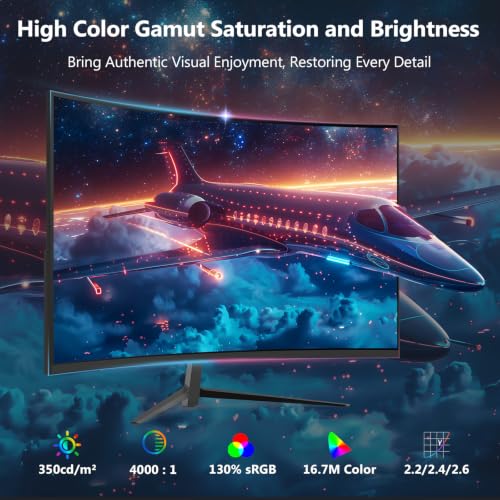
The Z-Edge 27 inch Curved Gaming Monitor delivers a targeted hardware configuration for players needing a balanced frame pipeline without overtaxing mid-range graphics cards. Operating at an FHD 1080p native resolution across an active LED-backlit VA panel, this screen hits a peak refresh rate of 180Hz over its DisplayPort connection, backed by an advertised 1ms response time. The physical chassis is engineered with a 1500R curve radius, which brings the display edges closer to the user’s natural peripheral field. The visual pipeline is reinforced by a static contrast ratio of 3000:1, producing distinct black levels alongside a maximum luminance measurement of 350 cd.
Connectivity options on this unit include one DisplayPort input and one HDMI port, with both interfaces engineered to accommodate the full 180Hz operational ceiling. The unit integrates flicker-free backlighting technology to mitigate eye strain and screen tearing during lengthy sessions. Physical dimensions measure 7 inches deep, 24 inches wide, and 17.1 inches high, framed in a three-sided edge-to-edge bezel configuration that minimizes visual seam breaks in side-by-side configurations. Standard VESA 100x100mm mounting holes are integrated into the rear housing, giving users the freedom to bypass the included desk base in favor of mechanical desk arms.
This monitor fits competitive players running mainstream GPUs who prioritize consistent 180 FPS output in battle royale or tactical shooter titles over ultra-dense pixel layouts. However, users running top-tier rendering hardware will find the 180Hz refresh rate ceiling outpaced by the manufacturer’s 280Hz and 300Hz options, while creative professionals demanding heightened pixel density may prefer the 1440p model instead.
Z-Edge 27 inch Curved Gaming Monitor for High-Framerate Competitors


Z-Edge 27 inch Curved Gaming Monitor, 1080P 300Hz 240Hz 4 photos from the Amazon listing
Engineered for high-tier esports performance, the Z-Edge 27 inch Curved Gaming Monitor elevates refresh performance to a rapid 300Hz ceiling over DisplayPort. Utilizing an FHD 1080p LED VA panel, the display achieves an elevated static contrast ratio of 4000:1, yielding exceptional shadow differentiation and black uniformity compared to standard 1000:1 IPS alternatives. Motion reproduction is kept sharp via a rated 1ms response time, significantly reducing ghosting trails during high-velocity camera pans. While the listing does not specify the exact numerical curve radius, it features an immersive curved screen structure intended to wrap around the primary viewing arc.
Where this model establishes clear separation is in its I/O layout. The backplate incorporates two DisplayPort connections capable of driving the full 300Hz refresh rate, alongside dual HDMI ports supporting up to 240Hz. This quad-port arrangement lets users interface two dedicated gaming rigs alongside consoles without needing an external switcher. Color capabilities are reported at 130 percent gamut coverage, supported by a 300 cd peak brightness output and a matte anti-glare screen finish. Physical dimensions measure 7.5 inches deep by 24.2 inches wide by 18 inches high, maintaining standard 100x100mm VESA compatibility for mounting arms.
This display is built expressly for competitive first-person shooter enthusiasts and esports competitors whose graphics hardware can consistently render frame rates north of 240 FPS at 1080p. Readers evaluating ultra-fast gaming monitors might also look into a broader ultrawide such as the sceptre 30 inch curved monitor 200hz, but this 300Hz 16:9 model remains the superior choice for high-frequency competitive tournaments. It yields to the 1440p variant when fine desktop text and high graphic resolution take precedence over sheer frame rate.
Z-Edge 27 inch Curved Computer Monitor for Everyday Productivity


Z-Edge 27 inch Curved Gaming Monitor, 1080P, 180Hz/144Hz Computer 4 photos from the Amazon listing
Targeting mixed-use office workstations and casual media desks, the Z-Edge 27 inch Curved Computer Monitor scales down raw speed in favor of gentle ergonomics and versatile connectivity. Built with an advanced VA panel, the monitor operates at a standard FHD 1080p resolution with a 100Hz refresh rate and a 5ms response time. The screen utilizes an 1800R curvature, which presents a milder geometric arc than the aggressive 1500R gaming panels, making it better suited for aligning straight spreadsheets and text documents without excessive visual warping. The panel maintains a solid 3000:1 contrast ratio, 99 percent color gamut coverage, and a pixel pitch of 0.31mm.
The port selection features one modern HDMI port alongside a legacy analog VGA interface. This combination allows seamless compatibility with legacy business workstations, basic laptops, and modern desktop PCs alike. Integrated Eye-Care Technology utilizes hardware flicker-free dimming and low blue light filtering to minimize fatigue during eight-hour work shifts. The monitor includes a tiltable stand allowing angle adjustments for ergonomic line-of-sight positioning, framed by a three-sided frameless bezel design. The listing states a brightness spec of 6.85 lm, deviating from standard cd/m2 metrics, while viewing angles hold steady at the standard 178 degrees horizontally and vertically.
This 100Hz white-accented model suits home office workers, telecommuters, and casual gamers seeking smooth daily scrolling alongside an immersive movie-viewing canvas. When building out budget-friendly workstation setups, readers frequently weigh alternatives like the sceptre 27 inch monitor curved, but Z-Edge’s clean profile makes it an attractive contender. However, competitive gaming enthusiasts should steer toward the brand’s 180Hz, 280Hz, or 300Hz models due to this unit’s 5ms response time and 100Hz refresh limit.
Z-Edge 27 inch Curved Gaming Monitor for Fast-Paced Action


Z-Edge 27 inch Curved Gaming Monitor, 1080P, 300Hz/240Hz Computer 4 photos from the Amazon listing
The Z-Edge 27 inch Curved Gaming Monitor bridges the gap between mid-tier refresh speeds and bleeding-edge esports screens. This model features a native 240Hz refresh rate that can be overclocked to 280Hz via its DisplayPort 1.4 connection, delivering a rapid 1ms MPRT response time to eliminate motion smear. The 1080p Full HD panel uses a 1500R curvature tailored to match the natural anatomical arc of the human eye, expanding visual perception in peripheral zones. Backlight performance peaks at 350 nits of brightness, working in tandem with a high 4000:1 static contrast ratio to illuminate shadow details in dimly lit gaming environments.
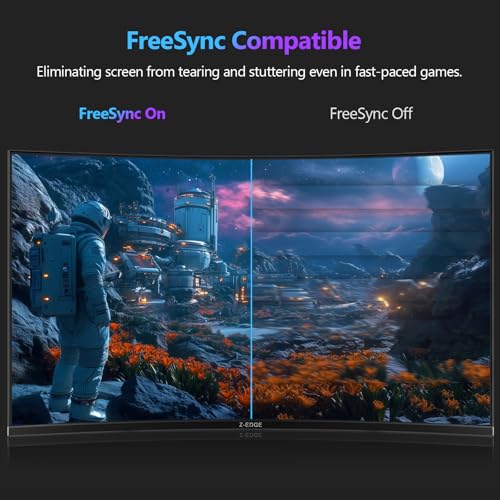
Variable refresh rate synchronization is handled through integrated AMD FreeSync, matching panel cadence to the GPU’s output to prevent screen tearing and frame stutter. On the rear I/O panel, the monitor offers a DisplayPort 1.4 connection that delivers the full 280Hz signal and an HDMI 2.0 port that operates at up to 240Hz. The panel supports 16.7 million colors across a 130 percent gamut measurement with a matte screen finish. Measuring 7 inches deep, 24 inches wide, and 17.1 inches high, the unit features a three-sided frameless edge, though the listing specifies that the monitor is compatible with a 100x100mm standard stand and notes that no desk stand is included in this particular listing package.
This high-frequency monitor is specifically targeted at competitive FPS, battle royale, and sim racing players who already possess a dedicated 100x100mm VESA monitor arm or multi-display mounting rig. Its 280Hz ceiling provides a distinct motion clarity advantage over 144Hz or 180Hz monitors. Conversely, users who need an out-of-the-box desk stand or want the finer visual acuity of QHD should step to the 165Hz 1440p model instead.
Z-Edge 27 inch Curved Gaming Monitor for Multi-Device Streamers



Z-Edge 27 inch Curved Gaming Monitor, QHD 1440P 165Hz 4 photos from the Amazon listing
Designed for power users managing dense hardware arrays, the Z-Edge 27 inch Curved Gaming Monitor is another 300Hz powerhouse featuring a distinct panel calibration. The 27-inch 1080p VA LED panel runs at a native 300Hz refresh rate with a 1ms response time to ensure responsive frame-by-frame mouse tracking. It features a 3000:1 contrast ratio, generating rich dynamic depth with deep black levels. The display listing specifies a fine 0.16mm pixel pitch along with 130 percent color gamut reproduction, powered by a 250 candela per square meter brightness level and complete flicker-free dimming mechanics.
Input flexibility is a significant asset on this unit, which provides two DisplayPort connections supporting the full 300Hz signal alongside dual HDMI ports supporting up to 240Hz. This interface density allows a user to permanently wire a high-end gaming PC, a secondary streaming rig, a PlayStation 5, and an Xbox Series console simultaneously. While the listing does not specify the exact curve radius, it features an immersive curved chassis design engineered to reduce eye strain over extended gaming marathons. Viewing angles remain wide at 178 degrees across both vertical and horizontal axes, ensuring color stability when viewing the screen from off-center angles.
This model is an ideal match for multi-system gamers and competitive players who require multiple high-bandwidth inputs on a single display. Because its brightness tops out at 250 cd/m2, it is best deployed in light-controlled or dim environments. Gamers setting up their stations in bright rooms with direct ambient sunlight will find better specular headroom on the brand’s 350-nit displays.
Z-Edge 27 inch Curved Gaming Monitor for High-Detail 1440p Gaming


Z-Edge 27 inch Curved Computer Monitor, FHD 100Hz White 4 photos from the Amazon listing
Departing from 1080p panels, the Z-Edge 27 inch Curved Gaming Monitor is the lineup’s flagship high-resolution entry, boasting a 2K QHD 2560×1440 canvas. Packing roughly 77 percent more pixels into the same 27-inch diagonal as its 1080p siblings, it delivers notably crisper image clarity, fine text rendering, and detailed geometry. The panel operates at a swift 165Hz refresh rate via DisplayPort and up to 144Hz over its HDMI interfaces, backed by a 1ms response time and premium flicker-free visual processing. The panel is constructed with a 1500R curvature, bending the edges inward to provide balanced focal alignment across the expanded QHD visual field.
The panel leverages VA LED technology to achieve a 3000:1 static contrast ratio, supported by a 300 cd brightness output and wide 130 percent color gamut coverage. Port selection includes one DisplayPort input alongside two HDMI ports, allowing straightforward switching between a primary QHD gaming PC and secondary media devices. Measuring 7 inches deep, 24 inches wide, and 17.1 inches high, this monitor includes a three-sided edge-to-edge frame that maximizes visual screen area while fitting standard 100x100mm VESA wall mounts or desktop arms.
This monitor is the definitive pick for visually rich open-world RPGs, immersive simulators, and content creators who require high pixel density alongside fluid frame delivery. Gamers exploring curved immersion often weigh this compact 27-inch QHD format against larger options like an lg 32 curved monitor, but the 27-inch 1440p configuration retains the sharpest pixel density per square inch. It only yields to the 280Hz and 300Hz models if your sole gaming focus is esports where maximum frame rate completely supersedes image detail.
How to Choose the Right Z-Edge Curved Monitor
Selecting the right model from this lineup requires balancing target frame rates, available graphics hardware, workspace lighting, and panel curvature geometry. Because every unit in this selection shares the same 27-inch physical form factor, your choice hinges on the electronic and optical specifications detailed below.
- Target Refresh Rate versus GPU Capability: If your graphics processing unit is tuned for competitive 1080p esports and regularly pushes past 240 frames per second in games like Valorant or Counter-Strike, the 300Hz models (B0DFQ8V151, B0DXKZZF9B) and the 280Hz model (B09DCBJWDB) offer maximum frame fluidity and minimal latency. If you possess a mid-range card running graphically demanding titles, the 180Hz (B08L3BHN3P) model provides a balanced ceiling. For pure productivity and media playback where frame pacing above 100 FPS yields diminishing returns, the 100Hz model (B08H8JM216) serves daily workflows adequately.
- Display Resolution and Pixel Density: Five of these six monitors feature 1080p Full HD (1920×1080) panels, which keep the rendering load light on your GPU but yield a standard pixel density of roughly 81 pixels per inch. If your workflow involves fine spreadsheet work, coding, photo editing, or AAA narrative gaming, the QHD 1440p model (B0BW47KFXB) provides a massive bump to approximately 108 PPI, producing razor-sharp text and intricate visual detail at the cost of requiring more graphics compute power.
- Curvature Geometry (1500R vs. 1800R): Curvature radius dictates viewing distance and peripheral wrap. The aggressive 1500R curve (featured on B08L3BHN3P, B09DCBJWDB, and B0BW47KFXB) has a focal radius of 1.5 meters, pulling your peripheral vision into the game world and providing high immersion for simulator cockpits and fast action. The gentler 1800R curve (on B08H8JM216) bends less sharply, which works better in mixed office setups where horizontal grid lines must avoid appearing artificially distorted.
- Interface Bandwidth and Port Counts: Monitor refresh ceilings depend directly on the physical cable connection used. On the 300Hz and 280Hz displays, reaching the full refresh rate mandates using DisplayPort, as the integrated HDMI ports top out at 240Hz. Furthermore, if you plan to connect multiple consoles, laptops, and gaming towers to one display, the quad-port layouts on models like B0DFQ8V151 and B0DXKZZF9B (each packing two DisplayPort and two HDMI jacks) completely eliminate the hassle of swapping cables manually.
- Luminance and Ambient Workspace Lighting: Room lighting is another crucial metric. If your desk sits near an unshaded window, consider the 350-nit displays (B08L3BHN3P, B09DCBJWDB) to cut through heavy ambient glare. For light-controlled environments or nighttime sessions, the 250 to 300 cd/m2 ratings on the remaining models will be more than sufficient, allowing their 3000:1 and 4000:1 VA contrast ratios to deliver deep, ink-like black levels.
FAQ
What is the difference between 1500R and 1800R curvature in Z-Edge monitors?
The number preceding the ‘R’ represents the radius of the circle in millimeters that the curve would form if completed. A 1500R display has a 1500mm radius, creating a tighter and more pronounced curve than an 1800R screen, which has an 1800mm radius. The tighter 1500R curve wraps closer to your peripheral vision for heightened gaming immersion, while the milder 1800R curve is gentler on the eyes when viewing spreadsheets and regular desktop documents.
Can Z-Edge gaming monitors achieve their full refresh rates through HDMI?
On high-refresh Z-Edge models, the maximum advertised refresh rate typically requires a DisplayPort cable. For instance, the 300Hz models support up to 300Hz over DisplayPort but cap at 240Hz over HDMI, the 280Hz model caps at 240Hz via HDMI 2.0, and the 165Hz 1440p monitor caps at 144Hz via its HDMI inputs. Only the 180Hz model (B08L3BHN3P) explicitly notes in its listing features that both its DisplayPort and HDMI ports support the full 180Hz frequency.
Which Z-Edge curved monitor is the best option for competitive esports?
Competitive esports players should choose either of the 300Hz models (B0DFQ8V151 or B0DXKZZF9B) or the 280Hz model (B09DCBJWDB). These screens offer a 1ms response time, exceptionally high refresh rates, and low input latency, delivering the rapid frame updates and reduced motion blur needed to track targets accurately in fast-paced competitive shooters.
Does Z-Edge make a 1440p curved monitor in the 27-inch size?
Yes, the Z-Edge 27 inch Curved Gaming Monitor under ASIN B0BW47KFXB features a 2K QHD 2560×1440 resolution. It combines that sharp pixel density with a 165Hz refresh rate over DisplayPort, a 1500R curve, and a 3000:1 VA contrast ratio, making it the highest-resolution option in the brand’s 27-inch curved display lineup.
Do these curved monitors support standard monitor arm mounting?
Most Z-Edge 27-inch curved displays feature standard 100x100mm VESA pattern screw holes on their rear casings, including models B08L3BHN3P, B0DFQ8V151, B09DCBJWDB, and B0BW47KFXB. Notably, the listing for the 280Hz model (B09DCBJWDB) specifies that it is compatible with a standard 100x100mm mount and does not include a desktop stand in the box, requiring an aftermarket arm or wall bracket.


