As Amazon Associates, we earn from qualifying purchases. This means we may receive a small commission at no extra cost to you if you click through and make a purchase.
JBL has spent decades establishing itself as a benchmark in acoustic engineering, particularly within professional recording environments where flat frequency response, precise transient handling, and controlled dispersion patterns are vital. The brand’s studio hardware is distinguished by proprietary developments such as the Image Control Waveguide, custom-engineered low-frequency transducers, and tailored Class-D bi-amplification topologies designed to translate audio balances accurately across external playback systems. In professional recording environments, jbl studio speakers are deployed to expose micro-dynamics, harmonic distortion, and phase anomalies during mixing and mastering passes.
While sharing a core acoustic lineage, the models in this lineup diverge significantly in low-frequency driver diameter, amplification topology, enclosure volume, and boundary compensation filters, ranging from ultra-compact desktop coaxial units to expansive 8-inch powered monitors and passive commercial reinforcement satellites.
JBL Studio Monitors Compared
| Model | Driver Configuration | Amplification / Power | Input Connectivity | Acoustic Boundary Controls |
|---|---|---|---|---|
| (2) JBL 305P MkII 5″ 2-Way | 5″ Woofer, 1″ Tweeter | Dual 41W Class-D (82W total per monitor) | Balanced XLR, 1/4″ TRS | Boundary EQ, HF Trim switch |
| JBL Professional 306P MkII 6-Inch 2-Way | 6.5″ Woofer, 1″ Tweeter | 112W Total System Power | Not listed | Not listed |
| JBL Professional 308P MkII 8-Inch | 8″ Woofer, 1″ Tweeter | Not listed | Balanced XLR, 1/4″ TRS | Boundary EQ, Input Sensitivity switch (+4dBu / -10dBV) |
| JBL Professional 1 Series 104-BT Compact | 4.5″ Coaxial Woofer, 0.75″ Soft-Dome Tweeter | Integrated 60W Class-D (30W per speaker) | Bluetooth 5.0, 1/8″ Aux, RCA, 1/4″ TRS | Front-panel input selection switch |
| JBL 306P MkII 6.5″ Studio Monitoring | 6.5″ Woofer, 1″ Soft-Dome Tweeter | Dual 56W Class-D (112W total per monitor) | Not listed | Boundary EQ |
| JBL Professional C1PRO High Performance 2-Way | 5.25″ Woofer, 0.75″ Tweeter | 150W Passive Power Handling | Spring terminals (passive) | SonicGuard HF overload protection network |
Table from this guide — scroll sideways for the remaining columns.
(2) JBL 305P MkII 5″ 2-Way for Small Room Reference Monitoring


(2) JBL 305P MkII 5" 2-Way 4 photos from the Amazon listing
Best for: Small home studios and podcast workstations
Pros
- Image Control Waveguide
- Dual 41W Class-D amplification
- Boundary EQ and HF trim
Cons
- ABS enclosure listing
- Rear ports require wall clearance
The (2) JBL 305P MkII 5″ 2-Way studio monitor package provides a complete stereo monitoring pair engineered specifically for nearfield music production, podcasting, and video editing suites where control room cubic volume is limited. At the core of this system is JBL’s patented Image Control Waveguide, an acoustic structure situated around the high-frequency transducer that creates a wide, acoustically seamless listening sweet spot with precise stereo imaging. Each cabinet utilizes an active bi-amplified architecture powered by dual 41-Watt Class-D power amplifiers, dedicating discrete amplification channels to the 5-inch low-frequency woofer and the 1-inch high-frequency dome tweeter. This division of power allows the transducer assembly to handle high-transient audio spikes without intermodulation distortion while maintaining consistent dynamic range across the full listening spectrum.
Bass reproduction in these jbl powered studio monitors is augmented by JBL’s patented Slip Stream low-frequency port, a flared port geometry designed to minimize turbulent air velocity and eliminate chuffing when reproducing low-end frequencies. To resolve acoustic boundary loading common in bedrooms and project spaces, the rear panel incorporates a Boundary EQ switch that attenuates low-frequency build-up caused by proximity to structural walls or workstation surfaces. Additionally, an HF Trim switch allows engineers to tailor the high-frequency shelf to match the absorption characteristics of the listening space. Signal connection is handled via professional balanced XLR and 1/4″ TRS inputs, ensuring seamless integration into modern audio interfaces and mixing consoles.
This stereo pair suits content creators, mixing engineers, and podcast producers operating in treated or semi-treated spaces measuring under 150 square feet. Unlike sprawling commercial installations that incorporate a jbl big speaker array, the 5-inch footprint minimizes early reflections off desk surfaces while providing the critical transient clarity necessary to evaluate vocal dynamics and balance stereo instruments. For creators seeking accurate stereo imaging without over-saturating smaller room modes, this matched pair delivers a calibrated baseline.
JBL Professional 306P MkII 6-Inch 2-Way for Mid-Sized Workspaces
JBL Professional 306P MkII 6-Inch 2-Way 4 photos from the Amazon listing
Best for: Mid-sized control rooms needing extra headroom
Pros
- 112W total system power
- 5-inch woofer transducer
- Engineered wood cabinet
Cons
- Sold individually as single unit
- No integrated Bluetooth receiver
The JBL Professional 306P MkII 6-Inch 2-Way expands driver displacement and acoustic headroom to serve medium-sized production suites and critical post-production environments. Built around a 6.5-inch (16.5 cm) low-frequency woofer and a 1-inch high-frequency transducer, this individual monitor delivers an aggregate power output of 112W via integrated amplification. The cabinet is constructed from engineered wood, providing structural rigidity and internal damping to suppress parasitic mechanical resonances during sustained high-SPL playback. Transducers feature magnetic shielding to prevent electromagnetic interference when placed adjacent to computer workstations, video displays, or sensitive outboard hardware.
Engineered for desktop computer setups, speaker stands, or floor placement, this unit shares the Image Control Waveguide topology found throughout the MkII generation. By controlling the horizontal and vertical dispersion patterns of the 1-inch tweeter, the speaker produces smooth off-axis acoustic response, permitting engineers to make accurate balance decisions even when shifting position across a console. The listing specifies remote control functionality and compatibility with signal paths spanning studio computers, mobile devices, and musical instruments, making it adaptable to diverse audio production pipelines.
This model is ideal for solo producers or facility managers who require modular purchasing flexibility, as it is sold individually rather than in fixed pairs. It bridges the gap between compact 5-inch desktop units and large-format 8-inch systems, offering the acoustic displacement needed for tracking mid-frequency instrumentation like electric guitars and snare drums with enhanced lower-mid clarity. While creators requiring weatherized hardware for outdoor work might assess a portable jbl waterproof speaker, the 306P MkII is dedicated exclusively to indoor critical listening where linearity and headroom take precedence.
JBL Professional 308P MkII 8-Inch for Extended Low-Frequency Tracking


JBL Professional 308P MkII 8-Inch 4 photos from the Amazon listing
Best for: Large rooms requiring deep low-frequency extension
Pros
- 8-inch low-frequency driver
- Patented Slip Stream port
- Balanced XLR and TRS inputs
Cons
- Bulky footprint for compact desks
- Sold as single speaker
The JBL Professional 308P MkII 8-Inch represents the largest transducer configuration within the 3-Series lineup, engineered for production environments requiring full-range monitoring without relying on an external subwoofer. The monitor pairs an 8-inch low-frequency woofer with a 1-inch high-frequency tweeter, incorporating updated transducer designs derived directly from JBL Master Reference Monitors. These updated drivers feature optimized mechanical damping, yielding rapid transient decay, reduced harmonic distortion, and extended low-frequency reproduction. The low-end profile is reinforced by the patented rear-firing Slip Stream port, which utilizes a dual-flared design to maintain linear laminar airflow during sustained bass passages.
Connectivity on the rear panel consists of balanced XLR and 1/4″ TRS jacks, complemented by a switchable +4dBu / -10dBV input-sensitivity selector that matches nominal line levels from consumer interfaces or professional outboard gear. To address room-boundary coupling, the monitor features a dedicated Boundary EQ filter, which compensates for boundary loading when the large cabinet is positioned near corner junctions or on workstation meter bridges. The cabinet is fabricated with a polyvinyl chloride (PVC) exterior over an acoustic shell, and each unit undergoes a 100-hour full-power stress test to verify component longevity under demanding studio workloads.
This 8-inch monitor suits electronic music producers, film scorers, and audio engineers operating in rooms exceeding 200 square feet with appropriate bass trapping. Its extended acoustic displacement delivers visceral sub-bass information that smaller 5-inch or 6.5-inch monitors fail to reproduce accurately. However, in untreated or highly reflective rooms, the deep low-frequency output can overwhelm untreated boundary modes, making placement and acoustic calibration critical considerations prior to installation.
JBL Professional 1 Series 104-BT Compact for Desktop Audio and Bluetooth Reference


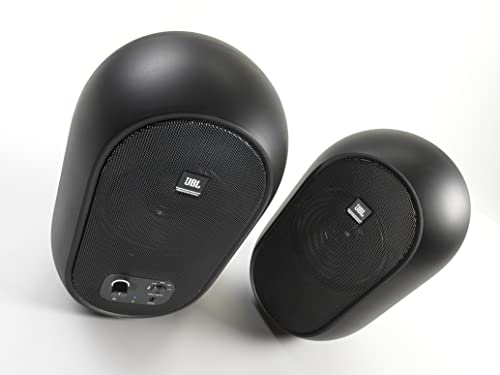

JBL Professional 1 Series 104-BT Compact 4 photos from the Amazon listing
Best for: Desktop editing suites prioritizing wireless streaming
Pros
- Coaxial driver configuration
- Bluetooth 5.0 streaming
- Front-panel input selection switch
Cons
- Limited 88 Hz bass floor
- Shared stereo power supply
The JBL Professional 1 Series 104-BT Compact provides a specialized, compact monitoring solution designed specifically for desktop workstations, video editing desks, and mobile production environments. Utilizing a proprietary coaxial driver architecture, the system places a 0.75-inch (19 mm) soft-dome tweeter directly at the acoustic center of a 4.5-inch (118 mm) low-frequency woofer. This concentric alignment produces a wide horizontal and vertical coverage window measuring 120 by 60 degrees, ensuring consistent phase alignment and uniform frequency response across nearfield listening axes. The enclosure is a ported design with a cabinet tuning frequency of 72 Hz, achieving a frequency range of 88 Hz to 20 kHz at -3 dB SPL (and down to 60 Hz at -10 dB SPL) with a momentary peak SPL of 104 dB.
Amplification is integrated entirely within the master monitor, housing a 60-watt Class-D power amplifier that distributes 30 watts to each speaker across an 8-ohm load (with a minimum impedance of 7.8 ohms at 260 Hz). The system provides flexible connectivity options, including Bluetooth 5.0 wireless streaming, balanced 1/4″ TRS inputs, unbalanced RCA jacks, and a front-panel 1/8″ aux input. A front-panel rotary switch allows creators to isolate individual inputs or select the “All” mode to sum multiple signals simultaneously. The front panel also hosts an integrated volume control and a 1/8″ stereo headphone jack with an automated speaker mute circuit for silent tracking passes.
This desktop pair serves vloggers, video editors, and mobile producers who must balance critical mixing with consumer playback checks via Bluetooth. While it cannot achieve the raw low-end output of larger reference hardware, its small footprint and multi-input summing streamline editing suites where space is limited. Users accustomed to using a jbl bluetooth speaker waterproof dustproof unit for everyday audio will find the 104-BT provides a substantially more clinical, phase-coherent soundstage while retaining modern wireless convenience.
JBL 306P MkII 6.5″ Studio Monitoring for Matched Pair Stereo Production


JBL 306P MkII 6.5" Studio Monitoring Speakers (Pair) 4 photos from the Amazon listing
Best for: Engineers purchasing a matched 6.5-inch pair
Pros
- Sold as complete pair
- Dual 56W Class-D bi-amplification
- Linkwitz-Riley crossover network
Cons
- Substantial desk space footprint
- Rear controls less accessible
The JBL 306P MkII 6.5″ Studio Monitoring bundle delivers a complete factory pair of 6.5-inch active studio monitors configured to establish an immediate stereo field. Each enclosure incorporates a bi-amplified Class-D architecture delivering 56 Watts to the 6.5-inch low-frequency driver and 56 Watts to the 1-inch soft-dome high-frequency driver, totaling 112 Watts of discrete power per cabinet. The system utilizes an acoustic 4th-order Linkwitz-Riley crossover centered at 1425 Hz, ensuring smooth phase transition between the woofer and tweeter while minimizing lobing errors off-axis.
Acoustic dispersion is shaped by the signature Image Control Waveguide, providing an expansive listening zone that maintains tonal neutrality when the listener moves away from the direct acoustic center. The rear plate incorporates a Boundary EQ filter to attenuate low-end mud caused by reflective surface coupling, alongside an input sensitivity switch rated at 92dB for a -10dBV input signal. The listing notes rubber enclosure materials, remote operation support, and integrated volume and microphone functionality. Refined high- and low-frequency transducers feature optimized mechanical damping to deliver superior transient response and lower total harmonic distortion across demanding passages.
This matched pair is designed for professional music producers, commercial tracking studios, and post-production facilities seeking a balanced acoustic profile without purchasing single monitors piecemeal. By offering greater low-frequency authority than the 5-inch 305P MkII while maintaining a tighter physical footprint than the 8-inch 308P, this 6.5-inch system occupies an acoustic middle ground suitable for mid-sized mixing environments that need reliable dynamic tracking.
JBL Professional C1PRO High Performance 2-Way for Passive Installations and AV Workstations


JBL Professional C1PRO High Performance 2-Way, 150 Watt 5.25” 2 photos from the Amazon listing
Best for: Commercial audio-visual and passive installation setups
Pros
- SonicGuard overload protection
- Included mounting brackets
- 150-watt power handling
Cons
- Requires external power amplifier
- Frequency response starts at 100 Hz
The JBL Professional C1PRO High Performance 2-Way approaches studio monitoring from a passive, installation-grade architecture. Unlike the self-powered models in the 3-Series lineup, the Control 1 Pro requires an external power amplifier, such as a Crown power amp or standard studio receiver, to drive its 150-watt power handling network. The driver complement includes a 5.25-inch low-frequency woofer and a 0.75-inch high-frequency tweeter housed inside a rugged, molded plastic enclosure. The system delivers a frequency response spanning 100 Hz to 18 kHz, reproducing mid-range details and vocal frequencies with consistent dynamic accuracy.
A key engineering feature of the C1PRO is its internal SonicGuard high-frequency overload protection network. This circuit actively safeguards the 0.75-inch tweeter against excessive input power spikes and amplifier clipping, preventing driver burnout during high-volume playback sessions. The speakers feature magnetic shielding, allowing safe placement directly next to legacy CRT displays or computer monitors. Included mounting brackets facilitate wall installation, while the flat base enables traditional bookshelf or desktop placement for audio-visual suites, broadcast booths, and commercial multimedia editing setups.
This passive system suits broadcast facilities, commercial AV installations, and hobbyists who already possess dedicated external power amplifiers. It offers exceptional physical durability and mounting flexibility that active studio monitors lack. While active models like the 305P MkII contain their own internal power matching, the Control 1 Pro provides system integrators with complete freedom over their amplification chain, making it a reliable solution for distributed monitoring, background reference, or surround sound satellite arrays.
How to Choose the Right JBL Studio Monitors
Selecting the ideal monitoring hardware requires analyzing your acoustic room volume, amplifier infrastructure, and input signal chain. In a technical jbl studio monitors comparison, transducer diameter plays the decisive role in low-frequency cutoff and room interaction:
- Driver Dimensions and Room Volume: Low-frequency waves require physical space to develop without generating severe acoustic standing waves. The compact 4.5-inch coaxial driver on the JBL Professional 1 Series 104-BT Compact and the 5-inch driver on the (2) JBL 305P MkII 5″ 2-Way are tailored for small spaces under 150 square feet. Conversely, the 8-inch woofer on the JBL Professional 308P MkII 8-Inch demands a larger room with dedicated low-frequency bass trapping to prevent constructive acoustic interference. Mid-sized rooms between 150 and 250 square feet benefit from the 6.5-inch transducers found on the JBL Professional 306P MkII 6-Inch 2-Way and JBL 306P MkII 6.5″ Studio Monitoring pair.
- Active Bi-Amplification vs. Passive Topologies: When determining which jbl studio monitors to buy, consider your existing hardware chain. Active models like the 305P, 306P, 308P, and 104-BT incorporate dedicated Class-D internal amplifiers matched specifically to their driver voice coils, eliminating the need for external amplification. In contrast, the JBL Professional C1PRO High Performance 2-Way is a passive system requiring an outboard amplifier, making it preferable for permanent architectural wall installations or commercial AV facilities with centralized equipment racks.
- Acoustic Boundary Controls: Placing studio monitors near boundaries like walls or large desks artificially boosts lower frequencies. The 3-Series MkII models feature dedicated Boundary EQ switches that apply a low-frequency shelf to restore a flat, neutral acoustic balance. The 104-BT relies instead on desktop acoustic optimization and coaxial driver alignment to ensure off-axis coherence across tight workstation surfaces.
- Input Flexibility: Studio reference monitors require appropriate electrical input pairing. The 3-Series monitors provide balanced XLR and 1/4″ TRS connections designed to eliminate common-mode noise from audio interfaces. Desktop creators needing versatile connectivity will appreciate the 104-BT, which integrates Bluetooth 5.0, RCA, and 1/8″ aux inputs alongside balanced TRS jacks.
By assessing these technical criteria against your workstation space, you can identify the exact hardware profile required for your production workflow, whether selecting compact nearfield tools or expansive tracking systems.
FAQ
What is the main advantage of the JBL Image Control Waveguide?
The Image Control Waveguide controls the horizontal and vertical acoustic dispersion of the high-frequency tweeter. This structure ensures a smooth transition between high and low frequencies across the crossover band, creating a wide, forgiving sweet spot and neutral off-axis response that preserves stereo imaging even if the engineer moves off-center.
How does the Boundary EQ setting affect bass performance near walls?
When a monitor is placed close to a rear wall or boundary surface, acoustic coupling causes an artificial boost in low frequencies, resulting in boomy, inaccurate bass reproduction. The Boundary EQ switch introduces a calibrated low-frequency shelf attenuation that compensates for this acoustic boundary loading, restoring a neutral, linear bass response.
Do all JBL studio reference monitors include built-in amplifiers?
No. Models such as the 305P MkII, 306P MkII, 308P MkII, and 1 Series 104-BT are active, self-powered systems with internal Class-D amplifiers. However, the JBL Professional C1PRO is a passive loudspeaker system that requires an external power amplifier or receiver to drive its internal crossover and drivers.
What is the difference between balanced XLR/TRS inputs and unbalanced RCA connections?
Balanced XLR and 1/4″ TRS connections utilize three conductors (hot, cold, and ground) to transmit audio signals. This design cancels out electromagnetic interference and ground hum over long cable runs via common-mode rejection. Unbalanced RCA and 1/8″ aux connections use two conductors and are more prone to picking up external noise over extended cable distances.
Can passive monitors like the Control 1 Pro run directly from an audio interface?
No. Standard audio interfaces output line-level audio signals, which do not carry sufficient electrical wattage to drive passive speaker voice coils. The JBL Professional C1PRO must be connected to a dedicated power amplifier, such as a Crown amplifier, which receives the line-level signal from the audio interface and amplifies it to speaker-level output.


