As Amazon Associates, we earn from qualifying purchases. This means we may receive a small commission at no extra cost to you if you click through and make a purchase.
ZEISS has long served as a benchmark in sport optics, engineering optical systems characterized by high light throughput, sophisticated phase-corrected prism assemblies, and specialized lens coatings. In the 8×32 configuration, the manufacturer focuses on balancing hand-held stability, exit pupil comfort, and field transportability. Choosing the right optical instrument requires understanding how glass selection, internal prism geometries, and chassis alloys affect resolution, edge distortion, and low-light fidelity across different observation environments.
While the entry-level Terra models utilize fiberglass-reinforced polymer chassis with 88 percent transmission Schmidt-Pechan optics, the mid-tier Conquest HDX introduces magnesium construction and FieldFlattener lens elements at 90 percent transmission, and the flagship Victory SF optimizes balance and viewing angles via SCHOTT fluoride glass and an expanded field of view.
ZEISS 8×32 Binoculars Compared
| Model | Light Transmission | Prism Type | Chassis Material | Eye Relief |
|---|---|---|---|---|
| ZEISS Terra ED Binoculars 8×32 Compact | 88% | Schmidt-Pechan ED | Fiberglass reinforced | Not listed |
| Zeiss 8×32 Terra ED Binoculars | Not listed | Not listed | Lightweight housing | Not listed |
| ZEISS Conquest HDX Binoculars 8×32 | 90% | Roof Prism | Magnesium | 16 mm |
| ZEISS 8×32 Victory SF Binoculars | 90% | Roof Prism | Not listed | 19 mm |
| ZEISS Terra ED Pocket Binoculars Compact | 88% | Schmidt-Pechan | Glass fiber reinforced | 16 mm |
Table from this guide — scroll sideways for the remaining columns.
ZEISS Terra ED Binoculars 8×32 Compact for Lightweight Field Tracking


ZEISS Terra ED Binoculars 8x32 Compact 4 photos from the Amazon listing
Best for: Ultralight backpackers prioritizing pocket portability
Pros
- Compact folding dual-hinge design
- SCHOTT ED glass with T* coating
- LotuTec weather-resistant coating
Cons
- Narrower 3.1mm exit pupil
- Smaller 25mm objective diameter
Best for: Mobile observers needing lightweight waterproof optics
Pros
- 88% light transmission ED glass
- Hydrophobic multi-layer coating
- Waterproof fiberglass reinforced casing
Cons
- Synthetic housing instead of magnesium
- Unlisted eye relief specification
The ZEISS Terra ED Binoculars 8×32 Compact serves as an entry point into the German manufacturer’s optical ecosystem, pairing an 8x magnification factor with 32-millimeter objective lenses. Central to its optical assembly is an extra-low dispersion (ED) optical glass system coupled with a Schmidt-Pechan prism design, achieving an 88 percent light transmission profile. The optical surfaces are treated with a hydrophobic multi-layer anti-reflective coating, engineered to reduce surface reflections while allowing water droplets and condensation to shed unimpeded during wet weather conditions.
From a mechanical perspective, this model relies on a waterproof casing molded from fiberglass-reinforced synthetic resin. This engineering choice curtails chassis mass while preserving structural rigidity against thermal fluctuation and mechanical impact. The focusing mechanism features a large, tactile focus wheel positioned directly where the index finger rests during two-handed operation, enabling rapid focus adjustments when tracking active wildlife across variable focal planes.
This configuration suits day hikers, general nature observers, and casual birders who prioritize low carrying mass over extreme metallurgical housings. It delivers dependable optical clarity and contrast in mixed daylight, though users requiring edge-to-edge optical flattening or higher metallurgical rigidity will find those advanced specifications in the Conquest and Victory families.
Zeiss 8×32 Terra ED Binoculars for Bundled Field Maintenance

Zeiss 8x32 Terra ED Binoculars 4 photos from the Amazon listing
Best for: Field observers seeking included optical maintenance accessories
Pros
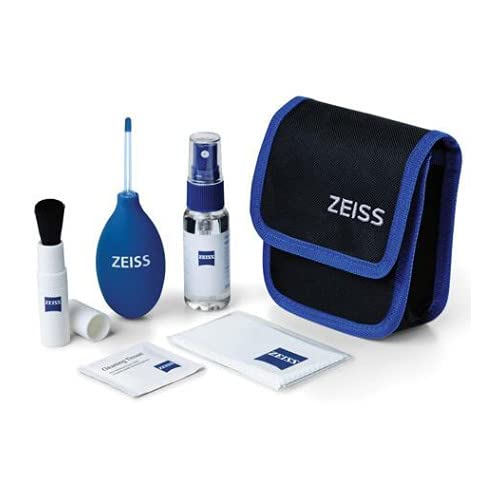
- Includes factory lens cleaning kit
- Smooth fast-focusing center wheel
- Hydrophobic multi-coating protection
Cons
- Identical optics to standalone model
- Non-locking diopter mechanism
Supplied as an equipment bundle, the Zeiss 8×32 Terra ED Binoculars combines the core 8×32 optical assembly with an official ZEISS lens cleaning kit. Like its standalone counterpart, this model utilizes precision ED glass elements treated with hydrophobic multi-coatings to protect exterior surfaces and maintain color fidelity. The 8x magnification combined with the 32-millimeter objective diameter creates an all-around optical balance suitable for extended outdoor surveying.
The ergonomic layout mirrors the modern styling of the manufacturer’s binocular line, pairing a lightweight, impact-resistant housing with smooth mechanical controls. The oversized center-focus dial operates with minimal rotational resistance, facilitating rapid tracking of fast-moving targets. The included maintenance bundle provides field-ready optical cloths and cleaning solutions calibrated specifically for multi-coated optical glass, preventing premature wear on delicate lens surfaces caused by field debris or improper cleaning tools.
This bundle package serves field researchers, expedition travelers, and outdoor naturalists who require factory-approved cleaning gear from day one. By bundling optical upkeep tools with the waterproof 8×32 platform, it ensures optical longevity for observers operating in dusty, marine, or damp environments without needing secondary maintenance acquisitions.
ZEISS Conquest HDX Binoculars 8×32 for Edge-to-Edge Resolution


ZEISS Conquest HDX Binoculars 8x32 4 photos from the Amazon listing
Best for: All-weather naturalists demanding edge sharpness and durability
Pros
- 90% light transmission
- FieldFlattener aspheric lens technology
- Magnesium housing with rubber armoring
- Fast 1.3 rotation focus wheel
Cons
- Heavier construction than polymer models
- Larger overall frame profile
The ZEISS Conquest HDX Binoculars 8×32 represents a substantial engineering progression in optical correction and chassis materials. The optical path achieves 90 percent light transmission by pairing high-definition ED glass with aspheric elements and integrated FieldFlattener Technology. This configuration corrects field curvature and spherical aberrations, ensuring true-to-life color fidelity and sharp detail preservation from the center of the image directly to the outer periphery of the field of view.
Mechanically, the Conquest HDX utilizes a robust, lightweight magnesium housing encapsulated within protective rubber armoring. The chassis is fully waterproof, shockproof, and nitrogen-purged to guarantee internal fogproof operation in extreme humidity. Mechanical specifications include a high-speed center focus knob completing full travel in just 1.3 rotations, a locking diopter system with +/- 4 diopters of adjustment, 16 millimeters of eye relief, a 4-millimeter exit pupil, and an integrated tripod mounting interface. Optical glass elements feature both the proprietary ZEISS T* high-contrast multi-coating and external LotuTec protective coatings, supplemented by removable flip-down lens covers and adjustable, removable eyecups.
This optic is engineered for serious hunters, dedicated birdwatchers, and professional field naturalists operating in dense terrain or harsh weather. Observers cross-referencing platforms against alternative mid-sized options like bushnell 8×32 binoculars will appreciate the Conquest HDX’s advanced edge resolution and rapid 1.3-turn focus tracking.
ZEISS 8×32 Victory SF Binoculars for Demanding Avian Observation



ZEISS 8x32 Victory SF Binoculars 4 photos from the Amazon listing
Best for: Demanding birdwatchers requiring maximum field of view
Pros
- Ultra-FL SCHOTT fluoride optics
- 20% wider observable field
- Ergonomic SmartFocus triple-link bridge
- Generous 19mm eye relief
Cons
- Listed 3.2mm exit pupil specification
- Premium tier investment required
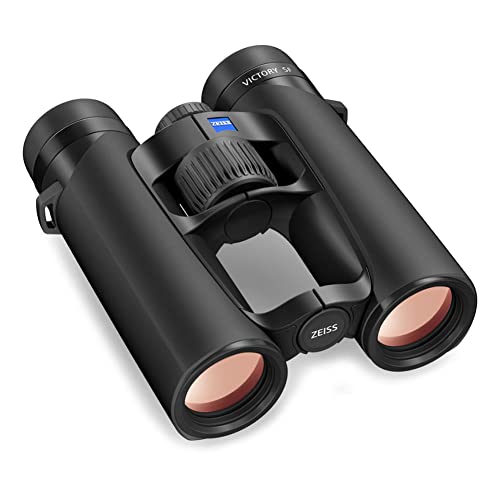
Representing the brand’s premier optical tier, the ZEISS 8×32 Victory SF Binoculars incorporates the proprietary Ultra-FL optical concept. The objective system integrates multiple SCHOTT fluoride glass elements, delivering 90 percent light transmission alongside color accuracy and detail resolution designed to discern intricate plumage patterns in deep twilight. The internal roof prism and optical train are finished with custom-layered ZEISS T* anti-reflective coatings tailored to each individual lens element to eliminate stray internal reflections.
The defining structural feature of the Victory SF is its triple-link open-bridge architecture and SmartFocus mechanical gearing. This ergonomic platform redistributes the instrument’s center of gravity rearward toward the user’s palms, significantly reducing hand and wrist fatigue during prolonged glassing sessions. The fast-focusing wheel is embedded directly within the bridge structure, offering anti-slip texturing for precise single-finger operation. The listing specifies an extremely wide field of view that increases the observable area of interest by up to 20 percent compared to conventional designs, an expansive 19 millimeters of eye relief, a listed 3.2-millimeter exit pupil, center focus controls, a tripod mount, and a +/- 4 diopter adjustment mechanism within a fully waterproof chassis.
This instrument is built specifically for passionate ornithologists and wildlife observers who spend full days scanning woodland canopies and dense cover. Observers evaluating mid-range configurations against broad-market offerings such as vortex optics binoculars will note the Victory SF’s specialized focus on wide-angle tracking and fatigue-reducing weight distribution.
ZEISS Terra ED Pocket Binoculars Compact for Ultralight Deployment


ZEISS Terra ED Pocket Binoculars 8x25 Compact, Waterproof, and 4 photos from the Amazon listing
For operations where pack space and carrying weight are restricted, the ZEISS Terra ED Pocket Binoculars Compact shifts the Terra architecture into a folding dual-hinge configuration. While utilizing a smaller 25-millimeter objective diameter and an elevated 10x magnification factor, this optical device incorporates genuine SCHOTT ED glass elements with an 88 percent light transmission rating. It pairs the brand’s proprietary ZEISS T* anti-reflective multicoating with exterior LotuTec hydrophobic coatings, ensuring clear contrast and water repellency in severe atmospheric conditions.
The chassis is manufactured from glass-fiber reinforced polymer, making it waterproof and nitrogen-filled to resist internal fogging. Mechanical features include a 16-millimeter eye relief, a 3.1-millimeter exit pupil diameter, a manual center focus mechanism, and a +/- 3 diopter adjustment range. The folding double-hinge design allows the optical barrels to collapse inward, compressing the entire unit into a pocket-friendly form factor suitable for rapid field deployment.
This optic serves minimalist backpackers, alpine hunters, and international travel naturalists who require high optical fidelity without dedicating significant cargo volume to a standard 32-millimeter chassis. While twilight light gathering is limited by the 3.1-millimeter exit pupil compared to 32-millimeter objective barrels, it remains a capable companion for daylight observation where pack volume takes precedence.
How to Choose the Right ZEISS 8×32 Binoculars
Selecting between the tiers within this lineup requires analyzing light transmission ratings, chassis metallurgy, optical flat-field correction, and eye relief requirements. Light transmission directly dictates low-light performance during dawn and dusk. The Terra ED series achieves an 88 percent light transmission figure via Schmidt-Pechan ED optical glass, which suffices for daylight hunting, hiking, and open-country viewing. In contrast, both the Conquest HDX and Victory SF platforms step up to a 90 percent transmission threshold. The Conquest achieves this using an HD lens concept with aspheric elements, while the Victory SF employs the Ultra-FL system containing multiple SCHOTT fluoride glass elements to resolve subtle contrast variations in failing ambient light.
Chassis metallurgy and mechanical architecture separate these optics into distinct operational tiers. The Terra ED 8×32 and Terra ED Pocket rely on glass-fiber reinforced synthetic casings, offering lightweight structural reliability and waterproof sealing. Observers requiring maximum rigidity under harsh mechanical handling should examine the Conquest HDX, which utilizes a magnesium housing wrapped in full rubber armoring, complete with nitrogen purging, shockproofing, and an integrated tripod interface. Users who regularly contrast mid-sized instruments with full-sized platforms like nikon binoculars 8 x 42 must weigh the Conquest HDX’s robust build against the compact carrying convenience of the Terra platform.
Eyepiece ergonomics, field curvature correction, and focusing speeds also play pivotal roles in matching an optic to specific field applications:
- Field Flattener and Edge Sharpness: The Conquest HDX features FieldFlattener Technology and aspheric lenses to eliminate peripheral distortion, providing edge-to-edge sharpness across the entire image circle.
- Field of View and Tracking: The Victory SF expands the observable field of view by up to 20 percent, allowing rapid detection of moving subjects within dense foliage, managed via its triple-link SmartFocus bridge mechanism.
- Eye Relief Accommodation: Eyeglass wearers should note that the Victory SF provides an extended 19 millimeters of eye relief, compared to the 16 millimeters offered on the Conquest HDX and Terra Pocket.
- Diopter Adjustments: While the standard Terra ED utilizes a conventional adjustment dial, the Conquest HDX introduces a locking diopter mechanism with a +/- 4 adjustment range to eliminate accidental field shifts.
FAQ
What optical differences distinguish Schmidt-Pechan prisms from alternative roof prism designs?
Schmidt-Pechan prisms are a specific category of roof prism characterized by a compact footprint that allows manufacturers to construct shorter, lighter binocular chassis. Because light undergoes multiple internal reflections, one surface requires a specialized reflective coating to minimize internal light loss. In the ZEISS Terra line, Schmidt-Pechan ED assemblies achieve an 88 percent light transmission rate, keeping the physical barrel length manageable for field carry.
How do LotuTec and ZEISS T* coatings function together on binocular glass?
ZEISS T* coating is a multi-layer anti-reflective treatment engineered to maximize light transmission and reduce internal surface reflections, delivering high-contrast images during dawn, dusk, and overcast conditions. LotuTec is an external hydrophobic coating applied to outer objective and ocular lenses. It causes moisture, raindrops, and oil to bead up and roll off without adhering, ensuring that external moisture does not obscure the optical path during inclement weather.
What are the practical advantages of the SmartFocus concept on the Victory SF?
The SmartFocus system relocates the focusing wheel into a triple-link open bridge, positioning it directly under the user’s index finger in an ergonomically neutral hand posture. The rotational gearing is calibrated to require minimal finger movement to transition from close focus to infinity, enabling observers to track rapidly moving subjects such as birds without repositioning their grip or inducing hand strain.
Why does the Conquest HDX utilize a magnesium chassis instead of fiberglass?
Magnesium provides elevated torsional strength, thermal stability, and impact resistance compared to fiberglass-reinforced polymers, ensuring internal optical prisms remain perfectly aligned under severe field drops or heavy mechanical vibration. The magnesium chassis in the Conquest HDX also supports specialized mechanical hardware, including an integrated tripod mounting interface and a locking diopter ring.
How does exit pupil diameter affect optical performance across these models?
The exit pupil diameter is calculated by dividing the objective lens diameter by the magnification factor, dictating the width of the light cone entering the observer’s eye. An 8×32 binocular generates a 4-millimeter exit pupil, which matches the dilation of the human eye in standard daylight and early twilight. Smaller configurations, such as the 10×25 Terra Pocket with its 3.1-millimeter exit pupil, produce a narrower beam that requires more precise eye alignment and provides less optical brightness in low-light environments.


