As Amazon Associates, we earn from qualifying purchases. This means we may receive a small commission at no extra cost to you if you click through and make a purchase.
Garmin has established itself as the dominant standard in cycling electronics, renowned for engineering dedicated cycling computers that integrate multi-band satellite tracking, extensive biometric analysis, and ruggedized chassis designs. The company focuses on processing complex telemetry directly on the handlebars, giving cyclists real-time access to navigational routing, climb profiles, and physiological modeling across road, gravel, and mountain bike disciplines.
While each computer in this lineup leverages Garmin’s ecosystem for performance tracking and multi-band satellite positioning, they diverge significantly in user interface architecture, screen size and resolution, GPS logging frequencies, and overall battery efficiency.
Garmin Bike Computers Compared
| Model | Screen Size & Type | Input Method | Demanding Battery Life | GPS Recording Frequency |
|---|---|---|---|---|
| Garmin Edge 540 | 2.6 inches, Display Type: Not listed | Tactile Buttons | Up to 26 hours | Multi-Band GNSS (Standard) |
| Garmin Edge 840 | 2.6 inches, Capacitive LCD (240 x 320) | Touchscreen & Buttons | Up to 26 hours | Multi-Band GNSS (Standard) |
| Garmin Edge 1050 | 3.5 inches, Vivid Color LCD | Capacitive Touchscreen | Up to 20 hours | Multi-Band GNSS (Standard) |
| Garmin Edge 850 | 2.7 inches, Vivid Color LCD | Touchscreen & Buttons | Up to 12 hours | Multi-Band GNSS with 5 Hz |
| Garmin Edge MTB | 2.1 inches, Gorilla Glass Color | 7 Dedicated Buttons | Up to 14 hours | Multi-Band GNSS with 5 Hz |
| Garmin Edge 550 | 2.7 inches, Vivid Color LCD (420 x 600) | Physical Buttons | Up to 12 hours | Multi-Band GNSS with 5 Hz |
Table from this guide — scroll sideways for the remaining columns.
Garmin Edge 540 for Button-Only Endurance


Garmin Edge 540 4 photos from the Amazon listing
Best for: Endurance cyclists preferring dedicated tactile buttons
Pros
- Up to 42-hour battery saver runtime
- Multi-band GNSS positioning
- ClimbPro works without course
- Dedicated physical button controls
Cons
- No touchscreen interface
- Smaller 2.6-inch screen size
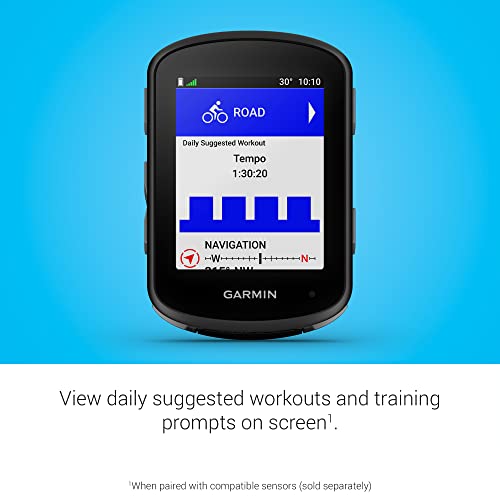
The Garmin Edge 540 is a compact GPS cycling computer built around a physical button interface and a 2.6-inch display. Designed for riders who prioritize operational consistency in wet, cold, or muddy conditions, the unit relies entirely on tactile chassis buttons rather than a touch-sensitive digitizer. Navigation is supported by preloaded North American mapping alongside multi-band GNSS technology, which receives signals across multiple satellite bands to ensure reliable positional accuracy under dense tree cover or steep rock walls.
Software features on the Edge 540 include the freeride ClimbPro ascent planner, which calculates remaining elevation gain and gradient percentage without requiring a pre-loaded course. When paired with compatible external sensors such as a power meter and heart rate monitor, the unit unlocks real-time stamina metrics, adaptive daily suggested workouts, and the Power Guide feature, which recommends target wattages across specific route sectors. The listing specifies USB-C charging, standard and out-front handlebar mounts, and a battery runtime of up to 26 hours in demanding conditions, extending up to 42 hours in battery saver mode.
This model suits endurance cyclists, gravel racers, and foul-weather commuters who demand tactile reliability and extended power runtimes over touchscreen conveniences. Cyclists who frequently re-route on the fly or prefer smartphone-like map navigation will find the physical button panning slower than the hybrid interface found on the Edge 840.
Garmin Edge 840 for Hybrid Touchscreen Navigation


Garmin Edge 840 4 photos from the Amazon listing
Best for: All-weather road and gravel riders wanting dual control
Pros
- Dual touchscreen and button interface
- Wi-Fi, Bluetooth, and USB connectivity
- 32 GB internal storage capacity
- 26-hour demanding battery life
Cons
- Lower resolution 240 x 320 display
- Shorter battery saver runtime than 540
The Garmin Edge 840 shares the exact 2.6-inch form factor and 240 x 320 LCD screen resolution of its sibling but adds a capacitive touchscreen to complement the full suite of physical edge buttons. Running on an Android-based operating system with 32 GB of internal storage, the device allows riders to swipe between data pages, pinch and pan navigational maps, or fall back to button operation when wearing thick gloves or riding through heavy rain. Connectivity includes Bluetooth, Wi-Fi, and USB, facilitating background map updates and swift ride synchronization.
Beyond the core telemetry shared across the 40-series generation, the Edge 840 incorporates advanced training analytics including event-adaptive coaching, heat and altitude acclimation tracking, and cycling ability classifications matched against course demands. When dialing in training performance alongside structural component upgrades like a superteam carbon wheelset, the real-time stamina insights and ClimbPro gradient analyses provide quantifiable pacing boundaries. Demanding usage yields up to 26 hours of runtime, with battery saver mode sustaining operations for up to 32 hours.
The Edge 840 is ideal for road racers, fast gravel riders, and technical navigators who need quick map manipulation without sacrificing button reliability in bad weather. It gives way to the Edge 1050 when larger visual map fields, on-device audio alerts, and greater internal storage capacities become essential.
Garmin Edge 1050 for Large-Screen Group Navigation


Garmin Edge 1050 4 photos from the Amazon listing
Best for: Riders demanding large displays and rich connected features
Pros
- Large 3.5-inch vivid touchscreen
- Integrated speaker and bike bell
- Up to 60 hours in battery saver
- Garmin Pay contactless payments
Cons
- Larger handlebar mounting footprint
- 20-hour demanding mode battery life
Positioned at the top of the brand’s visual hardware lineup, the Garmin Edge 1050 features an expansive 3.5-inch vivid color touchscreen display housed in an aerodynamic handlebar mount format. The unit is engineered with 64 GB of memory storage and runs an Android-based operating system, delivering high rendering speeds for detailed North American maps that visually differentiate between paved roads, unpaved surfaces, and off-road trails. An integrated on-device speaker functions as an audible bike bell and broadcasts spoken workout prompts and turn-by-turn navigation cues.
Connected capability is a central focus of the Edge 1050 architecture. When paired with a compatible smartphone running the Garmin Connect application, riders receive crowdsourced hazard alerts submitted by other cyclists and can log real-time roadway hazards directly from the screen. Group ride features provide live rider positioning, mid-ride messaging, climb leaderboards, and post-ride competition summaries. Furthermore, the Edge 1050 incorporates Garmin Pay contactless payments, enabling contactless transactions directly through the computer at supported financial institutions. Battery life is rated at up to 20 hours under demanding workloads and up to 60 hours in battery saver mode.
This head unit is designed for touring cyclists, performance road riders, and group-ride enthusiasts who want maximum visual clarity, integrated audio warnings, and direct on-device route creation. Weight-conscious hill climbers or rough-trail mountain bikers may find the larger physical footprint less desirable than the compact 800- or 500-tier chassis.
Garmin Edge 850 for High-Refresh Trail and Road Telemetry



Garmin Edge 850 4 photos from the Amazon listing
Best for: Technical riders wanting dynamic fueling and 5Hz tracking
Pros
- 5 Hz GPS descent recording
- Smart fueling and hydration prompts
- Vivid 2.7-inch dual input screen
- Built-in audio speaker
Cons
- 12-hour demanding battery life
- Requires phone for live radar overlays
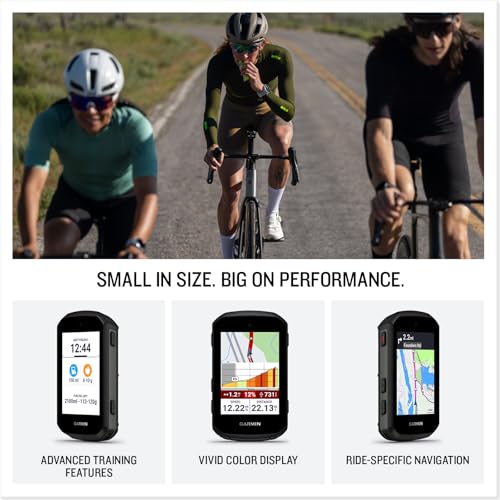
The Garmin Edge 850 updates the mid-sized platform with a 2.7-inch vivid color LCD screen operating on Garmin OS. Retaining the dual-input philosophy, it pairs capacitive touch input with physical chassis buttons for versatile input ergonomics. A significant hardware evolution in this model is the multi-band GPS module configured with automatic 5 Hz recording when engaging downhill and enduro ride profiles, sampling positional coordinates five times per second to capture accurate trajectory data through fast berms and steep descents.
Training and nutritional planning are upgraded via intelligent fueling alerts, which prompt the rider to hydrate and consume calories dynamically based on ambient heat, humidity, personal fitness metrics, and upcoming course elevation demands. The device comes preloaded with maps covering road, gravel, and trails, directly integrating Trailforks data with Forksight mode to display upcoming trail forks and grade variations. Like the larger units, the Edge 850 includes an integrated speaker for bike bell alerts and workout prompts, crowd-sourced hazard alerts, and real-time weather overlays showing radar and wind direction when connected to a smartphone. Battery performance delivers up to 12 hours in demanding modes and up to 36 hours in battery saver mode.
The Edge 850 is tailored for performance riders who transition regularly between road exploration and aggressive singletrack, where high-speed positional accuracy and active fueling guidance are vital. Riders embarking on multi-day ultra-endurance rides may find its 12-hour demanding battery life more restrictive than the older Edge 840 platform.
Garmin Edge MTB for Downhill and Enduro Dynamics


Garmin Edge® MTB, Rugged GPS Bike Computer, Mountain Biking 4 photos from the Amazon listing
Best for: Aggressive mountain bikers and downhill racers
Pros
- Scratch-resistant Corning Gorilla Glass
- 5 Hz recording with timing gates
- Dedicated MTB Dynamics and sensor array
- Lightweight 58-gram ruggedized chassis
Cons
- Compact 2.1-inch screen
- No touchscreen support
Purpose-engineered for demanding off-road conditions, the Garmin Edge MTB is a ruggedized 58-gram cycling computer equipped with a 2.1-inch color display. The screen is protected by scratch-resistant Corning Gorilla Glass to withstand impacts from mud, roost, and branches. It eschews touch inputs entirely, utilizing a 7-button layout that guarantees operational control while wearing heavy downhill gloves. External physical dimensions are compact at 0.8 inches high, 2.0 inches wide, and 3.1 inches long.
Internally, the Edge MTB integrates a specialized multi-sensor package consisting of a gyroscope, barometric altimeter, accelerometer, and magnetometer. This array drives mountain-bike-specific telemetry, quantifying Grit (trail difficulty), Flow (descent smoothness), jump count, jump distance, and in-air hang time. Like the 50-series units, it features 5 Hz high-frequency multi-band GPS recording during enduro and downhill profiles. Riders can set up physical timing gates along a course to record split times on specific trail sectors. Preloaded Trailforks and TopoActive maps leverage Forksight mode to display upcoming forks, remaining trail distance, and elevation profiles. Demanding battery life is rated at up to 14 hours, extending to 26 hours in power saver mode.
This model is built specifically for gravity riders, enduro racers, and downhill mountain bikers who require an ultra-durable, compact unit capable of recording technical jumps and split intervals. Road cyclists and cross-country tourers will find the smaller 2.1-inch display and lack of road-focused training metrics restrictive compared to generalist Edge computers.
Garmin Edge 550 for High-Resolution Button Navigation
Garmin Edge® 550, Compact GPS Cycling Computer 4 photos from the Amazon listing
Best for: Competitive riders wanting high resolution without touchscreens
Pros
- Sharp 420 x 600 vivid display
- 5 Hz GPS recording mode
- Tactile button-only design
- Smart fueling and Trailforks maps
Cons
- 12-hour baseline battery runtime
- No touchscreen navigation
The Garmin Edge 550 represents the evolution of Garmin’s button-operated chassis, featuring a 2.7-inch vivid color LCD screen boasting a high resolution of 420 x 600 pixels. The device is purely button-driven, avoiding capacitive touch layers to ensure screen clarity and eliminate unwanted input from rain or sweat. It runs on Garmin OS, supported by 32 GB of memory storage, and includes Wi-Fi, Bluetooth, and USB connectivity for automated data offloading.
Cyclists analyzing indoor training metrics while setting up a stationary bike alongside an odk 53 inch l shaped desk with led lighting will appreciate the unit’s seamless wireless synchronization of structured training sessions. On the road or trail, the Edge 550 features multi-band GPS with 5 Hz recording during downhill and enduro riding profiles, smart fueling notifications calibrated against environmental heat and effort, preloaded Trailforks maps with Forksight junction alerts, and real-time wind and weather radar overlays via smartphone connection. It also supports group messaging, real-time group climb leaderboards, and incident detection alerts. Battery runtime is rated at up to 12 hours under demanding conditions and up to 36 hours in battery saver mode.
The Edge 550 suits performance cyclists, gravel competitors, and trail riders who prioritize a high-resolution color screen and advanced telemetry but prefer the tactile security of physical button controls over a touchscreen. Riders seeking extended 20-plus-hour single-charge endurance without using power saver mode will find the earlier Edge 540 better suited to their pacing needs.
How to Choose the Right Garmin Bike Computer
Selecting the optimal device from this lineup requires balancing screen visibility, input ergonomics, satellite recording capability, and intended riding discipline. Because all six units provide dependable multi-band satellite reception and integrate with compatible ANT+ and Bluetooth sensors, individual operational needs dictate the final choice.
- Control Interface Ergonomics: Deciding between button-only and hybrid input systems represents a fundamental choice. The Garmin Edge 540, Edge 550, and Edge MTB rely completely on tactile physical buttons, making them completely immune to screen disruptions caused by heavy rain, mud splatters, or winter gloves. Conversely, the Garmin Edge 840 and Edge 850 offer dual control, allowing users to rapidly pinch and drag maps via capacitive touch while retaining buttons for critical ride operations like lap markers and timer stops. The flagship Edge 1050 prioritizes a smartphone-style capacitive touch interface for maximum navigational efficiency.
- Display Real Estate and Resolution: Visual clarity varies across the lineup. Riders seeking maximum information density and large mapping surfaces benefit from the Edge 1050 and its 3.5-inch vivid color display. The Edge 550 and Edge 850 utilize 2.7-inch vivid color panels, with the Edge 550 delivering a high 420 x 600 resolution that renders contours and elevation data cleanly. The Edge 540 and 840 maintain compact 2.6-inch displays, while the Edge MTB minimizes handlebar footprint with a compact 2.1-inch screen shielded by Corning Gorilla Glass.
- Battery Life Comparison and Power Budgets: Endurance cyclists must evaluate energy consumption against feature requirements. The Edge 540 and Edge 840 deliver up to 26 hours in demanding use cases, making them the superior options for multi-day bikepacking and 200-mile events. The Edge 1050 delivers up to 20 hours of baseline demanding operation but scales up to an impressive 60 hours in battery saver mode. The newer high-performance units, including the Edge 850 and Edge 550, draw more power to drive higher-resolution vivid screens and 5 Hz logging, resulting in a 12-hour demanding runtime that extends up to 36 hours in saver mode.
- Discipline-Specific Telemetry: For gravity, enduro, and trail riders, the Edge MTB, Edge 850, and Edge 550 introduce 5 Hz GPS recording during downhill descents, capturing five positional fixes per second to eliminate position lag on rapid trails. Furthermore, the Edge MTB integrates a dedicated sensor suite measuring jump hang time, Grit, Flow, and timing gates, whereas the road-oriented Edge 1050 offers Garmin Pay and an integrated audio bike bell for city navigation.
FAQ
What are the primary operational differences between the Garmin Edge 540 and Edge 840?
The Edge 540 is controlled entirely through seven chassis buttons, whereas the Edge 840 features both a capacitive touchscreen and physical buttons. Additionally, the Edge 840 includes on-board Wi-Fi and 32 GB of memory storage, while the Edge 540 relies on USB and Bluetooth for data transfers. Both units share identical 2.6-inch screens and 26-hour demanding battery runtimes.
How does 5 Hz GPS recording benefit cycling telemetry on newer Edge units?
Standard cycling computers record GPS coordinates at a frequency of 1 Hz, which equates to one positional fix per second. On models like the Edge 850, Edge 550, and Edge MTB, automatic 5 Hz recording during downhill and enduro profiles captures five data points per second. This higher recording rate significantly improves route accuracy, speed measurement, and line tracking through tight switchbacks and high-speed descents.
Can Garmin bike computers navigate routes without preloaded courses?
Yes. All six computers include preloaded North American road, gravel, or trail maps. Features such as ClimbPro operate automatically on every ride without requiring a course file to be loaded in advance. Devices like the Edge 1050 and Edge 850 also permit riders to generate new courses directly on the device using the touchscreen interface.
Which Garmin bike computer provides the longest battery runtime?
When evaluated in standard demanding use modes, the Edge 540 and Edge 840 provide the longest operational runtime at up to 26 hours. When evaluating extended low-power performance, the Garmin Edge 1050 delivers the highest maximum capacity, reaching up to 60 hours when operating in its specialized battery saver mode.
How do Garmin touchscreen bike computers handle wet conditions?
Garmin addresses wet weather on hybrid models like the Edge 840 and Edge 850 by incorporating full sets of physical buttons alongside capacitive touchscreens. If rain, mud, or moisture compromises screen responsiveness, riders can disable touch functions or simply execute all operational commands—such as zooming, panning data screens, starting laps, and pausing—using the tactile side buttons.


