As Amazon Associates, we earn from qualifying purchases. This means we may receive a small commission at no extra cost to you if you click through and make a purchase.
Nikon has earned a distinguished position in sporting optics by engineering specialized optical glass formulations, robust prism systems, and proprietary anti-reflective coatings across its hunting portfolio. Hunters tracking game across timber stands, brush country, and open hillsides rely on nikon hunting binoculars for light transmission, optical contrast, and mechanical durability. By applying strict nitrogen-purged weatherproofing and precision roof prisms, Nikon delivers dependable field clarity throughout early morning and late evening legal shooting hours.
Selecting which nikon hunting binoculars to buy depends on distinct engineering variations across magnification, objective diameter, exit pupil clearance, and prism coatings across the PROSTAFF, Monarch, and ACULON product lines.
Nikon Hunting Binoculars Compared
| Model | Magnification & Objective | Exit Pupil | Prism & Lens Coatings | Eye Relief |
|---|---|---|---|---|
| Nikon PROSTAFF P3 8×42 Binocular | 8×42 | 5 mm | Multilayer lenses, silver-alloy prism coating | 20.2 mm |
| Nikon PROSTAFF P7 8×42 Binocular | 8×42 | 5.3 mm | Fully multicoated, dielectric & phase-corrected prism | 20.2 mm |
| Nikon PROSTAFF P3 10×42 Binocular | 10×42 | 4.2 mm | Multilayer lenses, silver-alloy prism coating | 15.7 mm |
| NIKON Monarch M5 Binoculars | 10×42 | 4.2 mm | Fully multi-coated, ED glass, dielectric prism | 18.4 mm |
| Nikon ACULON A30 10×25 Compact Binoculars | 10×25 | 2.5 mm | Multilayer-coated lenses | Not listed |
| Nikon Monarch M7 10×42 Binoculars | 10×42 | 4.2 mm | Fully multi-coated, ED glass, dielectric prism, repellent exterior | 16.5 mm |
Table from this guide — scroll sideways for the remaining columns.
Nikon PROSTAFF P3 8×42 Binocular for Low-Light Woodland Hunting


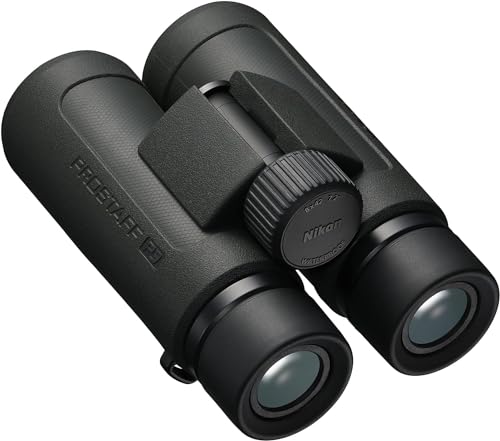

Nikon PROSTAFF P3 8x42 Binocular 4 photos from the Amazon listing

Best for: Open field scouting on standard budgets
Pros
- Extended 10x magnification reach
- Broad 367 ft field of view
- Lightweight polycarbonate housing
Cons
- Tighter 15.7 mm eye relief
- Standard silver-alloy prism coating
Best for: Low-light timber hunters needing wide field
Pros
- Generous 20.2 mm eye relief
- Wide 377 ft field of view
- High 28.1 relative brightness
Cons
- Silver-alloy prism lacks dielectric efficiency
- No locking diopter ring
The Nikon PROSTAFF P3 8×42 Binocular delivers a dependable full-size optical platform designed for broad environmental awareness in heavy cover. Featuring 42 mm front objective lenses and 8x magnification, this optic produces a 5 mm exit pupil alongside a 28.1 relative brightness rating for dawn and dusk glassing. The optical train pairs lead- and arsenic-free Eco-Glass with multilayer coatings, utilizing a silver-alloy roof prism coating to preserve image contrast and brightness across the visible spectrum.
Constructed with a fiberglass-reinforced polycarbonate chassis and rubber armor, the housing withstands rough field handling while providing a secure grip. Internal O-ring seals and nitrogen gas purging ensure fogproof and waterproof integrity through rain, snow, and sudden temperature fluctuations. A wide 377-foot field of view at 1,000 yards enables rapid wildlife tracking, assisted by 20.2 mm of eye relief, turn-and-slide eyecups, and a smooth central focus knob.
This optic suits woodland hunters and tree-stand archers who prioritize twilight light gathering and wide-angle tracking. However, it gives way to the PROSTAFF P7 when hunters require dielectric coatings and phase-corrected prism resolution.
Nikon PROSTAFF P7 8×42 Binocular for All-Weather Deep Woods Tracking


Nikon PROSTAFF P7 8x42 Binocular 4 photos from the Amazon listing
Best for: Dense woods hunters wanting phase-corrected clarity
Pros
- Dielectric high-reflective prism coating
- Phase-correction roof prism coatings
- Locking diopter ring
- Oil and water repellent lens coatings
Cons
- Polycarbonate chassis lacks magnesium rigidity
Serving as the flagship tier of the PROSTAFF family, the Nikon PROSTAFF P7 8×42 Binocular combines an 8x magnification profile with enhanced optical coatings. Its 42 mm objective lenses deliver a 5.3 mm exit pupil and a 28.1 relative brightness index. Inside the roof prism assembly, Nikon incorporates phase-correction coatings alongside a dielectric high-reflective multilayer prism coating, maximizing light transmission and edge-to-edge resolution beyond silver-alloy platforms.
The optical system features fully multicoated lenses, a 377-foot field of view at 1,000 yards, and 20.2 mm of eye relief with turn-and-slide eyecups. The outer glass elements feature oil- and water-repellent coatings to shed moisture and smudges. The lightweight fiberglass-reinforced polycarbonate body is rubber-armored, nitrogen-purged, and waterproof. A locking diopter ring secures focus adjustments against snagging brush. For broader context on 42 mm optical performance, examine our nikon binoculars 8 x 42 technical analysis.
The nikon prostaff p7 8×42 is ideal for hunters operating in wet, dense timber where quick target acquisition and optical clarity are essential. It concedes ground to the Monarch M5 when hunters require Extra-low Dispersion glass to resolve distant antler tines against bright skylines.
Nikon PROSTAFF P3 10×42 Binocular for Open Terrain Scouting


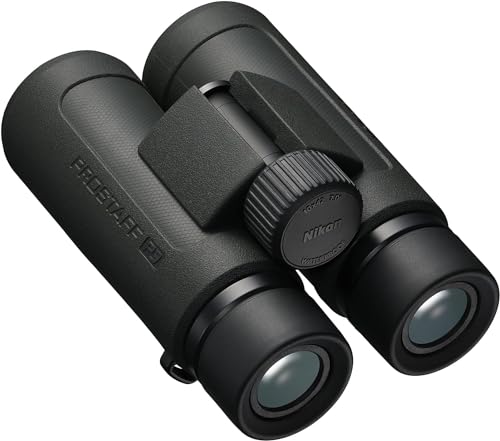

Nikon PROSTAFF P3 10x42 Binocular | Waterproof, fogproof, rubber-armored 4 photos from the Amazon listing
The Nikon PROSTAFF P3 10×42 Binocular extends visual reach to 10x magnification for hunters scouting vast terrain. With 42 mm front objectives, this optic produces a 4.2 mm exit pupil and a 17.6 relative brightness calculation. Its optical configuration employs anti-reflective multilayer coatings across lead- and arsenic-free Eco-Glass elements, supported by a silver-alloy prism coating designed to enhance brightness and color rendition.
Built with a closed-bridge configuration, the lightweight polycarbonate body features rubber armoring, O-ring seals, and nitrogen purging for waterproof and fogproof reliability. A generous 367-foot field of view at 1,000 yards provides broad situational awareness despite the higher magnification. Adjustments are managed via a large center focusing knob, accompanied by turn-and-slide eyecups and 15.7 mm of eye relief.
This model suits spot-and-stalk hunters scanning agricultural pastures, rangeland, or clearcuts where extra magnification helps identify distant game. It yields to the Monarch M5 when extended eye relief and chromatic aberration suppression become necessary.
NIKON Monarch M5 Binoculars for Distant Ridge and Brush Identification


NIKON Monarch M5 Binoculars 4 photos from the Amazon listing
Best for: Long-range glassing requiring chromatic fringing control
Pros
- Extra-low dispersion ED glass lenses
- Dielectric multilayer prism coatings
- Long 18.4 mm eye relief
- Close focus down to 8.2 feet
Cons
- Narrower 293 ft field of view
The NIKON Monarch M5 Binoculars introduce Extra-low Dispersion (ED) glass elements to control chromatic aberration and color fringing along high-contrast margins. Utilizing a 10x magnification and 42 mm objective format, this optic features fully multi-coated lenses and dielectric high-reflective multilayer roof prism coatings. Aspherical eyepiece lenses ensure sharp resolution across the optical field, while an 8.2-foot close focus allows near-range observation.
The optic delivers a 4.2 mm exit pupil and 18.4 mm of eye relief, paired with adjustable turn-and-slide eyecups for eyeglass wearers. Its 293-foot field of view at 1,000 yards provides detailed long-distance observation. Built with a nitrogen-purged, O-ring-sealed housing, the waterproof rubber-armored chassis withstands heavy field use. Those seeking higher magnification for extreme distances can consult our review of nikon binoculars 12×50 configurations.
The nikon monarch m5 10×42 suits hunters scanning sunlit canyons and distant ridgelines where chromatic aberration reduction is critical for game verification. It yields to the Monarch M7 for hunters needing a wider field of view and oil-repellent exterior coatings.
Nikon ACULON A30 10×25 Compact Binoculars for Ultralight Backcountry Stalks


Nikon ACULON A30 10x25 TrueTimber KANATI Camo Binocular | 4 photos from the Amazon listing
Best for: Ultralight minimalist backcountry packing
Pros
- Dual-hinge pocket-sized folding chassis
- Lead- and arsenic-free Eco-Glass
- Wide +/-5 diopter adjustment
Cons
- Small 2.5 mm exit pupil limits twilight
- Listing omits eye relief specification
The Nikon ACULON A30 10×25 Compact Binoculars deliver high magnification in an ultralight, pocket-sized folding chassis. Utilizing a dual-hinge design, the optic folds tightly for convenient transport inside hunting packs or jacket pockets. Its 25 mm objective lenses deliver 10x magnification, resulting in a 2.5 mm exit pupil tailored for daytime glassing and scouting.
The optical system features multilayer-coated lenses made from lead- and arsenic-free Eco-Glass, maximizing light transmission and color accuracy. An ergonomic rubberized body provides a comfortable, secure grip, while a central focus wheel ensures quick image adjustments. The diopter system provides an adjustment range of +/-5 diopters. The listing does not specify eye relief or relative brightness ratings. Waterproof construction ensures durability in outdoor conditions.
This compact model suits mobile backpack hunters and archery scouts who prioritize minimum pack weight over low-light exit pupil size. However, its small 2.5 mm exit pupil concedes low-light capability to full-size 42 mm models during dawn and dusk.
Nikon Monarch M7 10×42 Binoculars for Wide-Angle Glassing and High Resolution


Nikon Monarch M7 10x42 Binoculars | Official Nikon USA 4 photos from the Amazon listing
Best for: Demanding big-game hunters needing edge sharpness
Pros
- ED glass with aspherical eyepiece lenses
- Expansive 357 ft field of view at 10x
- Oil and water repellent external coatings
- Dielectric high-reflective prism coating
Cons
- Moderate 16.5 mm eye relief
Sitting at the summit of Nikon’s hunting binocular lineup, the Nikon Monarch M7 10×42 Binoculars combine high magnification with an expansive 357-foot field of view at 1,000 yards. The optical assembly unites ED glass elements with dielectric high-reflective multilayer roof prism coatings and fully multi-coated optics, delivering vivid colors and sharp edge-to-edge definition. Nikon’s optical engineering shares precision standards seen in its nikon mirrorless cameras z mount photographic lines.
The 42 mm objective lenses deliver a 4.2 mm exit pupil, a 17.6 relative brightness index, and 16.5 mm of eye relief with high-eyepoint turn-and-slide eyecups. The outer lens elements feature oil- and water-repellent coatings that resist moisture, dirt, and fingerprint smudges. The rugged rubber-armored chassis is nitrogen-purged and O-ring sealed for waterproof and fogproof reliability, complete with a +/-4 diopter adjustment range and aspherical eyepiece optics.
The nikon monarch m7 10×42 represents the best nikon binoculars for hunting open country, timber transitions, and western landscapes where wide-angle scanning and resolution matter most. It yields only to compact models like the ACULON A30 when extreme packability overrides optical performance.
How to Choose the Right Nikon Hunting Binoculars
Conducting a detailed nikon hunting binoculars comparison requires matching optical specifications to your hunting environment, targeted game species, and typical lighting conditions. Exit pupil diameter is a fundamental optical factor, determined by dividing the objective lens diameter by magnification power. The PROSTAFF P3 8×42 and PROSTAFF P7 8×42 yield exit pupils of 5.0 mm and 5.3 mm respectively, delivering ample light to dilated eyes during dawn and dusk transitions. Platforms featuring 10×42 optics provide a 4.2 mm exit pupil, balancing twilight usability with distant magnification, while the 2.5 mm exit pupil on the ACULON A30 10×25 requires direct daylight for optimal image brightness.
Prism coatings and glass composition dictate color accuracy, contrast, and glare resistance. The PROSTAFF P3 series uses silver-alloy prism coatings for dependable brightness. Upgrading to the PROSTAFF P7 introduces dielectric high-reflective multilayer coatings and phase-correction roof prism coatings, which align light waves for superior image definition. The Monarch M5 and Monarch M7 advance optical clarity further by incorporating Extra-low Dispersion (ED) glass, which minimizes chromatic aberration and color fringing along high-contrast edges.
Field of view determines your scanning efficiency. An 8x magnification optic typically offers a wide 377-foot field of view at 1,000 yards, which is ideal for scanning thick timber. At 10x magnification, the field of view narrows to 293 feet on the Monarch M5, whereas the Monarch M7 maintains an expansive 357-foot span. Choose 8x magnification for woodland hunting and 10x magnification for long-range glassing across open country.
Mechanical construction and durability ensure longevity in rough weather. All six models provide waterproof construction, but specific features distinguish each tier. The PROSTAFF P7 includes a locking diopter ring, while the PROSTAFF P7 and Monarch M7 feature oil- and water-repellent exterior lens coatings. Backpackers prioritizing compact size should look to the ACULON A30, while stationary hunters will prefer the ergonomic stability of full-size 42 mm frames.
FAQ
What is the optical difference between the Nikon PROSTAFF P3 and PROSTAFF P7 lines?
The PROSTAFF P7 features dielectric high-reflective multilayer prism coatings and phase-correction coatings, whereas the PROSTAFF P3 uses standard silver-alloy prism coatings. In addition, the PROSTAFF P7 includes oil- and water-repellent lens coatings and a locking diopter adjustment ring, both of which are absent on the PROSTAFF P3.
Why is Extra-low Dispersion ED glass critical for big game hunting?
Extra-low Dispersion (ED) glass corrects chromatic aberration, which causes color fringing along high-contrast borders such as an animal’s silhouette against snow or bright brush. By aligning different light wavelengths to a single focal point, ED glass provides sharper edge detail and accurate color reproduction for distant game identification.
Should hunters choose 8×42 or 10×42 magnification for field glassing?
Hunters glassing dense timber or tracking fast-moving animals generally benefit from 8×42 binoculars due to their wider field of view and larger exit pupil, which excels in dim light. Hunters observing open valleys, cutovers, and distant ridges benefit from 10×42 magnification to resolve fine details at long distances.
How do dielectric high-reflective multilayer coatings improve twilight vision?
Dielectric prism coatings reflect over 99 percent of the visible light spectrum across the roof prism surfaces, minimizing light loss inside the optical chamber. This ensures higher transmission to the hunter’s eye compared to standard silver-alloy coatings, producing brighter and higher-contrast images during critical dawn and dusk hours.
Is a compact 10×25 binocular sufficient for hunting in low light?
A compact 10×25 binocular has a 2.5 mm exit pupil, which restricts light intake when a hunter’s pupils dilate in twilight. While convenient for daytime scouting and weight-conscious backcountry hunts, compact optics cannot match the low-light brightness provided by full-size 42 mm objective lenses.


