As Amazon Associates, we earn from qualifying purchases. This means we may receive a small commission at no extra cost to you if you click through and make a purchase.
The PlayStation hardware ecosystem has expanded dramatically beyond standard gamepads, giving competitive players access to advanced input devices engineered for strict latency thresholds, mechanical precision, and ergonomic longevity. PlayStation officially licensed pro controllers must meet exacting communication standards on the PS5 platform, yet each manufacturer approaches competitive advantage through distinct engineering philosophies. While Sony focuses on deep operating system integration and signature tactile feedback mechanisms, specialized third-party hardware partners prioritize physical modularity, microswitch actuations, and magnetic sensor longevity.
In this technical playstation controller pro comparison, these six gamepads diverge across stick sensor architecture, button switch hardware, remapping capacities, and native platform feature retention. Selecting the best playstation controller pro requires balancing the drift-resistant properties of magnetic Hall effect sensors against the mechanical tactile feedback of microswitch buttons and first-party haptic immersion.
PlayStation Pro Controllers Compared
| Model | Stick Sensor Tech | Remappable Inputs | Connectivity | DualSense Haptics Support |
|---|---|---|---|---|
| Turtle Beach Victrix Pro BFG Reloaded | Hall Effect Magnetic | 4 Back Buttons | Wired / Wireless (2.4GHz RF) | No |
| Victrix Pro BFG Wireless Gaming Controller | Standard Potentiometer | 4 Back Buttons | Wired / Wireless (Bluetooth) | No |
| Nacon Revolution 5 Pro Officially Licensed | Hall Effect Magnetic | 4 Omron Microswitch Paddles | Wired / Wireless (USB-A RF) | No |
| Razer Wolverine V2 Pro Wireless PlayStation | Standard Potentiometer (Firmware Calibrated) | 6 Buttons (4 Triggers, 2 Bumpers) | Wired / Wireless (2.4GHz HyperSpeed) | No |
| PlayStation DualSense Edge Wireless Controller | Replaceable Potentiometer Modules | 2 Back Buttons (Swappable Paddles/Levers) | Wired / Wireless (Bluetooth) | Yes |
| PlayStation DualSense Wireless Controller | Fixed Potentiometer | 0 Remappable Buttons | Wired / Wireless (Bluetooth) | Yes |
Table from this guide — scroll sideways for the remaining columns.
Turtle Beach Victrix Pro BFG Reloaded for Modular Flexibility


Turtle Beach Victrix Pro BFG Reloaded 4 photos from the Amazon listing

Best for: Fighting game enthusiasts and modular layouts
Pros
- Reversible stick orientation
- Swappable 6-button fight pad
- Profile switching button
Cons
- Standard potentiometer sticks
Best for: Tournament modularity and fighting game inputs
Pros
- Hall-effect stick modules
- 6-button fightpad module
- 20-hour battery life
Cons
- Lacks native DualSense haptics
The Turtle Beach Victrix Pro BFG Reloaded introduces magnetic hardware modernization to modular esports gamepads. Designed with three swappable core modules, this gamepad integrates contactless Hall effect technology directly into its primary analog stick components. By measuring position via magnetic field displacement rather than resistive physical wiper tracks, the stick modules eliminate electrical wear and sensor degradation, providing resilient tracking accuracy across high-volume competitive play sessions. The internal rechargeable battery yields up to 20 hours of operation across both low-latency wireless and direct wired modes.
Input flexibility extends to the trigger and face button architecture. The controller features 5-stop Hall effect clutch triggers engineered with a dedicated hair-trigger mode, allowing players to shorten physical throw distance for instantaneous firing commands in shooter titles. For fighting game specialists, the unit includes an ergonomically enhanced 6-button fightpad module driven by mechanical Kailh microswitches, translating finger presses into crisp, short-travel digital inputs. Four mappable quick-action rear buttons allow players to execute jump, reload, and crouch inputs without lifting their thumbs from the analog sticks.
Equipped with 11 interchangeable components, the package permits full customization of stick lengths, D-pad shapes, and gate profiles to match individual thumb biomechanics. While the gamepad incorporates a 3.5mm audio jack with Sony 3D Audio processing, it sheds native DualSense rumble motors to prioritize lightweight handling and rapid physical response. Competitive tournament competitors who demand swappable fightpad layouts and magnetic stick longevity will find this modular build specifically addresses their execution demands.
Victrix Pro BFG Wireless Gaming Controller for Fighting Game Precision


Victrix Pro BFG Wireless Gaming Controller: Tekken 8 Rage 4 photos from the Amazon listing
The Victrix Pro BFG Wireless Gaming Controller, produced under the PDP brand and featuring a Tekken 8 Rage Art aesthetic, focuses on modular layout adaptation for fighting games and competitive action titles. Weighing 298 grams with total physical dimensions of 3.58 by 7.87 by 7.87 inches, this 17-button controller is officially licensed by both PlayStation and Bandai Namco. It delivers cross-generation compatibility across PlayStation 5, PlayStation 4, and Windows PC platforms via low-latency Bluetooth and wired connections.
The signature mechanical engineering feature of the Pro BFG is its reversible left-hand module, which enables users to physically switch between symmetrical PlayStation stick geometry and offset, asymmetrical stick layouts. The standard right-hand module can be unscrewed and swapped out for an included 6-button fight pad module fitted with tactile microswitches. This modular transformation positions six face buttons under the right thumb, mimicking arcade panel ergonomics. The package also includes four interchangeable sticks, three distinct D-pad shapes, and four analog stick gates, all organized within an included protective carrying case.
On the reverse side of the chassis, four mappable back buttons provide direct ergonomic access to primary face commands. Players can toggle between three unique on-board button mapping configurations instantly using the integrated Profile Button. For detailed signal customization, the free Victrix Control Hub PC application allows users to calibrate stick deadzones, adjust trigger actuation boundaries, run diagnostics, and customize EQ profiles for the integrated 3.5mm headphone jack. This configuration serves players who shift between standard first-person shooters and complex six-button fighters.
Nacon Revolution 5 Pro Officially Licensed for Magnetic Durability


Nacon Revolution 5 Pro Officially Licensed 4 photos from the Amazon listing
Best for: Magnetic sensor precision and paddle longevity
Pros
- Hall effect joysticks and triggers
- Omron micro-switch back paddles
- Included 3-meter cable
Cons
- 10-hour battery life
- No haptic feedback support
The Nacon Revolution 5 Pro Officially Licensed targets component longevity by deploying magnetic Hall effect sensors across both its dual joysticks and analog triggers. By removing the mechanical friction points found in traditional resistive potentiometers, the internal sensors completely eliminate the primary cause of stick drift. Built with an item weight of 0.3 kilograms and dimensions measuring 2.4 inches deep by 6.4 inches wide by 4.5 inches high, this 30-button controller establishes an asymmetrical stick footprint designed for extended endurance in competitive environments. Gamers looking into high-end hardware options often examine the broader playstation elite controller market to weigh these magnetic upgrades against first-party designs.
Actuation speed is reinforced by physical trigger blockers that allow players to manually restrict trigger travel from a full pull down to a short throw. Rear inputs rely on four Omron microswitch back paddles integrated into the rear grip curvature, providing distinct tactile clicks with minimal actuation force. Directional input accuracy is handled by a specialized D-pad developed in direct collaboration with professional fighting game competitor Mister Crimson, giving players the option to swap between standard cross and specialized multi-directional directional pads depending on the genre.
Wireless transmission operates through an included USB-A RF adapter designed for PS5, PS4, and PC, paired with a rechargeable battery that delivers up to 10 hours of active playtime. A 3-meter USB-C to USB-A cable is included for tournament setups where wired signal integrity is mandatory. Notably, Nacon explicitly states that the Revolution 5 Pro omits PS5-exclusive features, including native DualSense haptic feedback, adaptive trigger motor resistance, and the onboard controller speaker. It is engineered specifically for players who prioritize magnetic component precision and microswitch paddles over sensory immersion.
Razer Wolverine V2 Pro Wireless PlayStation for Ultra-Fast Actuation



Razer Wolverine V2 Pro Wireless PlayStation 4 photos from the Amazon listing
Best for: Fast microswitch actuation and extra bumpers
Pros
- Mecha-tactile action buttons
- 6 remappable buttons
- 8-way microswitch D-pad
Cons
- App required for deadzones
- Heavier form factor
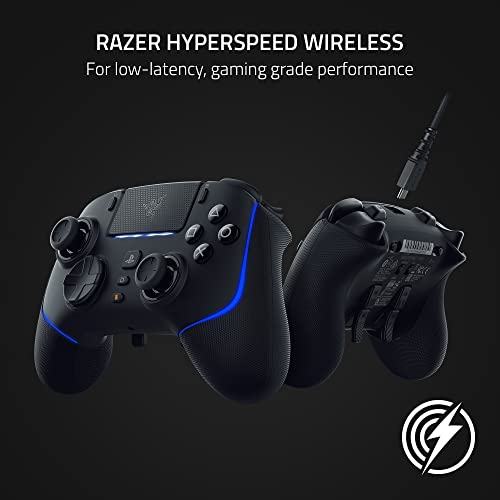
The Razer Wolverine V2 Pro Wireless PlayStation brings mechanical keyboard switch actuation to a high-end console gamepad. Connecting via an ultra-fast 2.4GHz Razer HyperSpeed Wireless USB Type-A dongle, the controller ensures low-latency wireless signal processing on PS5 consoles and PC. Tipping the scales at 15.2 ounces with dimensions of 6.36 by 4.17 by 2.57 inches, the Wolverine V2 Pro houses 23 total physical buttons built around an asymmetrical thumbstick configuration. Pairing this responsive input pipeline with a low-input-lag display like an msi oled monitor 1440p creates an ultra-responsive competitive setup.
The core performance advantage rests within Razer Mecha-Tactile Action Buttons and an 8-way microswitch D-pad. The face buttons utilize a shortened actuation distance that triggers commands faster than conventional rubber conductive pads while delivering a tactile click. The 8-way directional pad engages discrete microswitches on every directional axis, preventing ambiguous inputs during diagonal combo execution. The HyperTrigger system allows players to toggle the analog triggers between measured, full-range dynamic pulls and instant, zero-travel mouse-click actuations via physical sliding switches on the underside of the shell.
Input expansion is substantial, offering six remappable buttons consisting of four extra rear triggers and two custom top bumpers nestled between the main shoulder buttons. Two additional thumbstick caps (tall concave and short convex) enable physical personalization for precision aiming or speed. The controller also features customizable Chroma RGB backlighting with 16.8 million colors managed through the Razer Controller app for iOS and Android. A major manufacturer firmware update directly addresses analog performance, delivering fine-tuned default deadzones, in-app deadzone curve customization, and an improved anti-stick drift calibration profile.
PlayStation DualSense Edge Wireless Controller for Native System Parity


PlayStation DualSense Edge Wireless Controller - Midnight Black 4 photos from the Amazon listing
Best for: Native PS5 system integration and haptics
Pros
- Replaceable stick modules
- Native DualSense haptics and triggers
- First-party PS5 OS integration
Cons
- Shorter battery duration
- Potentiometer modules wear over time
The PlayStation DualSense Edge Wireless Controller represents Sony’s first-party solution for competitive performance, designed from the ground up to retain full compatibility with the PlayStation 5 operating system. Featuring a Midnight Black chassis measuring 7.8 by 7.8 by 4 inches and an overall listed package weight of 2.6 pounds, the 21-button controller integrates seamless on-screen profile swapping, analog sensitivity curve adjustments, and stick deadzone calibration directly within the PS5 system UI without requiring secondary PC software or mobile apps.
Modularity on the DualSense Edge is centered around its field-serviceable chassis. Unlike controllers that require complete disassembly when an analog stick wears down, the Edge features entirely replaceable stick modules that can be unlatched and swapped out using a quick-release lever mechanism. The controller includes interchangeable stick caps in high and low dome profiles, alongside swappable rear back button hardware that allows users to install either flat lever paddles or half-dome buttons. These two remappable rear inputs let players bind any standard face or shoulder command to their fingertips.
Critically, the DualSense Edge retains the complete suite of proprietary immersion technologies found in the base console gamepad. Dual voice-coil haptic actuators provide nuanced environmental feedback, while dynamic adaptive triggers deliver variable force resistance based on in-game actions. Physical slide stops on each trigger housing allow players to mechanically shorten trigger travel into short, medium, or full pulls, adjusting deadzones automatically via console software. It stands as the definitive choice for players who demand competitive rear paddles and modular stick hardware without forfeiting first-party haptics.
PlayStation DualSense Wireless Controller for Standard Baseline Control


PlayStation DualSense™ Wireless Controller – Midnight Black - For 4 photos from the Amazon listing
Best for: Baseline competitive play and full immersion
Pros
- Native adaptive triggers and haptics
- Built-in microphone and mute
- Broad cross-platform support
Cons
- Zero back paddles or mappable buttons
- Fixed stick modules
The PlayStation DualSense Wireless Controller serves as the foundational benchmark against which all competitive hardware is measured. Weighing 14.4 ounces with physical dimensions of 7.5 by 7.5 by 2.5 inches, this standard 14-button gamepad ships in Midnight Black and establishes the baseline ergonomic form factor for the PS5 platform. It connects via Bluetooth or USB Type-C to PlayStation 5 consoles, PC and Mac computers, as well as Android and iOS mobile devices.
The primary engineering focus of the base DualSense is sensory feedback. Rather than traditional eccentric rotating mass vibration motors, the unit uses voice-coil haptic actuators capable of rendering precise physical frequencies that correspond to surface textures, weapon recoil, and spatial cues. The dynamic adaptive triggers incorporate internal stepper motors and gear trains to create real-time resistance variations, simulating brake stiffness, weapon jams, or Bowstring tension directly against the player’s index fingers.
In terms of competitive utility, the baseline DualSense contains a built-in microphone array with a dedicated hardware mute button, an integrated mono speaker, a 3.5mm stereo headset jack, and a center capacitive touchpad. However, it lacks modular components, swappable stick modules, physical trigger travel stops, and rear remappable buttons. While its standard potentiometer analog sticks and rubber-membrane face buttons deliver reliable day-to-day operation, players seeking hardware customization, mechanical microswitches, or back-paddle inputs must step up to dedicated pro-tier alternatives.
How to Choose the Right PlayStation Pro Controllers
Deciding which playstation controller pro to buy depends on evaluating stick sensor longevity, mechanical switch actuation, physical chassis layout, and platform software parity. Competitive players should weigh these key hardware pillars before selecting a flagship controller:
- Stick Sensor Architecture: Traditional resistive potentiometers rely on physical contact wipers that wear down over time, eventually introducing electrical noise known as stick drift. If sensor longevity is your top priority, choose controllers featuring Hall effect ps5 controller specs, such as the Nacon Revolution 5 Pro or the Turtle Beach Victrix Pro BFG Reloaded. These gamepads use contactless magnetic fields to detect movement, entirely bypassing mechanical sensor wear. Alternatively, the PlayStation DualSense Edge handles this issue through user-replaceable potentiometer stick modules, allowing you to slide in fresh hardware modules if wear occurs over time.
- Remappable Inputs and Button Actuation: Competitive gaming requires executing core commands without sacrificing analog stick control. Standard gamepads like the base DualSense feature zero back buttons, whereas pro controllers provide two to six additional remappable inputs. The DualSense Edge provides two swappable rear paddles, while the Victrix Pro BFG and Nacon Revolution 5 Pro offer four rear buttons. The Razer Wolverine V2 Pro leads in total input count with six extra mappable buttons, including two unique shoulder bumpers. Additionally, players who prefer rapid mechanical clicks should prioritize controllers equipped with Kailh, Omron, or Mecha-Tactile microswitches over traditional rubber membranes.
- Trigger Mechanics and Immersion Features: First-party PS5 games often utilize adaptive trigger tension and advanced haptic feedback to heighten gameplay immersion. Both the baseline DualSense and the DualSense Edge feature fully integrated adaptive trigger motors and voice-coil haptics. Conversely, third-party tournament controllers—including the Victrix Pro BFG series and the Nacon Revolution 5 Pro—omit these immersion features entirely to reduce weight, conserve battery, and focus on physical trigger stops with instantaneous hair-trigger actuation.
- Physical Modularity and Grip Layout: Ergonomic preferences vary significantly between symmetrical and asymmetrical stick placements. The DualSense, DualSense Edge, and Turtle Beach Victrix Pro BFG provide symmetrical layouts, though the Victrix uniquely features a reversible left module that allows conversion to an offset layout. The Nacon Revolution 5 Pro and Razer Wolverine V2 Pro adopt fixed asymmetrical layouts natively. Players who heavily focus on fighting games should prioritize the Victrix Pro BFG family for their swappable 6-button microswitch fightpad modules.
FAQ
Do third-party PlayStation pro controllers support native DualSense haptic feedback and adaptive triggers?
No. Officially licensed third-party controllers such as the Nacon Revolution 5 Pro, Razer Wolverine V2 Pro, and Victrix Pro BFG omit proprietary Sony DualSense haptics and motorized adaptive trigger resistance. These features are exclusive to first-party PlayStation controllers like the standard DualSense and DualSense Edge. Third-party pro gamepads replace these mechanisms with manual trigger-stop switches and lightweight rumble motors to reduce controller mass and optimize input speed.
What are the technical advantages of Hall effect stick sensors over replaceable modules?
Hall effect sensors utilize permanent magnets and electrical conductors that never make physical contact. Because position is measured purely through magnetic field flux variations, there are no internal resistive wipers to grind away or develop deadzone drift. In contrast, replaceable modules like those on the DualSense Edge still utilize standard friction-based potentiometer sensors that will eventually degrade, requiring the user to purchase and install replacement modules to restore zero-drift calibration.
How do microswitch face buttons impact competitive input latency compared to membrane pads?
Standard gamepads use conductive silicone membranes that require a full downward compression stroke to bridge an electrical contact on the circuit board. Microswitches, such as the Mecha-Tactile switches on the Razer Wolverine V2 Pro or the Kailh switches on the Victrix fightpad module, utilize mechanical metal leaves. These provide a much shorter actuation travel distance, immediate tactile and acoustic feedback, and a faster reset cycle, enabling quicker successive button inputs during high-stress competitive engagements.
Can button mapping profiles be saved directly to the controller hardware?
Yes. Flagship pro controllers feature onboard memory to store custom profiles without needing persistent software connections. The Victrix Pro BFG includes a dedicated hardware Profile Button that cycles through three onboard profiles instantly. The DualSense Edge stores multiple custom profiles directly within the controller hardware and integrates with the PS5 operating system for rapid switching via functional Fn shortcut buttons. The Razer Wolverine V2 Pro and Nacon Revolution 5 Pro also maintain stored profiles configured via their respective mobile and PC companion applications.
Which controller configuration provides the greatest advantage for fighting games?
The Victrix Pro BFG series (both the standard Pro BFG and the Reloaded edition) offers the most dedicated hardware advantages for fighting games. Rather than forcing players to execute complex combos on standard right-hand thumbsticks and shoulder buttons, these controllers include a modular 6-button fightpad module driven by mechanical microswitches. This module replaces the right analog stick entirely, laying out six direct digital inputs that mirror standard arcade fight stick ergonomics directly on the gamepad face.
Gamers who prioritize ultra-low latency and tactile mechanical feedback often demand the same rigorous build quality from their audio gear. If your creative desk setup extends beyond gaming into live mixing or beat production, our curated DJ Controller Picks detail the best hardware interfaces utilizing similar responsive controls. Investing in dependable, high-precision gear ensures seamless performance whether executing tournament inputs or crafting studio sets.
Long competitive matches demand peak mental focus and sustained hydration alongside low-latency gear. Keeping pure, filtered water at your desk through top Reverse Osmosis Picks ensures uninterrupted endurance during marathon tournament sessions. High-end hardware elevates input precision, but maintaining your physical baseline completes the competitive gaming setup.
Many of these pro gamepads double as tournament-grade inputs for competitive PC setups, where low latency and switch responsiveness matter just as much. If you are assembling a matching desktop rig alongside your console, reviewing curated PC Case Picks will help you balance desk space, airflow, and hardware access. Ultimately, choosing the right combination of modular controllers and thermal-efficient hardware ensures peak performance across both platforms.


