As Amazon Associates, we earn from qualifying purchases. This means we may receive a small commission at no extra cost to you if you click through and make a purchase.
Lenovo holds a commanding position in academic computing due to its consistent deployment of ergonomic keyboards, balanced thermal envelopes, and structured hardware tiers tailored for varied student workloads. The manufacturer spans the spectrum from lightweight Chrome OS netbooks to heavy-duty multi-core notebooks, giving undergraduates options that prioritize battery efficiency, display real estate, or local compute throughput. Selecting a dependable lenovo laptop for college students requires looking past exterior casing and analyzing fundamental component specifications, such as bus architecture, soldered versus expandable memory, and interface speeds.
While all six featured notebooks deliver portable productivity for higher education, they diverge significantly in compute architecture, ranging from quad-core Intel N-series and octa-core MediaTek ARM silicon up to an 8-core AMD Ryzen 7 processor, paired with storage configurations spanning compact eMMC up to high-speed NVMe solid-state drives. Evaluating this lenovo laptop comparison helps determine which lenovo laptop to buy based on course demands, software stacks, and daily transport requirements.
Lenovo Laptops Compared
| Model | Processor | System Memory | Internal Storage | Display Specifications |
|---|---|---|---|---|
| Lenovo 2026 laptop (V15 G6) | Intel N100 (4C/4T, up to 3.4GHz) | 16GB DDR5-4800 | 512GB PCIe 4.0 NVMe SSD | 15.6″ FHD (1920×1080) Anti-glare, 250 nits |
| Lenovo IdeaPad Slim 3i • 15.6″ | Intel N100 (4C/4T, up to 3.4GHz) | 4GB LPDDR5 | 128GB SSD | 15.6″ FHD (1920×1080) Anti-glare, Low Blue Light |
| Lenovo IdeaPad Slim 3 Laptop 2025 | AMD Ryzen 7 5825U (8C/16T, up to 4.5GHz) | 16GB DDR4-3200 | 512GB NVMe M.2 SSD | 15.6″ FHD (1920×1080) Touchscreen IPS, 300 nits |
| Lenovo Flagship Chromebook | MediaTek Kompanio 520 (8C, 2.0GHz) | 4GB RAM | 64GB eMMC | 14″ FHD (1920×1080) Touchscreen IPS |
| Lenovo V15 Business Laptop | Intel N100 (4C/4T, up to 3.4GHz) | 4GB LPDDR5-4800 | 128GB UFS 3.1 | 15.6″ FHD (1920×1080) Anti-glare, 250 nits |
| Lenovo IdeaPad Slim 3i 15.6″ FHD | Intel N150 (4C/4T, up to 3.6GHz) | 8GB LPDDR5 | 128GB UFS Storage | 15.6″ FHD (1920×1080) LED Anti-glare, 250 nits |
Table from this guide — scroll sideways for the remaining columns.
Lenovo 2026 laptop for Multitasking Capacity


Lenovo 2026 laptop 4 photos from the Amazon listing
Best for: Multitasking students needing memory and fast NVMe storage
Pros
- 16GB DDR5-4800 memory
- 512GB PCIe 4.0 NVMe SSD
- Dual USB-C with DisplayPort
Cons
- Quad-core Intel N100 ceiling
- 250 nits display brightness
The Lenovo 2026 laptop, built on the Lenovo V15 G6 platform, addresses the common memory bottleneck found in entry-level university portables. Powered by an Intel N100 quad-core processor with four threads, up to 3.4GHz max turbo frequency, and 6MB of Intel Smart Cache, this machine is paired with 16GB of high-speed DDR5-4800 RAM. That substantial memory allocation ensures that dozens of browser tabs, research PDFs, and data-entry tools run concurrently without system paging or aggressive memory compression. Storage is managed by a 512GB PCIe 4.0×4 NVMe SSD, providing fast operating system boot times and swift read/write cycles for bulky academic project files.
Visual output is handled by a 15.6-inch Full HD (1920×1080) anti-glare panel delivering 250 nits of brightness and an 87 percent screen-to-body ratio. For peripheral expansion, the chassis incorporates two USB-A 3.2 Gen 1 ports, two USB-C 3.2 Gen 1 ports supporting USB Power Delivery (30-65W) and DisplayPort 1.2, an HDMI 1.4b port, a headphone/microphone combo jack, and Gigabit Ethernet. Network connectivity is reinforced with Wi-Fi 6 (802.11ax 2×2) and Bluetooth 5.2. Built-in security features include Firmware TPM 2.0, a Kensington Nano Security Slot, and an HD 720p webcam with an integrated physical privacy shutter.
This configuration suits business, humanities, and social science students who regularly juggle intensive document suites, statistical spreadsheets, and research databases. However, because it relies on the efficiency-focused Intel N100 processor with integrated Intel graphics, it yields computational supremacy to higher-tier multi-threaded processors when handling continuous raw mathematical simulations or 3D rendering tasks.
Lenovo IdeaPad Slim 3i • 15.6″ for Core Productivity
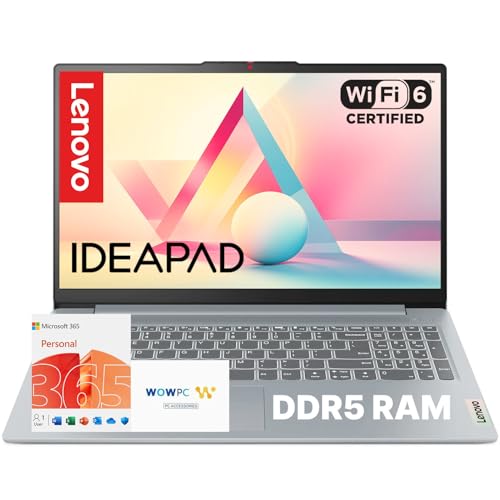


Lenovo IdeaPad Slim 3i • 15.6" 4 photos from the Amazon listing
Best for: Balanced general education with bundled Office
Pros
- 8GB LPDDR5 system RAM
- Intel N150 3.6GHz boost
- Bundled 1-Year Office 365
Cons
- 128GB internal storage ceiling
- Basic 250 nits brightness

Best for: Demanding STEM computing and touch navigation
Pros
- 8-core Ryzen 7 5825U processor
- 300 nits IPS touchscreen
- 16GB RAM and 512GB SSD
Cons
- Heavier package weight
- Zero available memory slots
Best for: Everyday lecture notes and basic document editing
Pros
- TÜV Low Blue Light display
- Rapid Charge Boost charging
- Integrated fingerprint reader
Cons
- 4GB RAM limits multitasking
- USB-C port data transfer only
Engineered for standard lecture note-taking and administrative coursework, the Lenovo IdeaPad Slim 3i • 15.6″ centers on portable everyday computing. It features the Intel Processor N100 with four cores and four threads operating up to 3.4GHz, supported by integrated Intel UHD Graphics. Memory stands at 4GB of power-efficient LPDDR5 RAM, while primary storage is handled by a 128GB solid-state drive complemented by 1TB of cloud storage and included Microsoft Office software. The chassis features a slim profile designed to be up to 10 percent slimmer than prior iterations, backed by MIL-STD-810H military-grade testing and spill resistance for reliable commuting durability.
The notebook integrates a 15.6-inch Full HD (1920×1080) anti-glare display featuring a 16:10 aspect ratio and up to 88 percent active area ratio, providing extra vertical reading space for technical documentation and term papers. TÜV-certified Low Blue Light engineering limits visual fatigue during protracted nighttime study intervals. Rapid Charge Boost supplies up to two hours of operational uptime from a brief 15-minute wall charge, while a fingerprint reader built directly into the power button streamlines biometric logins. Additional hardware highlights include a full-size keyboard with numeric keypad, Dolby Audio stereo speakers, and an HD 720p webcam with a privacy shutter.
This model is ideal for general education requirements where writing essays, streaming online lectures, and managing email represent the primary workload. The 4GB memory ceiling restricts heavy multitasking, and the single USB-C 3.2 Gen 1 port supports data transfer only, requiring students seeking display-out capabilities over USB-C to look toward higher-tier V-series options.
Lenovo IdeaPad Slim 3 Laptop 2025 for Heavy Academic Workloads
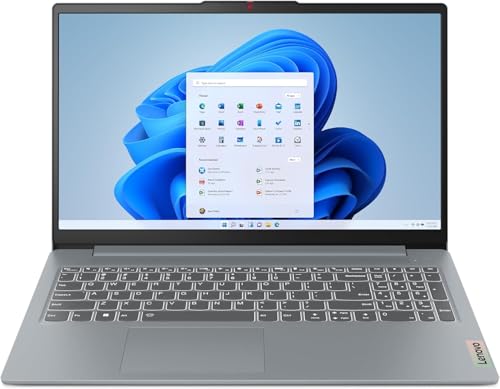


Lenovo IdeaPad Slim 3 Laptop 2025 15.6” FHD 1920 4 photos from the Amazon listing
Students requiring true workstation throughput within an ultra-portable form factor will find a massive performance leap in the Lenovo IdeaPad Slim 3 Laptop 2025. Anchoring this model is the 8-core, 16-thread AMD Ryzen 7 5825U processor, which operates at a 2.0GHz base clock and ramps up to a 4.5GHz boost frequency. Backed by integrated AMD Radeon Graphics and 16GB of DDR4-3200 RAM, this machine handles compiled code bases, multi-layered data analysis, virtualization, and creative media editing that would stall an efficiency-tier chip. Local storage is provided by an expansive 512GB NVMe M.2 SSD, preloaded with Windows 11 Pro and web versions of essential Microsoft productivity tools.
The display is a standout 15.6-inch Full HD (1920×1080) IPS LCD touchscreen outputting 300 nits of brightness. The IPS panel ensures wide viewing angles, while touch input enables direct interactive navigation through software interfaces and technical diagrams. Students tracking academic hardware via lenovo laptops on sale clearance frequently highlight high-output Ryzen configurations for their longevity across demanding engineering and STEM degree paths. Physical connectivity includes Wi-Fi 6, Bluetooth 5.2, a 720p HD webcam with a privacy shutter, and a dedicated numeric keypad.
This powerful machine is built for STEM, computer science, and multimedia majors who need substantial local computing resources. Its 3.17 kg recorded package weight and non-upgradeable memory configuration represent the primary trade-offs against lighter, cloud-focused alternatives.
Lenovo Flagship Chromebook for Portable Cloud Workflows


Lenovo Flagship Chromebook 4 photos from the Amazon listing
Best for: Lightweight campus portability and cloud workflows
Pros
- Lightweight 2.86 lb chassis
- 14-inch IPS touchscreen
- Backlit keyboard inclusion
Cons
- 64GB eMMC storage limit
- Chrome OS application boundaries
For undergraduates prioritizing minimal pack weight and instant cloud synchronization across campus facilities, the Lenovo Flagship Chromebook offers a streamlined alternative to Windows portables. Built around an 8-core MediaTek Kompanio 520 processor featuring four ARM Cortex-A73 performance cores and four Cortex-A53 efficiency cores clocked at 2.0GHz, it runs Google Chrome OS with fast startup speeds and robust energy conservation. The platform is paired with 4GB of system memory and 64GB of ultracompact eMMC storage, utilizing cloud storage integration for academic file archives and lecture recordings.
Weighing in at 2.86 pounds with dimensions of 13.23 by 8.7 by 0.73 inches, this compact notebook houses a 14-inch Full HD (1920×1080) IPS touchscreen. The energy-efficient LED backlight and wide-angle IPS glass permit direct touch annotation and collaborative study sessions. Shoppers evaluating a lenovo laptop 14 inch touchscreen will appreciate the integrated backlit keyboard for low-light lecture halls, as well as the 720p HD webcam with privacy shutter and dual-array microphone. Expansion is supported by one USB-A 3.2 Gen 1 port, one USB-C 3.2 Gen 1 port, a microSD card reader, a 3.5mm combo audio jack, Wi-Fi 6 (11ax 2×2), and Bluetooth 5.1.
This Chromebook is tailored for students whose academic stack revolves around web portals, Google Workspace, web-based research, and video conferencing. It yields to Windows-based alternatives when specific courses mandate proprietary desktop software, local compiling environments, or offline x86 applications.
Lenovo V15 Business Laptop for Rugged Daily Transport


Lenovo V15 Business Laptop, Intel Processor, 128GB Storage, Copilot 4 photos from the Amazon listing
Best for: Budget-focused coursework requiring military-grade durability
Pros
- MIL-STD-810H tested chassis
- Fast UFS 3.1 storage
- USB-C Power Delivery and DisplayPort
Cons
- 4GB memory configuration
- Restricted Windows 11 S mode
The Lenovo V15 Business Laptop blends an ultra-portable profile with rugged exterior construction. Built to withstand active university commuting, the Arctic Grey chassis measures 0.70 inches thick, weighs 3.42 pounds (1.55 kg), and satisfies MIL-STD-810H military-grade testing across 20 specific durability parameters. Compute performance is driven by an Intel N100 quad-core processor delivering up to 3.4GHz turbo speeds and 6MB cache, paired with 4GB of high-speed LPDDR5-4800 RAM and 128GB of UFS 3.1 storage. The inclusion of UFS 3.1 storage provides superior read and write speeds over older eMMC storage modules, facilitating smooth application access under Windows 11 S.
Its 15.6-inch Full HD (1920×1080) anti-glare screen delivers 250 nits of brightness, an 88 percent screen-to-body ratio, and TÜV Rheinland Low Blue Light certification to safeguard visual comfort during marathon study periods. I/O connectivity is extensive: two USB-A 3.2 Gen 1 ports, a memory card slot, and a full-function USB-C 3.2 Gen 1 port supporting Power Delivery (45-65W) and DisplayPort 1.2 external display output. Wireless communication is maintained through Wi-Fi 6 (802.11ax) and Bluetooth 5.2, alongside integrated HD Audio and a numeric keypad.
This model suits budget-conscious students who require a physically resilient notebook capable of driving desktop monitors via USB-C in dorm rooms or study pods. The main operational compromise remains the 4GB RAM threshold and Windows 11 S operating mode, which limits software installations strictly to verified platform store applications until switched.
Lenovo IdeaPad Slim 3i 15.6″ FHD for Balanced Academic Office Use


Lenovo IdeaPad Slim 3i 15.6" FHD Laptop Computer with 4 photos from the Amazon listing
Positioned as an intermediate step between entry-level 4GB machines and high-end workstation models, the Lenovo IdeaPad Slim 3i 15.6″ FHD enhances everyday responsiveness. The machine is driven by the updated Intel N150 processor, featuring four cores and four threads that reach an elevated 3.6GHz max turbo clock, supported by 6MB of cache and the Lenovo AI Engine. The system incorporates 8GB of LPDDR5 RAM, which doubles the working memory of base-tier configurations and allows seamless switching between office suites, video calls, and research portals. Local storage is provided by a 128GB UFS/SSD module, and the device includes a 1-year Microsoft Office 365 subscription and a 1-year warranty from SageNova.
The 15.6-inch Full HD (1920×1080) LED anti-glare panel outputs 250 nits of brightness, ensuring crisp presentation clarity for class readings and online coursework. Audio performance is reinforced with Dolby Audio stereo processing, while video communication utilizes a 720p HD camera equipped with a physical privacy shutter. The interface layout includes one USB-C 3.2 port, two USB-A 3.2 ports, an HDMI 1.4 port, an SD card reader, and an audio combo jack. Connectivity is handled by Wi-Fi 6 and Bluetooth, running full Windows 11 Home.
This configuration suits general undergraduates who need a ready-to-use software suite and dependable 8GB memory stability without managing software upgrades. However, students managing large local media archives or sizable offline programming assets may find the 128GB storage ceiling restrictive compared to 512GB alternatives.
How to Choose the Right Lenovo Laptop for College
Evaluating lenovo student laptop specs begins with a thorough lenovo laptop memory and cpu comparison. Processors like the Intel N100 and N150 utilize high-efficiency Gracemont architectures that sip power while delivering up to 3.4GHz to 3.6GHz across four threads, making them exceptionally well-suited for general education requirements and web-centric tasks. Conversely, the 8-core, 16-thread AMD Ryzen 7 5825U found in the Lenovo IdeaPad Slim 3 Laptop 2025 provides massive computing headroom for complex multi-threaded academic workloads. Memory capacity dictates your multitasking boundary: while 4GB of LPDDR5 handles straightforward single-application tasks, stepping up to 8GB or 16GB prevents system thrashing when running extensive research stacks. Those exploring versatile 2-in-1 options often cross-reference these hardware baselines against the lenovo yoga series to evaluate differing hinge mechanics and form factor tradeoffs.
Storage architecture forms another critical axis of performance. Entry-level models frequently utilize 64GB eMMC or 128GB UFS 3.1 flash storage. While UFS 3.1 provides substantially faster read/write speeds than eMMC, both fall short of the high data transfer speeds offered by dedicated 512GB PCIe NVMe solid-state drives. Students capturing extensive lab datasets, media projects, or local program environments should select NVMe-backed configurations like the Lenovo 2026 laptop to guarantee fast throughput and avoid relying on external storage drives.
Display quality and physical chassis durability directly impact everyday university use. For lecture halls with overhead fluorescent fixtures, anti-glare coatings and brightness ratings of 250 to 300 nits are vital for maintaining legibility. Touchscreen support, as seen on the Lenovo Flagship Chromebook and IdeaPad Slim 3 2025, facilitates natural navigation, while TÜV Low Blue Light certification limits visual strain during late-night assignment completions. Furthermore, laptops verifying MIL-STD-810H military-grade endurance, such as the Lenovo V15 Business Laptop and IdeaPad Slim 3i, ensure that hinge assemblies and chassis framing survive daily backpack transport across campus.
External display connectivity and port versatility vary widely across the lineup. Models equipped with full-function USB-C 3.2 Gen 1 ports supporting Power Delivery and DisplayPort 1.2—such as the Lenovo 2026 laptop and Lenovo V15 Business Laptop—allow single-cable docking for simultaneous charging and dual-monitor projection. In contrast, machines with data-only USB-C ports require separate HDMI cables for presentation displays, making port verification an essential pre-purchase step.
FAQ
Is 4GB of RAM sufficient for university coursework on a Lenovo laptop?
A 4GB memory capacity is sufficient for basic academic tasks such as writing term papers in word processors, browsing single research tabs, streaming lectures, and managing email. However, modern web applications and complex operating systems consume memory quickly. Students who regularly keep dozens of browser tabs open, run multiple software suites concurrently, or analyze large datasets will experience smoother responsiveness by selecting 8GB or 16GB configurations.
How does the Intel N100 compare to the AMD Ryzen 7 5825U in Lenovo student laptops?
The Intel N100 is an energy-efficient quad-core, four-thread processor designed for everyday administrative tasks, web productivity, and quiet operation with low thermal output. The AMD Ryzen 7 5825U is a higher-performance workstation-class processor featuring 8 cores and 16 threads with a 4.5GHz boost frequency. The Ryzen 7 handles compiled programming code, scientific data computation, and multimedia editing far more efficiently than the entry-tier Intel chip.
What is the difference between UFS 3.1 storage and an NVMe SSD in these laptops?
UFS 3.1 (Universal Flash Storage) is an embedded storage solution designed for ultra-low power consumption and compact form factors, offering significantly faster data rates than legacy eMMC memory. An NVMe PCIe SSD, however, communicates directly over high-speed PCI Express lanes, delivering much higher sustained sequential read and write speeds. NVMe drives are preferred for rapid system startup, large file transfers, and intensive read-write academic workflows.
Can all of these Lenovo student laptops connect to external dorm room monitors?
Most featured models can output video to external monitors, but their connection interfaces differ. The Lenovo 2026 laptop and Lenovo V15 Business Laptop feature USB-C ports with native DisplayPort 1.2 alongside standard HDMI, enabling modern single-cable USB-C docking or dual-screen configurations. Other models, such as the IdeaPad Slim 3i with data-only USB-C, rely strictly on their dedicated HDMI port for external display output.
Does Chrome OS on the Lenovo Flagship Chromebook support university software requirements?
Chrome OS is optimized for web applications, Google Workspace, cloud platforms, and Android-based applications. While it functions smoothly for general reading, writing, and online test-taking, it cannot natively run proprietary Windows or macOS x86 software. Students enrolled in specialized engineering, architecture, or computer science programs requiring local desktop application installs should opt for Windows 11 models.


