As Amazon Associates, we earn from qualifying purchases. This means we may receive a small commission at no extra cost to you if you click through and make a purchase.
Amazon Basics has established a prominent foothold in personal computing accessories by manufacturing standardized, utility-driven hardware that prioritizes baseline operational integrity over superfluous aesthetic flourishes. Within the realm of USB technology, the brand delivers a functional split between solid-state NAND flash storage devices and physical interconnect cabling. These products adhere strictly to universal communication standards established by the USB Implementers Forum, providing dependable digital pipelines for daily data management, peripheral synchronization, and auxiliary charging duties without requiring proprietary software suites or intrusive background drivers.
Across this lineup, hardware diverges sharply between legacy USB 2.0 interconnects operating at 480 Mbps signaling rates, Type-A solid-state thumb drives engineered for bulk desktop storage, and dual-connector USB-C and USB-A devices offering read throughput up to 400 MB/s, making a methodical amazon basics usb comparison essential for matching bus speeds to system host ports.
Amazon Basics USB Drives and Cables Compared
Best for: Connecting office printers and Type-B peripherals
Pros
- Gold-plated durable contacts
- Extended 6-foot cable span
- Multi-layer internal shielding
Cons
- USB 2.0 speed limit
- Requires legacy Type-B hardware
| Model | Hardware Interface | Data Transfer Rating | Form Factor or Cable Length |
|---|---|---|---|
| Amazon Basics 128 GB Ultra Fast | USB 3.1 Gen 1 / USB 3.0 Type-A | Up to 130MB/s read, 30MB/s write | Retractable thumb drive |
| Amazon Basics 128GB USB Flash Drive | USB 3.2 Gen 1 (Dual USB-C and USB-A) | Up to 400MB/s read | Rotating metal casing |
| Amazon Basics 256 GB Ultra Fast | USB 3.1 Gen 1 / USB 3.0 Type-A | Up to 130MB/s read, 30MB/s write | Retractable thumb drive |
| Amazon Basics 256GB USB Flash Drive | Dual USB-C and USB-A | Not listed | Thumb drive memory stick |
| Amazon Basics USB-C to USB-A 2.0 | USB 2.0 (USB-C to USB-A) | Up to 480 Mbps | 3-foot cord |
| Amazon Basics USB 2.0 Cable | USB 2.0 (USB-A to USB-B) | Up to 480 Mbps | 6-foot cord |
Table from this guide — scroll sideways for the remaining columns.
Amazon Basics 128 GB Ultra Fast for Legacy Type-A Desktops

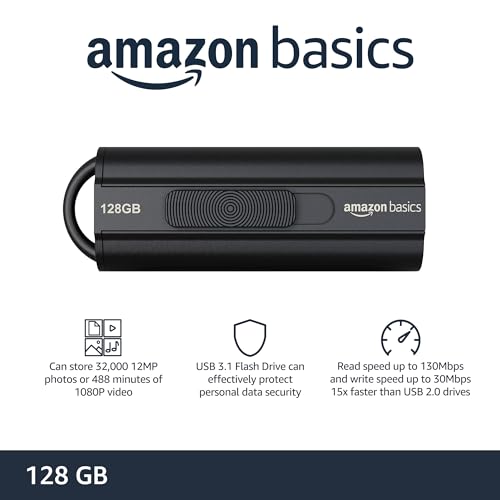


Amazon Basics 128 GB Ultra Fast 4 photos from the Amazon listing
Best for: Desktop users wanting retractable Type-A storage
Pros
- 130MB/s read speed
- Retractable capless housing
- Integrated keyhole loop
Cons
- Modest 30MB/s write rate
- Lacks USB-C port
The Amazon Basics 128 GB Ultra Fast, designated under model number LS21USB128G1, is a dedicated storage solution engineered around standard Type-A connectivity. The hardware utilizes high-grade NAND FLASH memory components packaged inside a lightweight, black plastic enclosure. Rather than utilizing a detachable protective cap that can easily become lost during travel, the chassis features an integrated retractable telescopic mechanism paired with a built-in keyhole loop for attachment to key rings or lanyards. The drive requires an active USB 3.1 Gen 1 or USB 3.0 port on the host machine to deliver its operational ceiling, while maintaining backwards compatibility with legacy USB 2.0 ports at reduced interface speeds.
Benchmarked under controlled internal testing conditions, this amazon basics 128 gb ultra fast unit achieves read speeds reaching up to 130MB/s and sequential write speeds up to 30MB/s, delivering roughly 15 times the transmission velocity of outdated USB 2.0 flash drives. The 128 GB gross capacity provides enough overhead to house approximately 32,000 12-megapixel still photographs or 488 minutes of standard 1080p video footage. Due to operating system binary partition math versus decimal capacity marketing, the actual usable volume presented by host operating systems sits above 115 GB of unallocated space.
This unit directly serves desktop and workstation operators who handle continuous file archiving across standard Type-A slots without needing mobile phone integration. However, users seeking to migrate larger file directories quickly across modern ultra-thin laptops will find the 30MB/s write ceiling restrictive, meaning those workflows are better handed off to higher-throughput dual-connector units that feature broader physical bus support.
Amazon Basics 128GB USB Flash Drive for Cross-Platform Mobile Workflows


Amazon Basics 128GB USB Flash Drive 4 photos from the Amazon listing
Best for: Mobile users moving files between multiple platforms
Pros
- Dual USB-C and USB-A ports
- 400MB/s read speed
- Durable metal swivel casing
Cons
- Write speed not listed
- Incompatible with Lightning ports
Representing a modern step in portable solid-state design, the Amazon Basics 128GB USB Flash Drive (model LS25USBC128G1) is built around a dual-port architecture. Encased in a Champagne Silver metal exterior casing, this amazon basics dual port usb device incorporates an integrated rotating swivel shield with an integrated hanging hole. One end terminates in an industry-standard USB Type-A connector, while the opposite end exposes a reversible USB Type-C plug. This interface design allows the drive to bridge communication between modern smartphones, tablets, and conventional computing hardware without external adapters, though the listing explicitly notes that it remains incompatible with legacy Apple Lightning ports.
Internally, this drive functions on the USB 3.2 Gen 1 hardware protocol, delivering exceptional read rates verified up to 400MB/s under factory testing parameters. The listing does not specify the maximum sequential write speed. Out of the box, the drive arrives formatted under the exFAT file system architecture, which ensures native read and write functionality across both mobile and desktop environments while avoiding the legacy 4GB single-file boundary. Much like typical external flash media, the usable capacity hovers above 115 GB due to OS system boundaries. Photographers evaluating mobile workflows alongside an sd card amazon basics setup will find this unit convenient for clearing phone camera rolls.
This flash drive suits mobile professionals, students, and multi-device operators who constantly shift documents, media files, and backups between Android handsets, iPad units, and traditional laptops. It renders standard single-ended Type-A sticks obsolete for mobile tasks, though users handling continuous multi-gigabyte disk writes might experience thermal throttling common to compact all-metal form factors.
Amazon Basics 256 GB Ultra Fast for High-Capacity Archiving

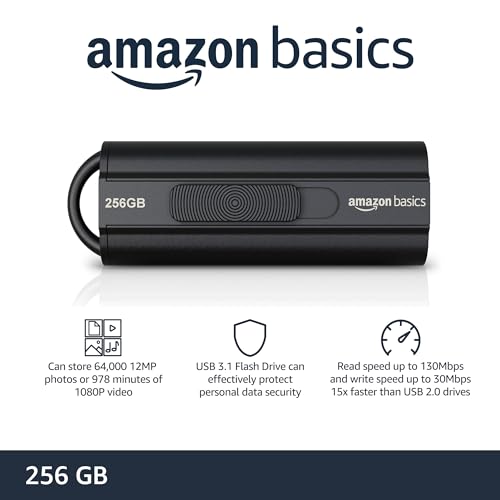


Amazon Basics 256 GB Ultra Fast 4 photos from the Amazon listing
Best for: Archiving large photo and video desktop collections
Pros
- Spacious 256GB storage volume
- Retractable connector mechanism
- 130MB/s read transfer speed
Cons
- Factory default FAT32 4GB limit
- No LED activity light
The Amazon Basics 256 GB Ultra Fast expands local solid-state storage for systems relying on traditional USB ports. Encased in a black, lightweight telescopic body identical to its 128 GB sibling, this drive features a slide-out Type-A connector with an integrated keyhole for secure carry. The listing notes that there is no integrated LED activity light on this model, which eliminates visual distraction during night-time operation or home theater playback. It connects via USB 3.1 Gen 1 and USB 3.0 host connections, while preserving full backward compatibility for older USB 2.0 host ports.
Under controlled conditions, the drive records read transfer speeds up to 130MB/s and sustained write figures reaching 30MB/s. Its 256 GB memory bank provides enough structural volume to accommodate 64,000 12-megapixel images or 978 minutes of 1080p high-definition video, delivering usable capacity confirmed above 230 GB after system initialization. A crucial technical detail noted in the manufacturer specifications is that the drive comes pre-formatted in the legacy FAT32 file system. While this provides out-of-the-box support for Windows and Mac environments, FAT32 limits individual file transfers to 4GB. Users transferring substantial disk images or uncompressed movie files must reformat the partition to exFAT or NTFS before deployment.
This drive is tailored for users who require an economical bulk repository for static files, long-term photograph albums, and system system-recovery media across standard computer hardware. Because its write performance is limited to 30MB/s, users regularly dealing with immediate high-speed transfers should consider newer generation dual-port flash configurations instead.
Amazon Basics 256GB USB Flash Drive for Dual-Port High-Volume Storage


Amazon Basics 256GB USB Flash Drive 4 photos from the Amazon listing
Best for: High-capacity dual-connector flash memory needs
Pros
- 256GB high-capacity storage
- Dual USB-C and USB-A connectors
- Champagne silver exterior
Cons
- Transfer speeds not specified
- Minimal published listing data
The Amazon Basics 256GB USB Flash Drive brings high storage density to a versatile multi-connector layout. Identified under its retail listing as a thumb drive memory stick featuring dual USB-C and USB-A interfaces, this hardware is styled with a Champagne Silver finish. The dual-sided design addresses the evolving interconnect market by integrating both the legacy Type-A standard and modern reversible Type-C ports into a single housing. This allows direct hardware interfacing with laptops, desktops, and mobile hardware without requiring auxiliary dongles.
While the hardware profile provides 256 GB of nominal storage capacity, the listing does not specify precise read speeds, write throughput metrics, internal controller revisions, or casing material specifics. Drawing strictly from the product information provided in the listing, this amazon basics 256gb usb flash drive is cataloged as a dual-port memory stick intended to handle versatile data shuttling duties across disparate device ecosystems.
This product is suited for consumers who prioritize dual-connector utility and doubled storage density for shuttling large media directories across newer phones and legacy systems. Where users require certified 400MB/s read speeds or detailed hardware data sheets, the thoroughly specified 128GB dual-port drive or dedicated external drives provide more documented performance boundaries.
Amazon Basics USB-C to USB-A 2.0 for Peripheral Interconnects and Device Charging


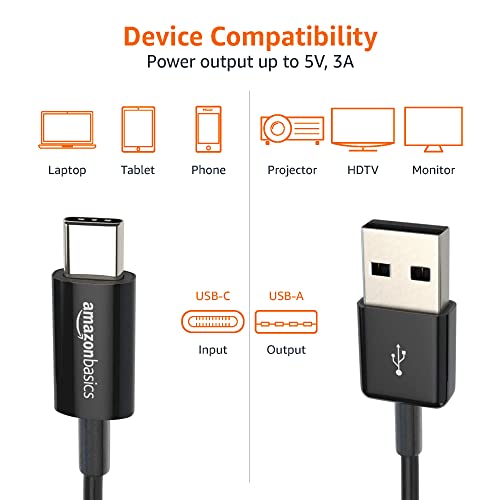
Amazon Basics USB-C to USB-A 2.0 Fast Charger Cable, 4 photos from the Amazon listing
Best for: Everyday standard charging and data syncing cables
Pros
- Official USB-IF certified
- Supports up to 15W charging
- Flexible 3-foot length
Cons
- Limited to USB 2.0 480Mbps
- Restricted charging on PD devices
Shifting from portable storage to wired connectivity, the Amazon Basics USB-C to USB-A 2.0 cable delivers a standardized physical link between Type-C endpoints and Type-A host ports. Measuring 3 feet (0.9 meters) in length with a flexible black jacket, this Male-to-Male interconnect carries formal USB-IF certification, guaranteeing compliance with universal electrical, mechanical, and signal integrity standards. The listing details a Cat 5 category classification, 28 pins, and an operating frequency of 0.48 GHz, backed by an Amazon Basics 1-year limited warranty.
From an electrical perspective, this cable supports standard device charging configurations up to 15W at a 5V/3A power profile. The listing explicitly states that the recommended 15W/3A load must not be exceeded, and points out that charging speeds are limited when connected to Power Delivery (USB-PD) fast chargers. For data throughput, the wire utilizes the USB 2.0 standard, capping data sync rates at 480 Mbps (0.48 Gbps). This bandwidth accommodates peripheral data transfers such as moving music, photos, or documents between handsets and computers, or syncing an in-car navigation console. When configuring a desktop layout, routing a dedicated amazon basics usb a to usb c wire keeps handheld accessories powered reliably.
This 3-foot cable is designed for powering mobile phones, tablets, power banks, and low-draw desktop accessories from traditional Type-A charging bricks or laptop ports. It is not intended for high-speed drive backups or video display output, as the 480 Mbps physical bus is outmatched by modern multi-gigabit storage interfaces.
Amazon Basics USB 2.0 Cable for Printers and Legacy B-Port Hardware


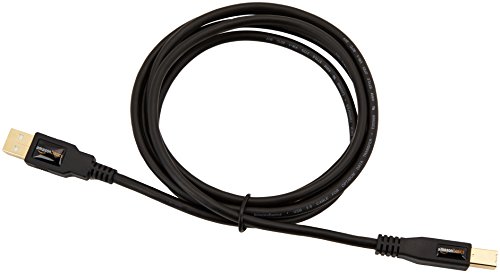
Amazon Basics USB 2.0 Cable, USB-A to USB-B, for 4 photos from the Amazon listing
The Amazon Basics USB 2.0 Cable provides a dedicated 6-foot connection designed specifically for legacy peripherals and office hardware. The assembly features a standard USB Type-A Male termination on one end and a square USB Type-B Male connector on the opposite side. Constructed with corrosion-resistant gold-plated connectors and internal multi-layer shielding, the cord minimizes electromagnetic interference and signal degradation over its 1.8-meter span. The listing lists technical specifications including a 4-pin arrangement, a 5-volt maximum electrical threshold, a 480 MHz operational frequency, and a Cat 5 category designation.
Operating over the standardized USB 2.0 transmission protocol, this Amazon Basics USB 2.0 Cable caps continuous data transfer rates at 480 Mbps. While this throughput is modest compared to modern 3.0 generation storage protocols, it provides ample bandwidth for the operational command sets of office printers, flatbed scanners, digital cameras, external legacy hard drives, and musical interface gear. Organizing long peripheral runs alongside an amazon basics desk setup benefits from the 6-foot length, which allows flexible cable routing around monitor arms and PC towers.
This cable serves home and commercial office environments that require a dependable, shielded interconnect to run stationary USB-B peripherals from desktop computers. It provides no utility for modern mobile devices or modern external SSD storage, standing purely as a legacy peripheral solution.
How to Choose the Right Amazon Basics USB Hardware
Determining which amazon basics usb to buy requires evaluating interface protocols, host connector styles, physical drive constructions, and expected throughput thresholds across your hardware setup. Identifying whether your task involves portable file storage or static peripheral cabling is the starting point for narrowing down the lineup.
- Physical Host Connector Compatibility: Assess the physical ports available on your host hardware. The Amazon Basics 128 GB Ultra Fast and 256 GB Ultra Fast units require standard Type-A slots, making them suitable for traditional desktop towers and docking blocks. If your workflow involves transferring data across modern smartphones, tablets, and laptops, the dual-port 128GB and 256GB memory sticks provide dual USB-C and USB-A connections to bridge modern and legacy ports.
- Bus Transfer Speed and Bandwidth: Review your workflow demands against verified amazon basics usb transfer speed metrics. For heavy reads, the dual-port 128GB drive leads the group with 400MB/s performance over USB 3.2 Gen 1. Conversely, the 128 GB and 256 GB Ultra Fast drives operate on USB 3.1 Gen 1 protocols capped at 130MB/s read and 30MB/s write speeds, which requires more patience during large directory migrations.
- Storage Capacity and Operating System Limits: Both 128 GB and 256 GB storage tiers offer ample overhead for documents and photo collections. Remember that usable space registers higher than 115 GB on 128 GB models and higher than 230 GB on 256 GB drives due to system binary calculations. Furthermore, note that the 256 GB Ultra Fast model ships with a FAT32 format, requiring a manual reformat to exFAT or NTFS if you plan to move single files larger than 4GB.
- Interconnect Cable Functions: When choosing cables, balance power delivery limits with data speed. The 3-foot USB-C to USB-A cord manages basic 15W charging and 480 Mbps data synchronization for mobile devices. For dedicated office hardware like desktop printers and flatbed scanners, the 6-foot USB 2.0 A-to-B cable provides the necessary reach and gold-plated terminal shielding.
FAQ
What is the difference between USB 3.1 Gen 1 and USB 2.0 in the Amazon Basics lineup?
USB 3.1 Gen 1 operates with a theoretical signaling rate of 5 Gbps, allowing drives like the Amazon Basics 128 GB Ultra Fast to achieve read speeds up to 130MB/s when plugged into compatible ports. In contrast, USB 2.0 caps total throughput at 480 Mbps (roughly 60MB/s theoretically, with real-world transfers often lower), as seen on the Amazon Basics USB-C to USB-A and USB-A to USB-B cables.
Why does my Amazon Basics USB flash drive show less storage than advertised?
This variance occurs because storage manufacturers calculate capacity using the decimal system (where 1 kilobyte equals 1,000 bytes), whereas host computer operating systems calculate capacity using the binary system (where 1 kibibyte equals 1,024 bytes). Consequently, an advertised 128 GB drive typically yields an available capacity higher than 115 GB in the OS, while a 256 GB drive shows an available capacity higher than 230 GB.
Can the Amazon Basics dual port USB drive connect to modern smartphones and tablets?
Yes. The Amazon Basics 128GB and 256GB dual-port models feature an integrated USB Type-C plug that connects directly to compatible USB-C phones, tablets, and computers. The manufacturer documentation specifies that the drive is formatted in exFAT by default for cross-platform support, though it is physically incompatible with legacy Apple Lightning ports.
Why is my 256 GB Ultra Fast drive failing to copy a single 6GB video file?
The Amazon Basics 256 GB Ultra Fast drive ships with FAT32 as its default factory file system. While FAT32 provides broad compatibility across Windows and Mac systems, it has a strict architectural limitation that prevents individual files larger than 4GB from being written to the volume. To resolve this, back up existing files and reformat the drive to exFAT or NTFS.
Can the Amazon Basics USB-C to USB-A 2.0 cable support high-wattage fast charging?
No. The Amazon Basics USB-C to USB-A 2.0 cable is rated for a maximum power load of 15 watts (5 volts at 3 amps). The listing specifically notes that the recommended 15W load must not be exceeded and that charging performance will be limited when the cable is connected to USB Power Delivery (USB-PD) enabled charging bricks.


