As Amazon Associates, we earn from qualifying purchases. This means we may receive a small commission at no extra cost to you if you click through and make a purchase.
Amazon Basics has established a massive footprint in everyday computing hardware by providing standardized, functional interconnects that strip away marketing excess in favor of baseline utility. In the realm of legacy-to-modern peripheral connectivity, the company focuses on delivering straightforward legacy USB-A to modern USB-C cords designed for routine battery replenishment and standard data transfers. These accessories are engineered around universal compliance standards rather than proprietary high-speed protocols, serving as reliable hardware for consumers who require straightforward links between legacy host machines, traditional wall bricks, and current-generation mobile electronics.
While the single standard cable serves as an isolated desktop tether and the five-pack provides an economical multi-port deployment for workspaces, the nylon braided variant extends the reach to six feet and introduces structural reinforcement tested against mechanical bending fatigue.
Amazon Basics USB-A to USB-C Cables Compared
| Model | Length and Quantity | Power Specification | Data Transfer Ceiling | Exterior Jacket |
|---|---|---|---|---|
| Amazon Basics USB-C to USB-A 2.0 | 3 Feet (0.9 Meters), 1-Pack | 15W (5V/3A) | 480 Mbps (USB 2.0) | Standard PVC (Black) |
| Amazon Basics 5-Pack USB-C to USB-A | 3 Feet (0.9 Meters), 5-Pack | 15W (5V/3A) | 480 Mbps (USB 2.0) | Standard PVC (Black) |
| Amazon Basics Nylon Braided USB-C to | 6 Feet (1.8 Meters), 1-Pack | 15W (5V/3A) | 480 Mbps (USB 2.0) | Braided Nylon (Dark Grey) |
Table from this guide — scroll sideways for the remaining columns.
Amazon Basics USB-C to USB-A 2.0 for Desktop Workstation Syncing


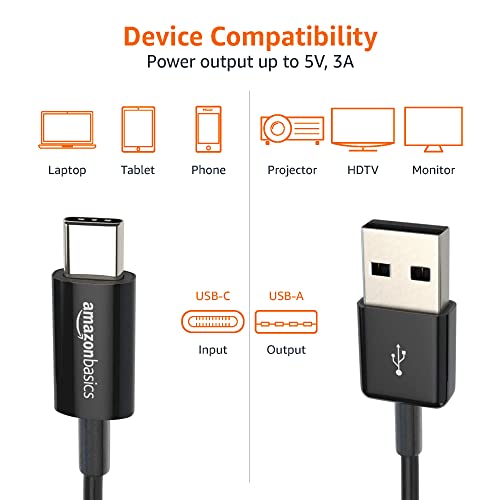
Amazon Basics USB-C to USB-A 2.0 4 photos from the Amazon listing
Best for: Single desktop workstation data syncing
Pros
- USB-IF certified safe charging
- Compact 3-foot footprint
- Solid 15W power output
Cons
- Standard PVC jacket
- Limited 480 Mbps throughput
The Amazon Basics USB-C to USB-A 2.0 cord is engineered as a direct replacement cable for everyday operations. Featuring a compact three-foot (0.9-meter) length, this male-to-male wire connects modern USB-C hardware—such as the Apple iPhone 15 and 16 lines, iPad tablets, and Samsung Galaxy handsets—to traditional USB-A host devices. This form factor works well for short-distance tethering to power banks, in-vehicle charging receptacles, and desktop hubs without excessive slack crowding your workspace. The physical sheath is composed of a smooth black finish, adhering to conventional peripheral aesthetics.
From an electrical and signal standpoint, this cable complies with USB-IF certification standards, ensuring appropriate operating parameters across host and client devices. It supports standard fast charging configurations up to 15W at 5V and 3A of current. The listing documentation explicitly notes that users must not exceed the recommended 15W maximum load and highlights that charging speeds remain limited when connected to Power Delivery (PD) hardware. Data throughput is governed by the USB 2.0 standard, achieving bandwidth ceilings of 480 Mbps (0.48 Gbps) over an operating frequency of 0.48 GHz. The technical specifications log a 28-pin construction and curiously denote a Cat 5 category in its listing attributes, while maintaining an Amazon Basics 1-year limited warranty.
This particular model is optimized for users who manage a dedicated terminal and need a no-nonsense link to sync local photos, transfer media files to hard drives, or maintain a standard charge. However, if your daily setup requires significant movement or your wall adapter is positioned across the room, the three-foot reach will feel constrained. Users who demand extended durability under frequent mechanical stress will find the standard PVC exterior less resilient than reinforced alternatives, signaling that heavy travelers should look toward braided offerings.
Amazon Basics 5-Pack USB-C to USB-A for Multi-Room Deployments


Amazon Basics 5-Pack USB-C to USB-A 4 photos from the Amazon listing
Best for: Multi-room home and office deployments
Pros
- Economical 5-cable bundle
- USB-IF certified compliance
- Universal 15W 5V/3A support
Cons
- Standard PVC sheathing
- Short 3-foot reach
When outfitting multiple workstations, an entire family fleet, or a commercial office environment, the Amazon Basics 5-Pack USB-C to USB-A provides a multi-unit bundle of standard three-foot black charging cables. Each cable in this five-piece bundle is functionally identical in form factor, providing five discrete lines to link USB-C devices to legacy USB-A ports on laptops, wall chargers, and automotive sockets. Instead of transporting a single cord between rooms, this package allows users to anchor individual lines permanently at bedside tables, desktop rigs, automobiles, and travel gear kits.
Electrically, every cord in this package delivers identical performance characteristics to the single standalone unit. Each cord is USB-IF certified, supporting a safe charging ceiling of 15W operating at a fixed 5V/3A profile. It also caps data transfer speeds at 480 Mbps, making it an appropriate choice for synchronizing smartphones, audio peripherals, and tablets with host PCs. The technical specifications indicate a 24-pin internal layout, male-to-male orientation, and compliance with standard USB 2.0 bus architecture. The manufacturer notes that units may originate from manufacturing facilities in China or the Philippines, and each cable carries the Amazon Basics 1-year limited warranty protection.
This multi-pack suits technicians, office administrators, or multi-device households who require consistent, standardized cables at every terminal. Because each cord measures 0.9 meters, it prevents cable clutter when routing power from an amazon basics desk grommet or a compact charging dock. Conversely, if your charging strategy relies on dynamic handling, constant packing into tight commuter bags, or connecting to distant baseboards, these standard-sheathed three-foot lines will present both reach and wear limitations compared to longer braided variants.
Amazon Basics Nylon Braided USB-C to for Extended Reach Durability


Amazon Basics Nylon Braided USB-C to 4 photos from the Amazon listing
Best for: Commuters needing extended reach and durability
Pros
- 5,000-cycle bend tested
- Braided nylon reinforcement
- Extended 6-foot reach
Cons
- Bulky excess slack for desks
- Capped at USB 2.0 speeds
The Amazon Basics Nylon Braided USB-C to cord addresses the dual challenges of physical reach and mechanical wear. Expanding the connection distance to six feet (1.8 meters), this dark grey cord allows users to operate their devices comfortably while tethered to distant wall outlets, rear-panel desktop inputs, or far-off automotive ports. Unlike the standard smooth PVC jackets found on shorter baseline models, this unit is wrapped in an interlocking braided nylon exterior engineered for enhanced structural integrity, flexibility, and resistance to outer sheath fraying.
Durability testing listed for this model demonstrates a certified mechanical endurance rating capable of withstanding 5,000 bend cycles at an angle of 95 degrees. The connector design incorporates the standard reversible USB Type-C orientation on the device end, eliminating port orientation friction during insertion. Internally, the cable meets official USB-IF certification criteria for USB 2.0 compliance, facilitating high-speed data transmission at 480 Mbps alongside safe 5V/3A (15W) power delivery. The listing specifically validates device compatibility across modern consumer hardware including MacBooks, Chromebook Pixel systems, legacy Galaxy Note 7 units, standard smartphones, external hard disk drives, and mobile battery packs.
This reinforced model is built for mobile users, frequent commuters, and bedside setups where cables endure repeated pulling, bending, and sharp directional changes. The six-foot span provides ergonomic freedom that three-foot alternatives cannot match. Nevertheless, users looking for high-density, low-clutter desk installations might find the extra coiled slack cumbersome, and those requiring only short interconnects for localized data syncing can save desk space with the more compact three-foot variants.
How to Choose the Right Amazon Basics USB-A to USB-C Cables
Selecting the optimal interconnect from this lineup requires evaluating physical installation parameters, mechanical durability requirements, and electrical charging ceilings. Although all three models share standard core data protocols and power transfer thresholds, their physical configurations serve distinct deployment scenarios.
The primary decision factor centers on physical span: evaluating an amazon basics usb-c cable 3ft vs 6ft layout. A three-foot (0.9-meter) cable, as seen on the standard single model and the five-pack bundle, provides an organized physical profile. This shorter length minimizes resistance, prevents desktop entanglement, and pairs neatly with laptops, in-car dashboard mounts, and multi-port charging hubs. When planning peripheral arrangements using amazon basics usb cords, keeping cable runs short prevents signal degradation and excess slack. In contrast, the six-foot nylon braided cord offers necessary clearance when routing cables from behind heavy furniture, reaching low wall outlets, or using a mobile device while reclined.
Material construction represents the next critical consideration. Standard PVC jacketing is flexible and cost-effective for static environments where cables remain undisturbed behind monitors or plugged into fixed charging stands. However, repeated bending along the strain relief collar will eventually induce fatigue in standard plastic sheathing. The nylon braided cable incorporates a woven fiber sleeve specifically tested to handle 5,000 bend cycles at 95 degrees, making it far superior for high-movement applications, daily travel bags, and environments where cords are repeatedly coiled and uncoiled.
Deployment volume dictates whether to buy individual units or multi-packs. If you are solving an isolated connectivity gap, such as linking an external storage drive to an office computer or connecting a secondary phone line, the single three-foot cable is the logical choice. However, modern households and multi-station offices rarely rely on a single charging station. The five-pack bundle lowers per-unit deployment overhead, outfitting multiple rooms, vehicles, and workstations simultaneously with identical, predictable hardware.
Finally, understand the power and data boundaries across all three options. Every model reviewed here is rated for USB 2.0 operation at 480 Mbps and capped at 15W (5V/3A) for power transfer. If your workflow involves transferring high-capacity video files or reading raw media from high-speed storage, such as an offloaded card from an sd card amazon basics adapter, these 480 Mbps lines will take considerably longer than high-bandwidth USB 3.1 or Thunderbolt alternatives. Similarly, these cables do not support USB Power Delivery profiles required to charge modern laptops at full 60W to 100W speeds, operating purely as low-power maintenance or standard charging solutions.
FAQ
Can these Amazon Basics cables support high-wattage laptop charging via USB Power Delivery?
No. All three cables feature an absolute electrical ceiling of 15W, operating at 5 volts and 3 amperes. While the product listings confirm physical connectivity with USB-C devices like MacBooks and Chromebooks for basic power transfer, they do not support the high-voltage Power Delivery (PD) protocols needed to recharge modern laptop batteries at standard operating speeds. Attempting to charge a laptop will result in slow trickle charging or simple battery level maintenance under low workloads.
What does the 480 Mbps data transfer rate mean for real-world file transfers?
The 480 Mbps (megabits per second) rating corresponds to legacy USB 2.0 bus architecture. In practical terms, this equates to theoretical peak data throughput of approximately 60 megabytes per second, though real-world overhead typically limits transfers to around 30 to 40 megabytes per second. This bandwidth is well suited for syncing mobile music libraries, backing up smartphone photo galleries, and handling low-bandwidth peripheral communication. It is not designed for transferring massive multi-gigabyte video libraries or running external solid-state drives at high speeds.
What is the functional difference between the 24-pin and 28-pin specifications listed?
The listing specifications note 28 pins for the single three-foot cable and 24 pins for the five-pack bundle. In standard USB Type-C architecture, a fully populated connector features 24 pins, whereas legacy USB-A connectors utilize 4 pins. The 28-pin mention on the single cable listing likely represents an internal supplier documentation entry combining the pin total of both physical terminal ends (24 pins on the Type-C head plus 4 pins on the Type-A plug). Functionally, both cables provide identical electrical output (15W at 5V/3A) and matching USB 2.0 data communication lines.
Why does the single cable listing mention an Ethernet Cat 5 category?
The mention of Ethernet Cable Category Cat 5 under the single cable specifications is an apparent catalog classification error within the manufacturer database. This product is strictly a male-to-male USB-C to USB-A serial interconnect designed for charging and USB 2.0 data transfers. It does not possess 8P8C modular RJ45 connectors, twisted copper network pairs, or Ethernet signaling hardware, and it cannot function as an internet network patch cable.
Are these cables safe to use with newer devices like the Apple iPhone 15 and iPhone 16?
Yes, these cables are fully compatible and safe for use with modern Type-C devices, including the Apple iPhone 15 and 16 series. All three options are USB-IF certified, which mandates internal pull-up resistors to prevent improper voltage delivery between legacy USB-A power sources and modern Type-C client devices. Charging will proceed safely at standard speeds up to the 15W hardware limit of the cable.


