As Amazon Associates, we earn from qualifying purchases. This means we may receive a small commission at no extra cost to you if you click through and make a purchase.
XREAL has established itself as a dedicated engineering force in the augmented reality hardware sector, prioritizing micro-OLED optical projection systems, low-latency spatial computing silicon, and cross-platform display bridging. Rather than building camera-centric audio frames or closed-ecosystem smart glasses, the manufacturer concentrates on wearable spatial monitors that project expansive virtual desktops and entertainment displays directly into the user’s field of vision. For mobile professionals, portable console gamers, and visual tech enthusiasts evaluating the current landscape of x real glasses, the hardware portfolio emphasizes high refresh rates, dedicated motion coprocessors, and direct display protocol compatibility over standard USB Type-C connections.
While the XREAL One Pro line focuses on maximum visual immersion with a wide 57-degree field of view and modular degrees of freedom, the XREAL 1S optimizes workspace productivity with a taller 16:10 resolution and dedicated ultrawide canvas modes, and the XREAL xbx a01+ strips away onboard tracking silicon to deliver a featherweight 62-gram wearable screen tailored for effortless travel entertainment.
XREAL Smart Glasses Compared
| Model | Field of View (FOV) | Display Resolution | Refresh Rate | Spatial Tracking |
|---|---|---|---|---|
| XREAL One Pro AR Glasses (B0FDPGHVCB) | 57 degrees | 1920 x 1080 (FHD) | 120 Hz | Native 3DoF (6DoF via optional XREAL Eye) |
| XREAL One Pro AR Glasses (B0GL8V6F1L) | 57 degrees | 1920 x 1080 | 120 Hz | Native 3DoF (6DoF via optional XREAL Eye) |
| XREAL 1S AR Glasses | 52 degrees | 1920 x 1200 | 120 Hz (3DoF mode) / 90 Hz (global) | Native 3DoF (6DoF via optional XREAL Eye) |
| XREAL xbx a01+ AR Glasses | Not listed | 1920 x 1080 (per eye) | Not listed | Smooth stabilized follow (0DoF) |
Table from this guide — scroll sideways for the remaining columns.
XREAL One Pro AR Glasses for Flagship Spatial Computing



XREAL One Pro AR Glasses 4 photos from the Amazon listing
Best for: Medium IPD users needing gesture control
Pros
- Optimized 57-66mm IPD fit
- 120Hz micro-OLED panel
- Button and gesture inputs
- 3ms motion-to-photon latency
Cons
- Not water resistant
- Restricted to medium IPD bracket

Best for: Spatial computing power users wanting widest FOV
Pros
- 57-degree FOV
- Native 3DoF X1 chip
- REAL 3D mode switch
- Bose-tuned audio
Cons
- Not water resistant
- Requires XREAL Eye for 6DoF
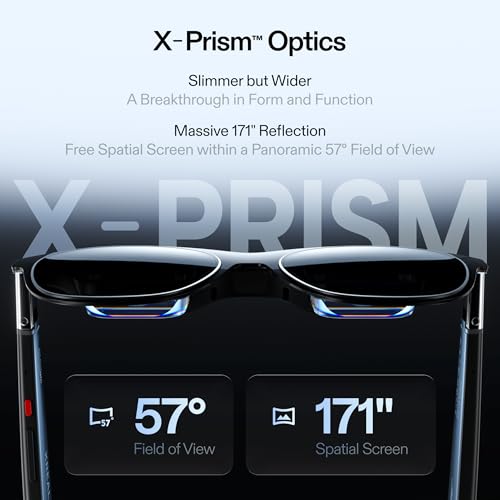
The XREAL One Pro AR Glasses represent the brand’s flagship spatial computing architecture, engineered around the proprietary X1 spatial computing chip and the fourth-generation Optic Engine with X-Prism optics. The integrated X1 silicon handles spatial orientation directly on the glasses, achieving a motion-to-photon latency of just 3 milliseconds for native 3DoF tracking. This onboard processing eliminates visual lag and jitter during rapid head movement without burdening the host device’s processor. Visually, the system pairs Sony 0.55-inch Micro-OLED panels with a class-leading 57-degree field of view, projecting a virtual canvas measured at 171 inches with a 120Hz refresh rate. The optical engine allows users to maintain clear visibility of physical surroundings while rendering high-contrast digital imagery, accompanied by an acoustic chamber professionally tuned by Bose engineers.
Hardware adjustability is central to the One Pro design. The chassis implements a dual interpupillary distance structure spanning two sizing brackets, with Medium fitting 57 to 66 millimeters and Large accommodating 66 to 75 millimeters to serve broad demographic requirements. Ergonomic elements include three-stage adjustable temple arms, three sizes of zero-pressure nose pads, and flexible spring hinges. For input and feature controls, physical buttons manage quick adjustments, including a one-touch switch that activates REAL 3D rendering to transform standard content into stereoscopic depth. Host connectivity relies on DisplayPort alternate mode over USB-C, interfacing natively with iPhone 16 and 15 series phones, DisplayPort-capable Android devices, the Steam Deck, ROG Ally, MacBooks, and Windows laptops. When paired with the optional XREAL Eye accessory, the optical platform expands from rotational 3DoF orientation to full 6DoF positional anchoring, allowing users to physically walk around pinned virtual monitors.
This model is purpose-built for visual fidelity enthusiasts and high-framerate mobile gamers who want the widest field of view XREAL manufactures alongside low-latency spatial orientation. It provides a noticeable upgrade in peripheral coverage compared to narrower wearable displays. However, shoppers seeking a dedicated productivity monitor with extra vertical pixel density for coding or spreadsheet analysis will find the 16:10 panel on the 1S better matched to their workflows.
XREAL One Pro AR Glasses for Precision Fit and Gesture Control


XREAL One Pro AR Glasses with X1 Chip, 171" 4 photos from the Amazon listing
This specific iteration of the XREAL One Pro AR Glasses packages the flagship X-Prism optical system specifically tailored for users within the Medium interpupillary distance range of 57 to 66 millimeters. Aligning optical centers with physical eye spacing is critical in augmented reality to prevent edge softness and chromatic aberration, making this dedicated size option essential for optical alignment. Like its sibling configuration, this model features the proprietary X1 spatial processing chip, delivering native 3DoF head tracking with 3-millisecond motion-to-photon latency, a 120Hz refresh rate, and Sony 0.55-inch Micro-OLED panels running at a resolution of 1920 x 1080. Unlike non-display wearable devices like the standard meta smart glass frames that focus on capture and voice tasks, the One Pro concentrates exclusively on high-performance visual display output.
The listing specifications highlight both button controls and gesture recognition input methods, broadening interaction options beyond mechanical chassis switches. Connectivity profiles include USB-C video integration supported by onboard Bluetooth and Wi-Fi communication hardware, facilitating streamlined communication with companion operating systems across iOS, Android, PC, Mac, and portable gaming platforms. Content viewing benefits from the 57-degree field of view, projecting an expansive 171-inch virtual screen that preserves ambient environment visibility. The integrated REAL 3D functionality allows immediate dimensional conversion for photos, movies, and supported gaming applications with a single control toggle.
This variant suits demanding mobile users with average interpupillary spacing who prioritize low motion blur, high refresh rates, and interactive control flexibility across handheld consoles and laptops. Shoppers whose measured interpupillary distance exceeds 66 millimeters should avoid this specific medium configuration to prevent visual fatigue, stepping instead into the Large chassis option or exploring alternative display formats.
XREAL 1S AR Glasses for Ultrawide Productivity and High-Resolution Gaming


XREAL 1S AR Glasses 4 photos from the Amazon listing
Best for: Multi-monitor productivity and 16:10 gaming
Pros
- 1920 x 1200 resolution
- Ultrawide 32:9 workspace modes
- 120Hz refresh in 3DoF
- TÜV eye comfort certified
Cons
- Narrower 52-degree FOV
- No standalone wireless streaming
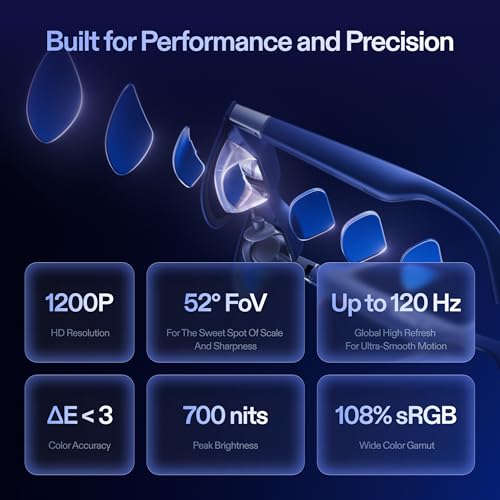
The XREAL 1S AR Glasses distinguish themselves within the catalog by targeting hybrid desktop productivity and multi-display management alongside entertainment. Outfitted with an upgraded optical engine rendering at 1920 x 1200 resolution, the 1S delivers a 16:10 aspect ratio that provides critical vertical screen real estate for technical workflows. Processing is driven by the custom X1 chip, executing native 3DoF tracking at 120Hz with 3-millisecond motion-to-photon response times, alongside a 90Hz global refresh rate designed to eradicate display flicker. The optical path produces a virtual screen perceived up to 500 inches across a 52-degree field of view. When evaluating a comprehensive rokid ai glasses with display comparison or surveying the AR monitor market, the 1S stands out through its versatile spatial canvas modes.
Software versatility on the 1S includes multiple display topologies accessible without complex driver configurations over USB-C DisplayPort. Users can toggle between 0DoF follow mode, 3DoF anchor mode, Real 3D depth mode, Side-View monitoring, and expansive Ultrawide configurations supporting both 21:9 and 32:9 desktop panoramic ratios. Internal hardware utilizes accelerometer and gyroscope sensor arrays to maintain rigid anchor points in physical space, with optional 6DoF positional tracking unlocked via the XREAL Eye. Visual health is reinforced through TÜV Rheinland certifications spanning low blue light emission, flicker-free operation, motion-blur-free 3DoF rendering, and 100 percent ultraviolet light protection. Audio reproduction is managed by custom AR-grade drivers mounted inside an acoustic chamber co-developed with Bose.
The 1S is the ideal recommendation for power users running multi-window productivity setups, terminal windows, and widescreen gaming titles where vertical pixel density and ultrawide aspect ratios are paramount. While its 52-degree field of view is slightly narrower than the 57-degree optic found on the One Pro line, the increased 1200p resolution and dedicated ultrawide canvas modes make it a superior tool for workstation replacement.
XREAL xbx a01+ AR Glasses for Ultralight Media Viewing


XREAL xbx a01+ AR Glasses 4 photos from the Amazon listing
Best for: Commuters wanting an ultralight portable display
Pros
- Ultralight 62g chassis
- 1600 nits peak brightness
- Pixelworks HDR processor
- Four directional audio modes
Cons
- No 3DoF spatial anchoring
- Display refresh rate not listed
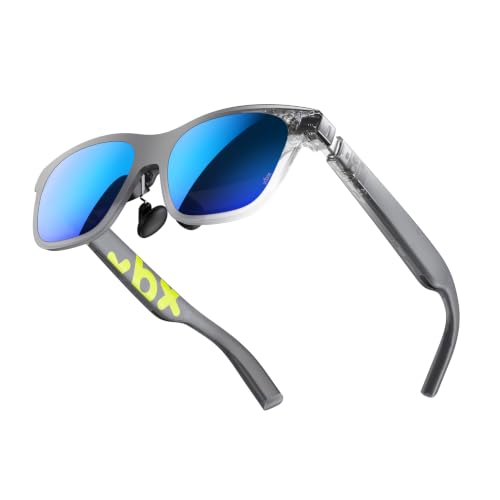
The XREAL xbx a01+ AR Glasses take a radically minimalist design approach, stripping out spatial tracking processors to deliver an ultralight 62-gram form factor focused on portable big-screen consumption. Styled like standard sunglasses with a semi-transparent chassis and blue finish, the a01+ eliminates internal batteries, drawing minimal power directly through a single USB-C DisplayPort Direct connection. While newer consumer frames like the new meta glasses focus on wireless social feeds and artificial intelligence capture, the a01+ functions strictly as a plug-and-play wearable monitor, presenting a 147-inch virtual display directly in front of the viewer without requiring anchor setup, app calibration, or drift resets.
Despite its lightweight frame, the optical core integrates dual Full HD 1080p micro-OLED panels backed by a dedicated Pixelworks display processor. This dedicated image chip executes real-time SDR-to-HDR conversion and native HDR10 processing, outputting luminance levels up to 1600 nits across 14 distinct brightness steps. The display pipeline features 3840Hz high-frequency dimming to eliminate eye strain, a relaxed 4-meter focal distance, and TÜV Eye Comfort 5.0 certification. Integrated audio relies on open-ear directional speakers featuring four user-selectable modes: Surround, Whisper, Cinema, and Standard. For ergonomics, the frame includes flexible temple pieces, button and microphone interfaces, and three nose-pad sizes to maintain comfort during extended flights or when resting in bed.
This model is the premier choice for frequent travelers, commuters, and bed-stand viewers who demand the lowest physical weight on their nose bridge and zero setup friction with smartphones, iPads, or gaming consoles. However, because the a01+ operates exclusively in a smooth stabilized follow orientation without spatial anchoring silicon, users who need pinned spatial displays or multi-monitor 3DoF desktops must look to the One Pro or 1S models.
How to Choose the Right XREAL Smart Glasses
Selecting the ideal model from the XREAL smart glasses lineup requires evaluating your primary operational use case, required tracking degrees of freedom, panel resolution, and physical ergonomic requirements. The brand structures its hardware across distinct performance categories rather than minor cosmetic variations, making technical alignment straightforward when analyzing core specifications.
- Field of View and Optical Engine: Field of view determines visual immersion and angular coverage. The XREAL One Pro models feature the widest visual window at 57 degrees powered by the Optic Engine 4.0 X-Prism system, projecting a 171-inch spatial screen. In contrast, the XREAL 1S utilizes a 52-degree field of view to balance optical efficiency with its larger 500-inch virtual perception, while the compact optical system in the xbx a01+ generates a 147-inch virtual canvas. Gamers prioritizing maximum peripheral coverage should focus on the 57-degree One Pro variants.
- Display Resolution and Aspect Ratios: Standard high-definition 1920 x 1080 resolution is standard across the One Pro series and the dual-panel xbx a01+, providing native 16:9 widescreen output optimized for commercial movies and mainstream console gaming. Conversely, the XREAL 1S steps up to a 1920 x 1200 panel delivering a 16:10 aspect ratio. Those extra 120 vertical pixels provide significant utility for text legibility, document reading, and rendering panoramic 21:9 or 32:9 virtual monitor layouts.
- Spatial Tracking Degrees of Freedom: Spatial freedom dictates how the projected monitor behaves when you move your head. Both the One Pro series and the 1S feature the custom X1 processor, delivering native 3DoF tracking that anchors the screen in virtual space with ultra-low 3-millisecond motion-to-photon latency. Both models can also achieve 6DoF positional tracking when paired with the optional XREAL Eye sensor. The xbx a01+ omits spatial tracking silicon entirely, using a stabilized follow mode where the display stays centered in your view, making it ideal for in-transit viewing where anchor points can be disrupted by vehicle motion.
- Chassis Weight and Physical Sizing: Weight and interpupillary distance dictate comfort during multi-hour sessions. The xbx a01+ is the lightest model in the lineup at just 62 grams, minimizing nose-bridge pressure for travel. The One Pro series incorporates sophisticated physical adjustment, providing dedicated chassis sizes for Medium (57–66mm IPD) and Large (66–75mm IPD) facial structures, complete with three-stage temple arms and multiple nose pad options. Getting an accurate measurement of your interpupillary distance is critical before choosing a One Pro SKU.
- Host Device Compatibility: Across the entire family, connectivity relies on USB-C carrying DisplayPort alternate mode signals. The glasses natively interface with iPhone 15, 16, and 17 series phones, DP-capable Android devices, MacBooks, Windows PCs, the Steam Deck, and the ROG Ally. Handheld consoles like the Nintendo Switch or older Apple hardware running Lightning ports require dedicated adapters to output video. None of the models carry internal batteries, drawing their operating power directly from the connected host device.
FAQ
What is the difference between 3DoF and 6DoF tracking on XREAL glasses?
Three degrees of freedom (3DoF) tracking detects rotational head movements—pitch, yaw, and roll. In native 3DoF mode, powered by the onboard X1 processor on models like the One Pro and 1S, the virtual monitor stays anchored in a fixed orientation in front of you as you turn your head, but moving physically forward, backward, or sideways moves the anchor point with you. Six degrees of freedom (6DoF) adds translational positional tracking along the X, Y, and Z axes. When paired with the optional XREAL Eye camera module, the One Pro and 1S allow you to lean into virtual displays, stand up, or walk around the room while the virtual display remains anchored to a fixed physical coordinate.
Which XREAL glasses offer the widest field of view?
The XREAL One Pro AR Glasses offer the widest field of view in the current product catalog at 57 degrees. Powered by XREAL’s Optic Engine 4.0 and X-Prism optical architecture, this 57-degree window projects a 171-inch virtual screen with Sony 0.55-inch Micro-OLED panels. By comparison, the XREAL 1S features a 52-degree field of view, trading slight peripheral expansion for a taller 16:10 aspect ratio and 1920 x 1200 resolution.
How does the XREAL 1S compare to the XREAL One Pro for desktop productivity?
The XREAL 1S holds a distinct advantage for office and multi-tasking workflows due to its 1920 x 1200 resolution panel and dedicated productivity viewing modes. The 16:10 aspect ratio renders additional vertical text lines, code blocks, and interface panels compared to the standard 1080p resolution on the One Pro. Furthermore, the 1S natively supports Ultrawide desktop modes configured in 21:9 and 32:9 ratios alongside Side-View positioning, making it exceptionally well suited for multi-window workstations.
Do XREAL smart glasses have internal batteries that require charging?
None of the four XREAL glasses covered in this lineup feature built-in batteries. Instead, they function as tethered micro-OLED monitors powered directly over a single USB-C cable via DisplayPort alternate mode from your host device, such as a smartphone, gaming handheld, tablet, or laptop. This architectural decision keeps the frames significantly lighter—down to 62 grams on the xbx a01+—and eliminates the need to manage internal battery degradation or recharging cycles.
What is REAL 3D mode and which models support it?
REAL 3D is XREAL’s hardware-level spatial processing mode that instantly converts standard content, including 2D movies, mobile games, and photos, into stereoscopic 3D depth with the flip of a single physical switch. This feature is integrated natively into the One series glasses, including both XREAL One Pro models, as well as the XREAL 1S. The lightweight xbx a01+ does not feature the dedicated 3D conversion switch, focusing instead on HDR10 video enhancement through its Pixelworks display engine.