As Amazon Associates, we earn from qualifying purchases. This means we may receive a small commission at no extra cost to you if you click through and make a purchase.
Pioneer has earned a commanding position in acoustic transducer engineering by prioritizing electromechanical efficiency, structural cone rigidity, and low-distortion motor assemblies across all tiers of bass reproduction. Studio engineers, mobile technicians, and audiophiles regularly incorporate Pioneer low-frequency hardware to resolve the structural bottom-end limits of nearfield monitors and full-range speakers. Assessing a pioneer studio subwoofer deployment requires analyzing how proprietary cone formulations, such as injection-molded polypropylene and specialized cellulose fiber composites, manage dynamic cone break-up and phase coherence under high thermal loads.
While every driver examined here reflects Pioneer’s core engineering discipline, their operational implementations diverge fundamentally: two units function as fully integrated active subwoofers with onboard Class-D amplification and acoustic suspension enclosures, while the third is a discrete component driver engineered for custom loading and high-current external amplification. Conducting a detailed pioneer studio subwoofer comparison demonstrates how spatial constraints, electrical headroom, and acoustic target curves dictate the ideal hardware selection.
Pioneer Subwoofers Compared
| Model | Driver Dimensions | Amplification Topology | Peak Power Handling | Sensitivity Benchmark |
|---|---|---|---|---|
| Pioneer TS-WX140DA Slim Compact Powered 8″ | 8 inches (20 cm) | Integrated Class-D | 170 Watts | 95 dB / 100 dB / 98 dB |
| PIONEER TS-WX1210A Powered 12″ Subwoofer | 12 inches | Integrated Class-D (300W RMS) | 1200 Watts | 114 dB |
| PIONEER A-Series TS-A120D4 12″ Subwoofer 1500W | 12 inches | External Outboard Required | 1500 Watts | 77 dB |
Table from this guide — scroll sideways for the remaining columns.
Pioneer TS-WX140DA Slim Compact Powered 8″ for Space-Constrained Deployments


Pioneer TS-WX140DA Slim Compact Powered 8" 4 photos from the Amazon listing
Best for: Space-restricted studios and electric vehicle installations
Pros
- Integrated high-efficiency Class-D amplifier
- Ultra-low 4.3 amp current consumption
- Three selectable digital bass listening modes
Cons
- Limited 170-watt peak power ceiling
- Smaller driver cone displacement
The Pioneer TS-WX140DA Slim Compact Powered 8″ is an ultra-low-profile active acoustic system engineered to deliver low-end reinforcement in spaces where cubic volume is severely restricted. Built around an 8-inch by 5-1/4-inch transducer housed within a sealed Injection-Molded Polypropylene (IMPP) enclosure, this self-powered system leverages a built-in Class-D monoblock amplifier producing a peak power rating of 170 Watts. The IMPP composite cone structure provides the exact physical damping required to resist high excursion distortion, maintaining tight transient tracking through rapid bass passages. Measuring just 27 centimeters in total outer frame dimension, this surface-mount platform is optimized for placement under seating, behind studio desk partitions, or inside mobile monitoring workstations. Audio technicians comparing this footprint to larger alternatives like a jbl subwoofer 10 inch will recognize how Pioneer prioritizes zero cabinet footprint over raw internal displacement.
From an electrical perspective, the pioneer class d subwoofer specs integrated into this system represent extreme power optimization. The high-efficiency amplifier operates with an ultra-low current demand capped at 4.3 amperes, allowing safe deployment within electric vehicle auxiliary circuits and low-draw electrical loops without causing thermal runaway or voltage sags. Pioneer incorporates three selectable digital listening modes—Deep, Dynamic, and Natural—directly accessible via the included wired remote controller. Each operational preset shifts the electroacoustic curve: Deep mode establishes a 95 dB sensitivity profile tuned for acoustic richness across jazz and orchestral recordings, Dynamic mode elevates output to 100 dB for punchy percussive attack, and Natural mode settles at 98 dB for balanced flat-response reference listening. The unit also includes onboard bass boost adjustment for instantaneous low-frequency elevation.
This compact powered unit suits monitoring professionals, mobile audio engineers, and tracking specialists who require accurate baseline reference monitoring without building custom enclosures. Its integrated amplification, minimal electrical signature, and compact profile resolve space-related integration challenges effortlessly. However, listeners seeking high sound pressure output or sub-bass reproduction that shakes physical boundaries will find this unit yields to the larger cones, substantial voice coils, and higher dynamic output found in Pioneer’s 12-inch active and passive systems.
PIONEER TS-WX1210A Powered 12″ Subwoofer for High-Output Sound Pressure


PIONEER TS-WX1210A Powered 12" Subwoofer 4 photos from the Amazon listing
Best for: High-SPL monitoring in larger listening rooms
Pros
- Built-in 300-watt Class-D monoblock amp
- High 114 dB sensitivity rating
- Variable low-pass filter and phase control
Cons
- Substantial floor-standing footprint
- Fixed sealed enclosure architecture
The PIONEER TS-WX1210A Powered 12″ Subwoofer moves into full-scale low-frequency reproduction, utilizing a 12-inch active driver housed in an engineered acoustic enclosure. Designed to generate serious acoustic pressure levels and extended dynamic bass, this floor-standing platform couples a large-diameter cone to a dedicated high-bandwidth Class-D amplifier delivering 300 Watts of continuous RMS power, with maximum handling specified at 1200 Watts. The sealed cabinet structure is constructed from a hybrid blend of cellulose fiber and urethane, configured specifically to eliminate internal standing wave reflections and eliminate mechanical panel resonance during sustained low-frequency output. When contrasting this integrated system against separate component alternatives like a planet audio 12 subwoofer, the TS-WX1210A provides a fully tuned acoustic system where the amplifier gain staging matches the driver excursion limits right out of the box.
Acoustic performance is reinforced by an extraordinary 114 dB sensitivity rating, ensuring that incoming signals translate into commanding bass depth with minimal total harmonic distortion. For precise acoustic alignment within complex audio systems, the TS-WX1210A features a suite of integrated analog frequency controls. The backplane architecture incorporates an adjustable low-pass filter, phase switching (0 to 180 degrees) to eradicate destructive acoustic cancellation against main studio monitors, and a sweepable variable bass boost delivering 0 to +12 dB of gain between 40 Hz and 100 Hz. These acoustic calibration parameters enable critical listeners to contour room boundaries, align crossover slopes, and eliminate muddy mid-bass accumulation from the listening sweet spot.
This powered enclosure caters directly to sound engineers, electronic musicians, and mobile producers who demand high decibel capability and authoritative dynamic punch without the technical burden of outboard power stages and raw cabinet design. It provides a robust, pre-engineered enclosure that integrates smoothly via wired remote operation. Conversely, users who require specialized ported enclosures, extreme multi-kilowatt power handling, or custom electrical impedance configurations will outgrow this sealed platform in favor of Pioneer’s component A-Series platform.
PIONEER A-Series TS-A120D4 12″ Subwoofer 1500W for Custom Component Systems

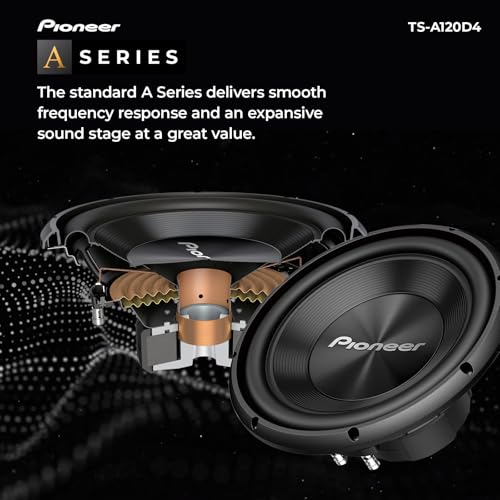


PIONEER A-Series TS-A120D4 12" Subwoofer 1500W 4 photos from the Amazon listing
Best for: Custom builders requiring discrete dual voice coils
Pros
- Dual 4-ohm voice coil flexibility
- Broad 20 Hz to 2.3 kHz frequency response
- Robust 500W RMS continuous power handling
Cons
- Requires external enclosure and amplifier
- Low 77 dB component sensitivity rating
The PIONEER A-Series TS-A120D4 12″ Subwoofer 1500W represents Pioneer’s discrete component approach to low-end reproduction, stripping away integrated amplifiers to focus entirely on raw transducer displacement and power handling. Featuring an oversized 12-inch cone assembly, this passive sub-bass driver is engineered for extreme duty, boasting a maximum power ceiling of 1,500 Watts alongside a continuous power handling capability of 500 Watts RMS. Built with a high-durability butyl rubber surround, the TS-A120D4 maintains strict mechanical cone linearity even under high-excursion demands, ensuring rapid transient response and minimizing dynamic compression during demanding low-end sequences. System designers reviewing multi-driver monitoring arrays alongside models like a polk audio subwoofer will note that Pioneer’s component platform prioritizes massive continuous wattage and complete enclosure customization.
Electrically, this driver is defined by its pioneer dual voice coil subwoofer architecture, utilizing two independent 4-ohm voice coils wound over heat-resistant formers. This dual-winding architecture gives audio engineers crucial configuration flexibility, allowing the driver to be wired in a 2-ohm parallel configuration to draw maximum power from high-current monoblock amplifiers, or an 8-ohm series configuration to stabilize multi-subwoofer arrays. The driver covers a remarkably broad frequency response range spanning from 20 Hz up to 2.3 kHz, delivering physical low-frequency extension while extending high enough into the lower-mid spectrum to permit seamless, gradual crossover slopes. Its measured sensitivity rating of 77 dB reflects the robust voice coil mass and heavy cone construction necessary to manage massive external power inputs without mechanical fatigue.
The TS-A120D4 is built specifically for advanced system integrators, studio technicians, and car audio competitors who possess dedicated outboard amplification, precision DSP crossovers, and custom enclosure fabrication facilities. It gives the user complete control over air volume, port tuning frequencies, and amplifier damping factors. Those seeking an immediate out-of-the-box solution with factory-matched amplification and compact enclosures, however, will be much better served by Pioneer’s integrated TS-WX active series.
How to Choose the Right Pioneer Subwoofers
Selecting the appropriate Pioneer transducer begins by resolving the fundamental architectural trade-offs between integrated active enclosures and raw component drivers. Reviewing pioneer active vs passive subwoofer dynamics clarifies that self-powered units like the TS-WX140DA and TS-WX1210A provide factory-matched Class-D amplification, internal low-pass filters, and pre-calculated enclosure volumes that eliminate acoustic guesswork. These complete units are ideal when workflow efficiency, rapid physical deployment, and integrated thermal protection are primary objectives. Conversely, component drivers like the TS-A120D4 provide modular independence, allowing engineers to drive the dual voice coils with high-damping studio amplifiers and tune custom acoustic baffles to specific room resonance modes.
Available installation space and enclosure volume form the second primary decision point. When evaluating which pioneer studio subwoofer to buy, physical footprint must be weighed against low-frequency displacement. The compact TS-WX140DA measures roughly 27 cm and employs surface-mount hardware to slip into under-seat voids or compact monitoring stations where traditional rectangular cabinets cannot fit. In contrast, the TS-WX1210A requires a dedicated floor footprint to accommodate its 12-inch cellulose fiber sealed cabinet, rewarding the larger space requirement with substantially greater internal air suspension and acoustic volume output. Measure your target listening space to verify whether a low-profile active enclosure or a high-volume sealed cabinet aligns with your physical boundaries.
Electrical consumption and amplifier matching represent the third critical criteria. Integrated powered subwoofers simplify power delivery because their internal amplifiers are calibrated directly to driver voice coil impedance. The TS-WX140DA draws a maximum of only 4.3 amperes, safeguarding delicate 12V circuits and electric vehicle power systems against overload. On the other hand, running the TS-A120D4 requires an external amplifier capable of delivering up to 500 Watts continuous RMS across either a 2-ohm parallel or 8-ohm series load. Selecting an external amplifier with clean continuous wattage prevents output clipping, protecting the high-excursion butyl rubber motor structure from thermal destruction.
Finally, evaluate acoustic bandwidth and equalization requirements for your listening environment. The TS-A120D4 lists an expansive frequency response reaching from a true sub-audible 20 Hz threshold up to 2.3 kHz, providing broad crossover latitude for complex acoustic tuning. For powered solutions, examining pioneer compact powered sub frequency response flexibility means utilizing digital processing controls: the TS-WX140DA uses its Deep, Dynamic, and Natural presets to shape response contours instantly, while the TS-WX1210A relies on sweepable 40 Hz to 100 Hz bass boost adjustments and variable low-pass filters to blend seamlessly with primary acoustic monitors.
FAQ
What is the difference between Pioneer active and component subwoofers?
Active Pioneer subwoofers, including the TS-WX140DA and TS-WX1210A, incorporate the driver cone, the acoustic cabinet, and a dedicated Class-D power amplifier within a single complete unit. They require only line-level or speaker-level audio input and basic electrical power to operate immediately. Component subwoofers, like the TS-A120D4, consist solely of the unpowered speaker driver, requiring the user to build or purchase a separate sealed or vented enclosure and provide external amplification matched to the driver’s impedance and continuous power rating.
How do the selectable listening modes function on the Pioneer TS-WX140DA?
The Pioneer TS-WX140DA provides three digital equalization curves controlled through its wired remote: Deep, Dynamic, and Natural. Deep mode optimizes low-end extension for smooth genres like jazz and classical, operating at a 95 dB sensitivity rating. Dynamic mode emphasizes punchy, resonant bass frequencies up to a 100 dB sensitivity rating for rock and electronic tracks. Natural mode produces a balanced, flat frequency response at 98 dB sensitivity designed for neutral reference playback.
What acoustic advantage does a dual voice coil subwoofer offer?
A dual voice coil driver, such as the PIONEER A-Series TS-A120D4, features two distinct 4-ohm voice coil windings mounted on a single former. This structural design enables flexible electrical wiring configurations: the coils can be wired in parallel to present a 2-ohm load to extract maximum wattage from modern monoblock amplifiers, or wired in series to create an 8-ohm load. This versatility simplifies impedance matching across multi-subwoofer monitoring setups.
Can the compact Pioneer TS-WX140DA be deployed in electric vehicles safely?
Yes, the TS-WX140DA is explicitly optimized for electric vehicle deployment. Its integrated Class-D amplifier is engineered for extreme electrical efficiency, capping maximum current consumption at 4.3 amperes. This minimal electrical load prevents deep battery drain and ensures that adding dynamic low-frequency audio reproduction will not adversely impact vehicle operating range or compromise auxiliary electrical systems.
Why does the component TS-A120D4 have a lower sensitivity rating than the powered models?
The TS-A120D4 lists a sensitivity rating of 77 dB because it is a raw component driver built with heavy-duty voice coils, a massive motor structure, and a robust butyl rubber surround designed to absorb up to 500 Watts continuous RMS and 1,500 Watts peak power. In contrast, powered models like the TS-WX1210A report high system sensitivity ratings (114 dB) reflecting the combined acoustic output of the matched internal Class-D amplifier operating inside a rigid, sealed enclosure.


