As Amazon Associates, we earn from qualifying purchases. This means we may receive a small commission at no extra cost to you if you click through and make a purchase.
Roku has established a dominant footprint in the home entertainment sector by pairing a clean, responsive application ecosystem with hardware optimized for diverse audio-visual demands. Whether deploying low-profile sticks engineered for discrete installations or dedicated set-top enclosures engineered for complex home theater routing, the manufacturer emphasizes broad platform access alongside support for modern streaming compression standards. Selecting the appropriate player requires evaluating specific system architectures, including local memory capacity, Wi-Fi frequency capabilities, video decoding profiles, and physical interface standards.
While all six hardware options share Roku OS navigation and unified voice remote controls, they diverge sharply in their core media decoders, network interfaces ranging from single-antenna Wi-Fi to Wi-Fi 6 and physical Ethernet, television power delivery options, and dynamic metadata support spanning basic 1080p SDR through Dolby Vision and HDR10+.
Roku Streaming Devices Compared
| Model | Form Factor | Max Video Resolution | Video Codecs & HDR | Networking & I/O |
|---|---|---|---|---|
| Roku Streaming Stick 4K with Voice | TV Stick | 4K UHD (up to 2160p at 60fps) | H.264/AVC, H.265/HEVC, AV1, VP9, HDR10/10+, Dolby Vision | Wi-Fi (Long-range receiver), HDMI |
| Roku Ultra | TV Box | 4K UHD (3840 x 2160) | H.264/AVC, H.265/HEVC, AV1, VP9, HDR10/10+, Dolby Vision | Wi-Fi 6, Ethernet, Bluetooth, USB, HDMI |
| Roku Streaming Stick HD with Voice | TV Stick | 1080p Full HD (1920 x 1080) | H.264/AVC, AV1 | Wi-Fi, Bluetooth, HDMI |
| Roku Streaming Stick Plus with Voice | TV Stick | 4K UHD | H.264/AVC, H.265/HEVC, AV1, VP9, HDR10/10+ | Wi-Fi, Bluetooth, HDMI |
| Roku Ultra LT Streaming Device 4K | TV Box | 4K UHD | H.265/HEVC, Dolby Vision | Dual-Band Wi-Fi, HDMI |
| Roku Ultra LT | TV Box | 4K UHD (up to 3840 x 2160), 720p | H.264, H.265/HEVC, VP9, Dolby Digital, HDR, Dolby Vision | Wi-Fi, Ethernet, Bluetooth, HDMI |
Table from this guide — scroll sideways for the remaining columns.
Roku Streaming Stick 4K with Voice for Discrete Installations
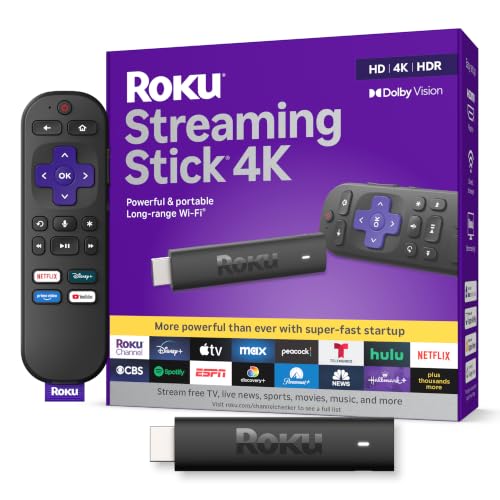


Roku Streaming Stick 4K with Voice 4 photos from the Amazon listing

Best for: Minimalist wall-mounted 4K televisions
Pros
- Powers directly from TV
- HDR10+ and AV1 decoding
- Bluetooth private audio
Cons
- No Dolby Vision support
- No wired LAN connection

Best for: Secondary 1080p bedroom or office screens
Pros
- TV-powered USB operation
- AV1 codec efficiency
- Bluetooth headphone listening
Cons
- Caps at 1080p resolution
- No HDR support
Best for: Frequent travelers and hidden HDMI setups
Pros
- AV1 and Dolby Vision
- Long-range Wi-Fi receiver
- 16 GB onboard storage
Cons
- No wired Ethernet port
- Lacks rechargeable remote
The Roku Streaming Stick 4K with Voice represents a compact approach to high-throughput streaming by nesting an advanced video pipeline directly behind a display. Engineered to prevent physical obstruction of neighboring HDMI interfaces on crowded back panels, this TV stick form factor pairs a compact chassis with an integrated long-range Wi-Fi receiver embedded in the cabling. Internally, the hardware carries 1 GB of RAM alongside 16 GB of memory storage capacity, allowing it to maintain rapid cache retention across demanding applications like Netflix, Prime Video, Hulu, and Vudu without constantly dumping system states during navigation.
From an imaging and decoding standpoint, this unit handles 4K UHD video output at up to 2160p running at 60 frames per second. Its processing profile covers legacy H.264/AVC, efficient H.265/HEVC, Google-backed VP9, and royalty-free AV1 streams, ensuring high compression efficiency and lower bandwidth usage on modern networks. Content mastery is reinforced through dynamic metadata pipelines supporting both HDR10/10+ and Dolby Vision. This enables frame-by-frame color and luminance tone mapping on compatible televisions, making it a compelling baseline for users evaluating a 65 in Roku TV or standalone external monitor setups.
This model is built for viewers who demand flagship picture profiles without adding shelf clutter or exposed power blocks. The bundled remote incorporates voice search and direct television power and volume control, streamlining daily use. However, because it relies completely on wireless connectivity and omits physical peripheral inputs, viewers requiring hardwired networking or external storage expansion will find its physical footprint too constrained for stationary home theater racks.
Roku Ultra for Flagship Performance


Roku Ultra 4 photos from the Amazon listing
Best for: High-end home theaters requiring maximum throughput
Pros
- Wi-Fi 6 and Ethernet
- Rechargeable Voice Remote Pro
- Dolby Atmos and Vision
Cons
- Larger set-top footprint
- Requires dedicated AC power
The Roku Ultra serves as the brand’s premier hardware package, built within a standalone TV box chassis to house robust processing components and expanded physical interfaces. Advertised with an interface that runs 30 percent faster than alternative hardware options from the manufacturer, it launches resource-intensive platforms such as Disney+, Apple TV+, and Netflix with virtually no buffer pause. The device integrates modern Wi-Fi 6 wireless connectivity alongside a dedicated 10/100 Ethernet port, Bluetooth functionality, and an external USB port for direct local media playback.
Evaluating the Google TV streaming devices landscape reveals that local audio and video pass-through capabilities dictate premium status, and the Roku Ultra specs meet these criteria comprehensively. The video processor handles 3840 x 2160 resolution rendering across an exhaustive codec array: H.264/AVC, H.265/HEVC, AV1, VP9, HDR10+, and Dolby Vision. On the acoustic side, the Ultra incorporates immersive Dolby Atmos decoding and passthrough, providing spatial multi-channel audio tracks to compatible external soundbars and AV receivers. It also features the rechargeable Roku Voice Remote Pro, which provides hands-free voice commands via couch-range microphones, backlit keys for dark viewing environments, and an integrated lost-remote chime.
The Roku Ultra is tailored specifically for primary home theater spaces and living rooms where display panels demand uncompromised data throughput. When performing a technical roku ultra vs streaming stick 4k evaluation, the Ultra stands out by providing wired stability, USB connectivity, and faster processing overhead. Conversely, those outfitting guest rooms or compact wall-mounted displays will find the external tabletop enclosure and wall power brick bulkier than necessary.
Roku Streaming Stick HD with Voice for Secondary Displays


Roku Streaming Stick HD with Voice Remote 4 photos from the Amazon listing
The Roku Streaming Stick HD with Voice delivers streamlined media playback focused entirely on standard high-definition panels. Weighing just 60 grams, this compact stick slips directly into an HDMI port and requires no external AC wall adapter when connected to a standard powered USB port on the host television. This self-contained power topology eliminates hanging cables and wall clutter, making it optimal for kitchens, dorms, or secondary guest rooms.
Despite its focus on standard 1080p resolution (1920×1080 output), Roku has maintained modern efficiency by integrating an AV1 hardware decoder alongside standard H.264/AVC playback. While it omits 4K rendering and wide color gamut HDR capabilities, the hardware supports extensive smart home platforms, including Apple AirPlay, HomeKit, Google Home, and Alexa integration. The included remote carries full television power and volume synchronization alongside Roku’s Bluetooth Headphone Mode, which routes streaming audio straight to personal wireless headphones via the mobile companion utility.
This stick is targeted squarely at owners of legacy 1080p televisions or smaller secondary screens who want modern app performance and simplified remote pairing. It provides an agile navigation interface without the redundant costs associated with 4K decoding pipelines. Nevertheless, users looking for high dynamic range mastering or multi-channel spatial sound stages will immediately reach the limitations of this model’s video processor.
Roku Streaming Stick Plus with Voice for Out-of-Sight 4K


Roku Streaming Stick Plus with Voice Remote - 4K 4 photos from the Amazon listing
Bridging minimalist installations with higher pixel densities, the Roku Streaming Stick Plus with Voice weighs 80 grams and operates cleanly behind flat-panel installations. Like its HD sibling, this unit is engineered to pull operational energy straight from a display’s integrated USB port, eliminating the need to drop cables down to an AC wall socket. Its slender form factor ensures neighboring HDMI, optical, or auxiliary ports remain uninhibited for game consoles or audio components.
On the specification front, the Streaming Stick Plus upgrades display output to full 4K UHD resolutions while maintaining broad stream compatibility through H.264/AVC, H.265/HEVC, VP9, and AV1 decoding. For high-contrast viewing, the processor incorporates static HDR10 and dynamic HDR10+ color pipelines, delivering extended color gamuts on properly configured HDR panels. Smart home integration mirrors the flagship line, pairing effortlessly with Alexa, Google Home, Apple AirPlay, and HomeKit environments for centralized smart ecosystem operation.
This model is the ideal match for wall-mounted 4K televisions where dangling power cables are unacceptable, such as minimalist living rooms or commercial office monitors. While it matches the baseline resolution of the Streaming Stick 4K, it lacks Dolby Vision dynamic profile licensing. For home cinema enthusiasts whose content libraries skew heavily toward Dolby Vision mastering, stepping sideways to the Dolby-enabled Stick 4K or upwards to the Ultra is the appropriate technical path.
Roku Ultra LT Streaming Device 4K for Desktop Setup Efficiency

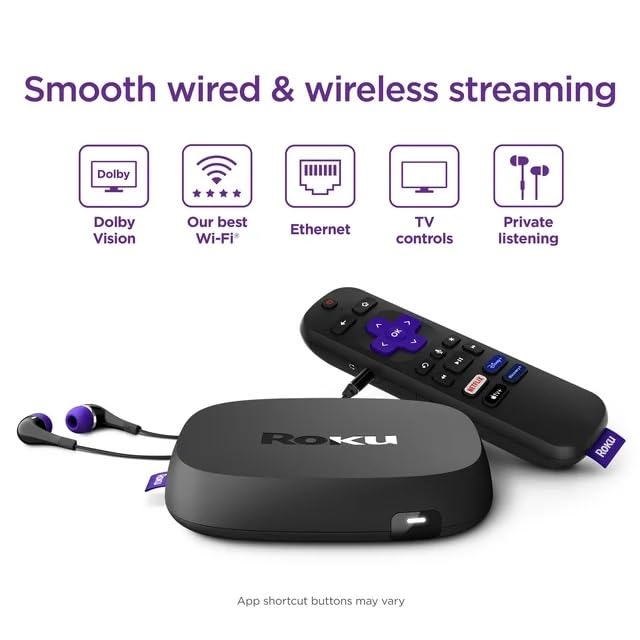
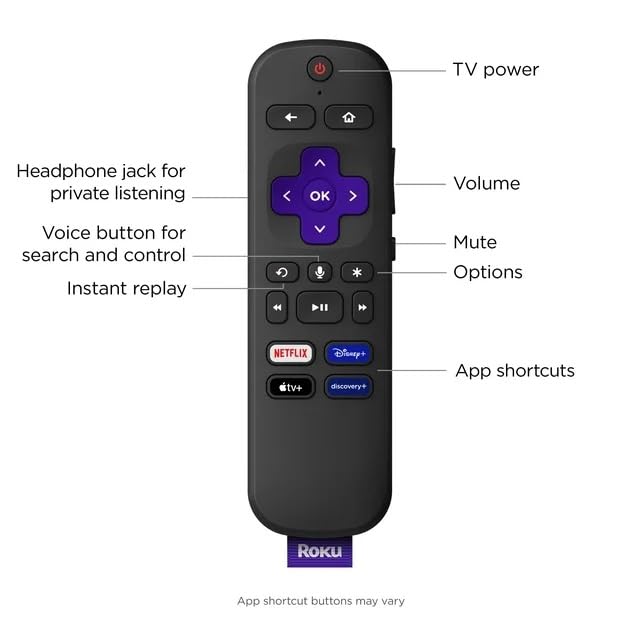

Roku Ultra LT Streaming Device 4K/HDR/Dolby Vision/Dual-Band Wi-Fi with 4 photos from the Amazon listing
Best for: Reliable wired connections with private listening
Pros
- Integrated Ethernet port
- Remote headphone jack
- Dolby Vision playback
Cons
- Bulky external console
- Lacks Wi-Fi 6
Best for: Streaming setups needing generous memory buffers
Pros
- 2 GB operational RAM
- Dolby Vision decoding
- Includes HDMI extension cables
Cons
- Lacks hardware Ethernet
- No AV1 codec listed
The Roku Ultra LT Streaming Device 4K approaches set-top streaming from a performance-tuned angle, integrating 2 GB of operational RAM alongside 2 GB of internal storage memory. This dedicated RAM allocation provides comfortable headroom for switching rapidly between heavy modern streaming services like HBO Max, Disney+, Netflix, and Sling. The external TV box configuration is packaged alongside an MTC HDMI cable and a USB extension cord, offering a turnkey physical setup out of the box.
From an imaging perspective, this hardware configuration concentrates on delivering 4K UHD video output with dedicated support for high-efficiency video coding via HEVC (H.265). It includes Dolby Vision support, delivering accurate dynamic scene calibration to compatible premium displays. Network management is handled through a dual-band Wi-Fi antenna setup designed to maintain connection stability across rooms separated from the central home router by multiple walls or architectural barriers.
This iteration of the Ultra LT is suited for media enthusiasts who desire set-top processing stability and 2 GB RAM buffer capacity without the expanded footprint of the full Ultra console. Its memory overhead helps prevent mid-stream application crashes and interface stutter. However, the listing does not specify wired Ethernet or AV1 decoding on this specific unit, making it less optimal for dense wireless environments where hardwired local area connections are mandatory.
Roku Ultra LT for Hardwired Home Theaters


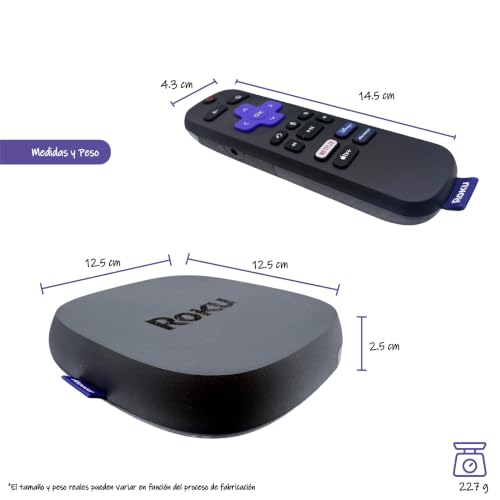
Roku Ultra LT (2023) HD/4K/HDR Dolby Vision Quad-Core Streaming 4 photos from the Amazon listing
The Roku Ultra LT provides an alternative set-top layout measuring 6 inches long, 4 inches wide, and 2 inches high. Designed to anchor home theater systems where wireless interference degrades image fidelity, this player integrates a dedicated RJ-45 Ethernet port alongside dual-band Wi-Fi, Bluetooth, and HDMI connectivity. This array of physical inputs guarantees sustained bitrates when streaming uncompressed 4K video feeds.
Decoding hardware supports output from 720p through 4K UHD (up to 3840 x 2160 resolution). Its comprehensive media pipeline handles H.264, H.265/HEVC, VP9, and Dolby Digital multi-channel sound channels. Video dynamic range capabilities encompass standard HDR along with dynamic Dolby Vision grading. Furthermore, the included voice remote features an integrated physical headphone jack alongside a complimentary pair of wired headphones, enabling zero-latency private listening directly through the handheld controller without needing mobile smartphone pairing.
This hardware profile is tailored directly for dedicated media suites, shared bedrooms, and nighttime viewers who prioritize wired network stability and analog private listening. It interfaces seamlessly with larger visual setups like a 75 inch Roku TV or premium projection screens. However, because it lacks the rechargeable Voice Remote Pro and Wi-Fi 6 wireless networking standard found on the top-tier Roku Ultra, network purists on gigabit wireless architectures may prefer the flagship Ultra package.
How to Choose the Right Roku Streaming Device
Determining which roku streaming device to buy depends on matching internal hardware specifications to your display panel, network topology, and audio processing equipment. Reviewing a detailed roku streaming device comparison reveals that hardware tiers differ significantly beneath the unified software interface.
- Form Factor and Mounting Clearances: If your television is mounted flush against a wall or suspended on an articulating arm, stick-style hardware such as the Roku Streaming Stick 4K with Voice, Roku Streaming Stick Plus with Voice, or Roku Streaming Stick HD with Voice prevents the need for an equipment shelf. They hide neatly behind the panel without blocking adjacent ports. Conversely, standalone boxes like the Roku Ultra and Ultra LT variants require shelf placement and accessible wall power, but provide enhanced physical I/O.
- Display Resolution and Dynamic Range: For standard 1080p displays, the Roku Streaming Stick HD with Voice provides a capable, low-overhead interface. However, 4K displays require careful evaluation of HDR standards. The Streaming Stick Plus handles baseline HDR10 and HDR10+, whereas the Streaming Stick 4K, Roku Ultra, and both Ultra LT models add Dolby Vision processing. If your television supports dynamic Dolby Vision mastering, selecting a model with hardware-level support is critical to prevent color grading fallback.
- Network Throughput and Connectivity: Streaming high-bitrate 4K content with spatial audio formats like Dolby Atmos requires stable data throughput. The Roku Ultra represents the newest roku streaming device tier in network capabilities, integrating modern Wi-Fi 6 alongside physical 10/100 Ethernet. For environments plagued by wireless congestion, the Ethernet ports on the Roku Ultra and Roku Ultra LT eliminate packet loss. Where hardwiring is impossible, the long-range Wi-Fi receivers on the stick models ensure adequate signal reception.
- Operational Memory and Interface Speed: Processing intensive channels like Disney+ and Apple TV+ benefit from higher hardware memory ceilings. The Roku Ultra LT Streaming Device 4K provides 2 GB of operational RAM to reduce app reloading, while the Roku Ultra provides a platform that runs 30 percent faster than alternative brand hardware. For standard daily playback, the 1 GB RAM configurations found on compact stick models remain responsive for single-app viewing.
- Remote Control and Private Audio: Control methods vary across the hardware lineup. The Roku Ultra features the top-tier Voice Remote Pro with rechargeable USB-C power, lost remote finders, and backlit buttons. The Roku Ultra LT provides a direct 3.5mm analog headphone jack on the remote body for latency-free private listening. Meanwhile, the standard voice remotes packaged with the streaming sticks support Bluetooth headphone routing and complete voice search functionality.
FAQ
What is the primary difference in a roku ultra vs streaming stick 4k evaluation?
The primary differences center on networking hardware, form factor, and remote capabilities. The Roku Ultra is an external set-top box equipped with Wi-Fi 6, physical Ethernet, a USB media port, and a rechargeable Voice Remote Pro with hands-free listening and backlit keys. In contrast, the Roku Streaming Stick 4K with Voice is an ultra-compact HDMI dongle designed to hide behind a television, utilizing wireless networking exclusively and operating with standard battery-powered voice controls.
Can Roku streaming sticks power directly from a television USB port?
Both the Roku Streaming Stick HD with Voice and the Roku Streaming Stick Plus with Voice are specifically designed to power directly from a television USB port, eliminating the need to route a power cable to an external wall outlet. The Roku Streaming Stick 4K utilizes a specialized cable with an embedded long-range Wi-Fi receiver, and while it can run off sufficient TV USB ports, using the provided power configuration ensures adequate current delivery for peak 4K HDR playback.
Which Roku models support AV1 video codec decoding?
Based on manufacturer specifications, the Roku Streaming Stick 4K with Voice, Roku Ultra, Roku Streaming Stick HD with Voice, and Roku Streaming Stick Plus with Voice all feature native AV1 decoding hardware. The AV1 codec provides high data compression efficiency, allowing streaming platforms to deliver high visual quality at significantly lower network bitrates compared to older AVC codecs.
Do all Roku 4K streaming devices support Dolby Vision?
No, Dolby Vision support is not universal across all 4K models. While the Roku Streaming Stick 4K with Voice, Roku Ultra, and both Roku Ultra LT models feature full Dolby Vision decoding, the Roku Streaming Stick Plus with Voice supports HDR10 and HDR10+ dynamic range formats but omits Dolby Vision dynamic metadata licensing.
How does private listening function across different Roku models?
Private listening is supported across different hardware tiers via distinct mechanisms. The Roku Ultra LT features a physical 3.5mm audio jack built directly into the handheld voice remote, allowing users to plug in wired headphones. Other current models, including the Roku Streaming Stick HD, Roku Streaming Stick Plus, and Roku Ultra, utilize Bluetooth Headphone Mode or the Roku mobile companion app to route multi-channel audio directly to wireless headsets.