As Amazon Associates, we earn from qualifying purchases. This means we may receive a small commission at no extra cost to you if you click through and make a purchase.
Samsung maintains an extensive footprint in the modern display market by offering distinct hardware tiers that cater to different viewing environments and technical requirements. Within the popular 65-inch screen class, the manufacturer stratifies its catalog across fundamental Crystal UHD architectures, specialized commercial platforms, and advanced Quantum Dot and Mini-LED display engines. This tiered approach allows buyers to select hardware based on concrete measurable performance metrics, including static contrast ratios, backlight configurations, dynamic range handling, and video processing capabilities rather than cosmetic variations alone.
While baseline 65 inch crystal uhd panels deliver dependable 4K clarity and contrast at a standard 60Hz refresh rate, stepping outward to commercial BED-H units adds centralized Tizen Enterprise device management, whereas ascending into QLED and Mini-LED tiers unlocks drastic brightness gains reaching up to 1,800 nits alongside native 120Hz refresh rates with Variable Refresh Rate technology.
Samsung 65-inch TVs Compared
| Model | Backlight Technology | Maximum Brightness | Refresh Rate | Processing Engine |
|---|---|---|---|---|
| Samsung 65-Inch Class Crystal UHD U8000H | LED | 300 nit | 60 Hz | Crystal Processor |
| Samsung 65-Inch Class Crystal UHD 4K (BED-H) | LED | 250 nit | 60 Hz | Crystal UHD Processor 4K |
| Samsung 65-Inch Class Crystal UHD U8000F | Direct LED | Not listed | 60 Hz | Crystal Processor 4K |
| Samsung 65-Inch Class M80H Series | Mini-LED | 1000 nit | 120 Hz (up to 144 Hz) | |
| Samsung 65-Inch Class QLED Q7F Series | Edge LED | 1800 nit | 60 Hz | Q4 AI Gen1 Processor |
Table from this guide — scroll sideways for the remaining columns.
Samsung 65-Inch Class Crystal UHD U8000H for Essential Home Entertainment
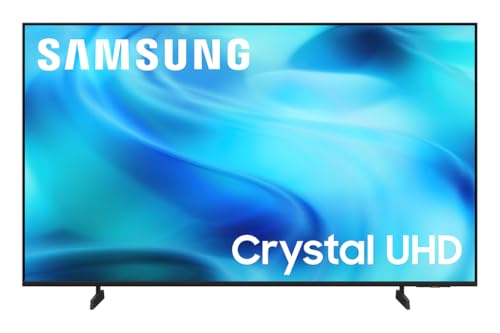


Samsung 65-Inch Class Crystal UHD U8000H 4 photos from the Amazon listing
Best for: Sunlit living spaces requiring maximum luminance
Pros
- 1800 nit maximum display brightness
- Quantum Dot 100% color volume
- Supreme UHD Dimming edge backlight
Cons
- Standard 60Hz refresh rate ceiling
- Edge LED localized light control

Best for: High-frame-rate console and PC gaming
Pros
- Native 120Hz with 144Hz VRR
- Dense Mini-LED backlight array
- 1000 nit maximum display brightness
Cons
- Higher operational processing demands
- Requires high-bandwidth video sources

Best for: Secure household viewing with Direct LED
Pros
- Direct LED backlight configuration
- Knox Security data encryption
- MetalStream single metal sheet build
Cons
- Peak display brightness not listed
- Panel capped at 60Hz refresh

Best for: Commercial digital signage and business displays
Pros
- Tizen Enterprise multi-device management
- 4700:1 high native contrast ratio
- Samsung Business TV app scheduling
Cons
- 250 nit maximum display brightness
- Restricted to standard HDR10 support
Best for: Everyday streaming and standard media rooms
Pros
- 4000:1 native static contrast ratio
- Crystal Processor with Color Booster
- Over 2,700 free streaming options
Cons
- 300 nit maximum brightness ceiling
- Standard 60Hz refresh rate limit
The Samsung 65-Inch Class Crystal UHD U8000H functions as a primary baseline for consumers seeking standard 4K resolution paired with Samsung’s proprietary smart ecosystem. Built around a standard LED backlight arrangement, this 2026 release operates at a native 16:9 aspect ratio and delivers a static contrast ratio of 4000:1. The panel exhibits a maximum display brightness of 300 nit, making it suited for controlled-light living rooms and bedrooms where excessive ambient glare is managed. For users outfitting secondary rooms who may also evaluate compact sizes like a samsung 43 inch smart tv 2025, this 65-inch model offers the same core ecosystem scaled up for wider living room viewing distances.
Under the chassis, the Samsung 65-Inch Class Crystal UHD U8000H utilizes the Crystal Processor to handle color optimization and 4K upscaling. This silicon incorporates Color Booster algorithms to enhance saturation across color channels and deploys Motion Xcelerator technology to estimate and adjust frame transitions at up to 60Hz. The television supports HDR10+ dynamic tone mapping, allowing compatible streaming sources to adjust scene-by-scene luminance. Smart features are anchored by Samsung Vision AI, Alexa integration, and access to over 2,700 free streaming options, including 750+ subscription-free live channels via Samsung TV Plus, requiring a free Samsung Account for full smart operational deployment.
When analyzing the samsung u8000h specs against higher-tier displays, its functional boundaries center on refresh rate and absolute brightness. While its 4000:1 contrast ratio ensures deep black levels in dark environments, its 300 nit maximum brightness ceiling lacks the specular intensity found in Mini-LED or high-output QLED hardware. Gamers seeking ultra-fast variable refresh performance will find this 60Hz screen gives way to the high-bandwidth 120Hz capabilities of the M80H series, making the U8000H best matched for everyday media streaming, broadcast sports, and standard home theater viewing.
Samsung 65-Inch Class Crystal UHD 4K for Commercial Digital Signage


Samsung 65-Inch Class Crystal UHD 4K Bed-H Series HDR 4 photos from the Amazon listing
The Samsung 65-Inch Class Crystal UHD 4K, identified as the BED-H Series (model LH65BEDHLG), diverges from standard consumer televisions by targeting commercial business spaces, boardrooms, and digital signage installations. The hardware incorporates a flat screen finish with a 3-sided bezel-less chassis designed for professional aesthetics. Operating at an aspect ratio of 1.85:1, this panel yields a high native static contrast ratio of 4700:1. The maximum display brightness is specified at 250 nit, paired with a 300 nit display backlight setting, optimized for continuous daily runtimes in professional environments.
Content delivery on the samsung bed-h series 65 inch is driven by the Crystal UHD Processor 4K, which executes intelligent upscaling to elevate lower-resolution media to crisp UHD clarity. Picture enhancements include PurColor calibration and baseline High Dynamic Range (HDR10 support), which widens detail visibility across light and dark frames. Unlike residential sets that prioritize consumer streaming hubs, the BED-H integrates the Tizen Enterprise Platform, allowing system administrators to deploy, configure, and maintain multiple connected displays over network infrastructure, while the mobile Samsung Business TV App lets managers schedule and display customized promotional assets directly from Android or iOS devices.
Within this lineup, the BED-H series yields to models like the U8000H or U8000F for traditional home users who require consumer-centric features such as HDR10+ tone mapping and broad consumer streaming app configurations. The commercial display targets retail stores, waiting rooms, and corporate lobbies where scheduling tools, device management protocols, and reliable signage uptime outweigh the need for high-end gaming features or ultra-bright consumer HDR performance.
Samsung 65-Inch Class Crystal UHD U8000F for Streamlined Living Rooms
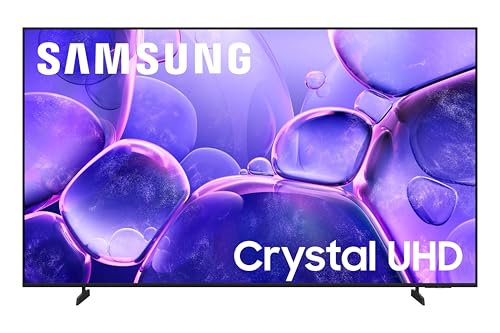

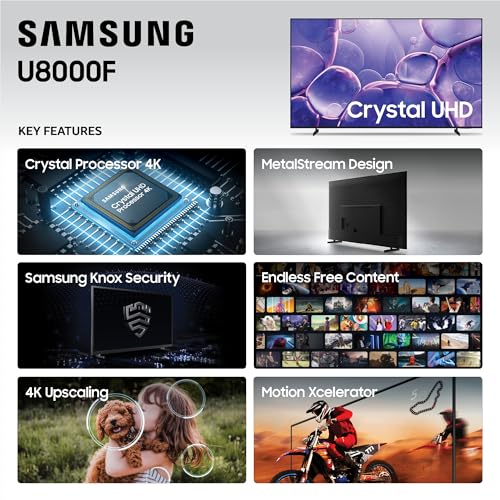

Samsung 65-Inch Class Crystal UHD U8000F 4K Smart TV 4 photos from the Amazon listing
The Samsung 65-Inch Class Crystal UHD U8000F represents a design-focused iteration within the Crystal UHD category, utilizing a refined MetalStream construction crafted from a single metal sheet with ultra-slim bezels. Internally, the display features a Direct LED backlight configuration, which positions light-emitting diodes directly behind the LCD substrate for consistent light dispersion across the 16:9 viewing area. The panel runs at a standard 60Hz refresh rate and delivers a high contrast ratio to maintain deep black levels during low-light movie playback.
In a direct comparison of samsung u8000f vs u8000h, the U8000F relies on the Crystal Processor 4K to manage 3D Color Mapping alongside its 4K upscaling engine. Motion handling is governed by Motion Xcelerator, which calculates intermediate movement between incoming video frames to eliminate stutter at 60Hz. A distinctive hardware and software integration on this model is Samsung Knox Security, which provides triple-layer protection against malicious applications, phishing attempts, and unauthorized data transmission from connected smart Internet-of-Things (IoT) peripherals. Smart connectivity includes Samsung TV Plus with 2,700+ free channels, over 400 premium channels, and multilingual interface options covering English, French, and Spanish.
The U8000F serves as a balanced solution for users who want clean hardware styling combined with hardware-level data encryption. The listing does not specify a numerical nit brightness rating for this model, positioning it alongside other standard Crystal UHD units rather than high-luminance light cannons. Where dynamic specular highlights and wide color gamuts are required, the U8000F yields to the Quantum Dot and Mini-LED panels in the lineup, remaining an excellent fit for secure, stylish living room environments.
Samsung 65-Inch Class M80H Series for High-Frame-Rate Gaming


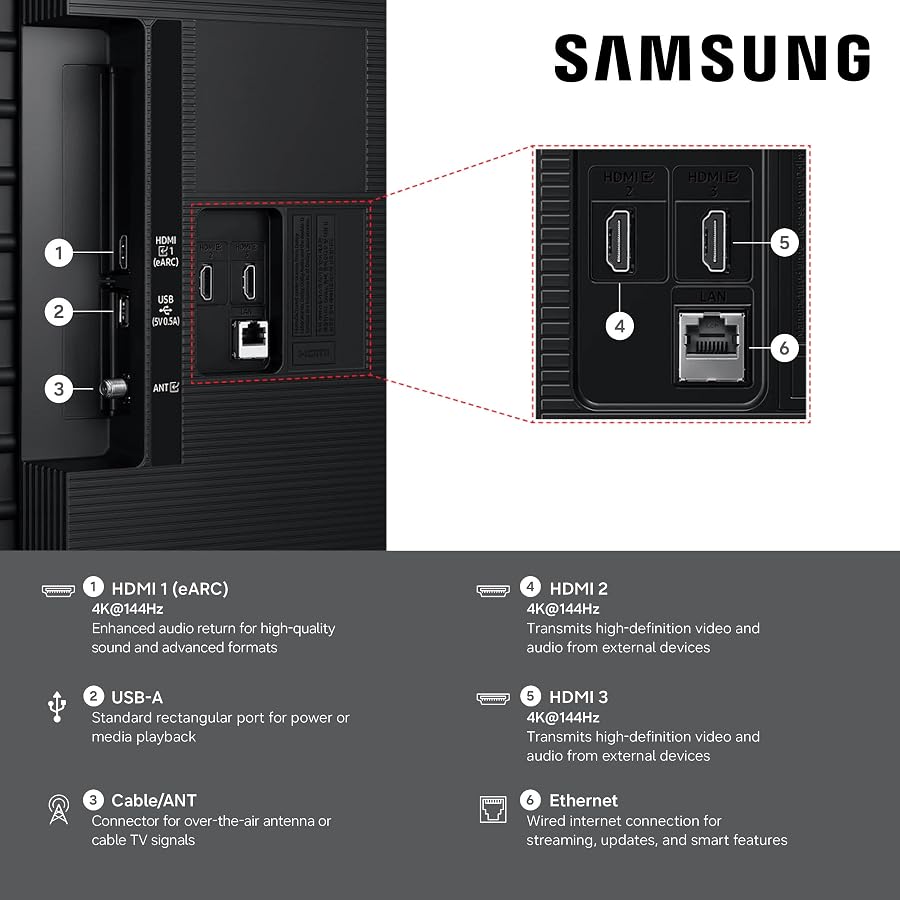
Samsung 65-Inch Class M80H Series, Mini LED, 4K, Smart 4 photos from the Amazon listing
The Samsung 65-Inch Class M80H Series represents a major technological leap beyond baseline LED panels by incorporating a dense Mini-LED backlight array. By utilizing thousands of miniaturized diodes, the M80H achieves granular lighting control, minimizing blooming and delivering high contrast performance across dynamic content. The display is rated for an impressive maximum display brightness of 1000 nit, allowing it to render bright daylight scenes and specular highlights with substantial optical punch. The panel also natively operates at a 120Hz refresh rate, providing double the baseline temporal resolution of standard Crystal displays.
A review of the samsung m80h mini led specs reveals an internal processing core powered by Samsung’s NQ4 AI Gen2 Processor. This silicon drives 4K AI Upscaling and manages the Mini LED with AI Mode, analyzing each frame in real time to balance color, contrast, and backlight intensity. Gaming performance is reinforced by Motion Xcelerator 144Hz support, enabling high-frame-rate rendering up to 144Hz with integrated Variable Refresh Rate (VRR) technology to eliminate frame pacing stutter and screen tearing. Color reproduction is powered by Pure Spectrum Color, mapping out one billion colors, while Auto HDR Remastering automatically elevates standard dynamic range (SDR) video streams into HDR-like presentations.
In the broader context of samsung 65 inch tv refresh rate capabilities, the M80H is explicitly engineered for enthusiasts operating high-performance gaming consoles or PC rigs. Whereas the standard Crystal UHD models top out at 60Hz and 300 nits, the M80H commands a 1000 nit ceiling alongside its 144Hz VRR ceiling. It surrenders raw peak luminance only to the Q7F QLED display, yet maintains superior localized contrast control through its advanced Mini-LED grid.
Samsung 65-Inch Class QLED Q7F Series for Bright Ambient Rooms
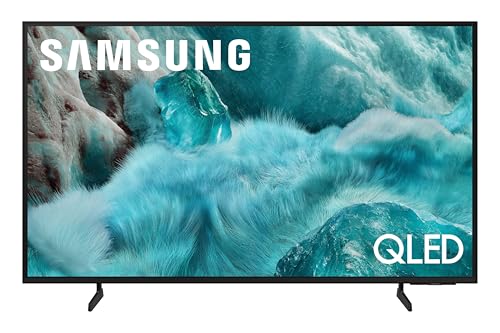


Samsung 65-Inch Class QLED Q7F Series Samsung Vision AI 4 photos from the Amazon listing
The Samsung 65-Inch Class QLED Q7F Series targets environments where ambient light is the primary viewing obstacle. Rather than utilizing a conventional color filter, this model integrates a microscopic Quantum Dot layer over an Edge LED backlight configuration, augmented by Supreme UHD Dimming. The panel delivers a massive maximum display brightness rating of 1800 nit, making it by far the brightest display in this comparative lineup. For homeowners who appreciate high-impact display hardware across different room sizes, this model reflects high-luminance design principles comparable to flagship scale options like an 85 inch samsung smart tv.
Evaluating samsung crystal uhd vs qled 65 inch displays reveals significant hardware advantages for the Q7F. Its Quantum Dot architecture achieves 100% Color Volume certified in the DCI-P3 color space, preserving hue accuracy across all luminance steps without desaturating under bright backlight drive. Processing is handled by the Q4 AI Gen1 Processor, which uses AI algorithms to boost both video clarity and audio output via Object Tracking Sound Lite. Dynamic tone mapping is supported via Quantum HDR and HDR10+, while system data and home network peripherals remain protected through integrated Samsung Knox Security.
The primary performance trade-off of the Q7F lies in its motion hardware. Despite its top-tier 1800 nit luminance and advanced Quantum Dot color filter, the panel utilizes a standard 60Hz refresh rate driven by Motion Xcelerator. Consequently, gamers seeking 120Hz or 144Hz fluidity with native VRR will find the Mini-LED M80H better suited for their needs. However, for bright daytime living rooms, sunrooms, and open floor plans, the Q7F provides unparalleled illumination and color saturation.
How to Choose the Right Samsung 65-inch TV
Selecting the optimal display from a comprehensive samsung crystal uhd 65 inch comparison requires assessing your room’s ambient light, source content types, and device connectivity requirements. Because display panels across these five models share the same physical screen diagonal, your decision hinges on the underlying backlight layout, the panel refresh cycle, and internal processing silicon. Evaluating a samsung 65-inch 4k smart tv comparison ensures you select the correct hardware without overpaying for features your setup cannot utilize.
- Backlight Architecture and Nit Ceilings: Backlight hardware dictates how well a display performs against room reflections and high dynamic range content. Standard Crystal UHD models like the U8000H and BED-H provide modest output ratings of 300 nit and 250 nit, respectively, making them best for dimly lit or moderate viewing environments. In contrast, the Mini-LED architecture on the M80H hits 1000 nits with localized illumination control, while the Edge LED layout of the QLED Q7F pushes luminance to 1800 nits, making the Q7F the definitive choice for rooms flooded with daylight.
- Native Refresh Rates and Gaming Capabilities: Motion resolution varies substantially across this catalog. The U8000H, U8000F, BED-H, and Q7F operate on standard 60Hz refresh panels, relying on Motion Xcelerator interpolation to track standard broadcast and film cadence. Buyers connecting modern gaming consoles or high-performance gaming rigs require the M80H, which provides native 120Hz refresh rates and up to 144Hz Variable Refresh Rate capability to eliminate artifacting and tearing during fast-motion scenes.
- Processing Silicon and Video Upscaling: Baseline models employ the Crystal Processor 4K, which relies on standard mathematical upscaling tables and color mapping algorithms to reproduce 4K imagery. Stepping up to the Q4 AI Gen1 or NQ4 AI Gen2 processors found in the QLED and Mini-LED tiers unlocks multi-layered artificial intelligence networks that analyze texture, edge sharpness, and noise patterns frame-by-frame, while introducing automated features like Auto HDR Remastering. Those assessing smaller spaces can review a 43 samsung smart tv comparison to see how these processors behave in lower-tier sizes.
- Deployment Objective: Determining which samsung 65 inch tv to buy ultimately depends on residential versus commercial utility. Standard home theaters and media rooms benefit most from the consumer app interfaces, HDR10+ tone mapping, and Samsung Vision AI found in the U8000H, U8000F, and higher models. Conversely, business owners requiring centralized content scheduling, 3-sided bezel-less packaging, and multi-display management across enterprise networks should prioritize the BED-H series for its dedicated Tizen Enterprise platform.
FAQ
What distinguishes the Samsung Crystal UHD series from QLED displays?
The fundamental distinction between Crystal UHD and QLED lies in the color filtration layer and backlight system. Crystal UHD displays use standard LED backlights passing through traditional color filters, delivering standard color spectrum coverage and modest luminance levels around 250 to 300 nits. QLED displays, like the Q7F, introduce an ultra-fine Quantum Dot nanocrystal layer that converts light into pure primary colors, allowing the screen to achieve 100% Color Volume and drastically higher peak brightness levels up to 1,800 nits.
Can Samsung 65-inch 60Hz televisions run 120Hz gaming consoles?
Samsung televisions equipped with 60Hz panels, such as the U8000H, U8000F, and Q7F, can accept signals from modern 120Hz gaming consoles, but the display will downscale the temporal output to 60 frames per second. These displays utilize Motion Xcelerator frame estimation to smooth motion, but they cannot display true 120Hz or 144Hz frame rates. True high-refresh gameplay requires a native 120Hz panel, such as the Mini-LED M80H series.
What is the difference between Direct LED and Edge LED backlighting in these models?
Direct LED configurations, featured in the Crystal UHD U8000F, place an array of light-emitting diodes directly across the back plane of the LCD screen, promoting consistent light uniformity across the display surface. Edge LED systems, utilized in the QLED Q7F, mount LEDs along the borders of the chassis and distribute light across the screen via light guides, enabling thinner cabinet depths and high optical brightness ratings such as 1800 nits with Supreme UHD Dimming.
Why choose the Samsung BED-H series over standard residential Crystal UHD TVs?
The BED-H series is engineered specifically for commercial digital signage and business operational demands rather than residential entertainment. It integrates the Tizen Enterprise Platform, which enables system managers to monitor, update, and configure multiple remote displays from a centralized location. Additionally, the Samsung Business TV App allows operators to draft, schedule, and project marketing content directly from mobile devices without requiring third-party media players.
How does Knox Security protect connected Samsung smart displays?
Samsung Knox Security provides multi-layer hardware and software encryption integrated directly into compatible smart TVs like the U8000F and Q7F. Knox continuously monitors the operating firmware to block unauthorized root access, shields sensitive user inputs like passwords and PIN credentials, prevents the execution of malicious applications and phishing domains, and secures communication protocols between the TV and connected IoT smart home hardware.


