As Amazon Associates, we earn from qualifying purchases. This means we may receive a small commission at no extra cost to you if you click through and make a purchase.
Propel has established a distinct presence in the micro-aeronautics market by engineering compact quadcopters that prioritize flight stability, aerobatic agility, and modular maintenance. In the sub-micro class, hardware performance depends heavily on the integration between onboard micro-electromechanical sensors, motor shaft tolerances, and radio frequency communication protocols. Navigating the lineup requires analyzing control frequencies, mechanical power delivery, and airframe durability so operators can select components that match their piloting demands and maintenance routines.
While the stunt-oriented airframe delivers integrated micro-sensors and pre-programmed flight maneuvers, the dedicated rotor package supports coreless motor maintenance, and the standalone high-frequency flyer provides a dedicated radio platform for rapid aerodynamic response.
Propel Mini Drones Compared

Best for: Beginners wanting automated stunts and altitude hold
Pros
- Altitude hold and headless mode
- Impact-absorbing ABS airframe
- Dual Bluetooth and RF connectivity
Cons
- AA remote batteries not included
- Level surface calibration required
| Model | Connectivity / Frequency | Motor / Drive Compatibility | Core Flight Features | Power Architecture |
|---|---|---|---|---|
| Mini Drone with Easy Stunt Flights | Bluetooth, Radio Frequency | Numbered proprietary rotor shafts | Altitude Hold, Headless Mode, 360 Flips | Built-in battery, USB charging |
| skrnrhrery Propeller Blades,1.8(in) Positive and Negative | Not listed | 720 and 8520 hollow cup motors | Clockwise (A) and Counter-Clockwise (B) Pitch | Not listed |
| Altitude Propel 2.4GHZ High Performance Drone | 2.4GHz Radio Frequency | Not listed | High performance flight dynamics | Lithium Ion |
Table from this guide — scroll sideways for the remaining columns.
Mini Drone with Easy Stunt Flights for Aerobatic Maneuvers

Mini Drone with Easy Stunt Flights & 360° Tricks 4 photos from the Amazon listing
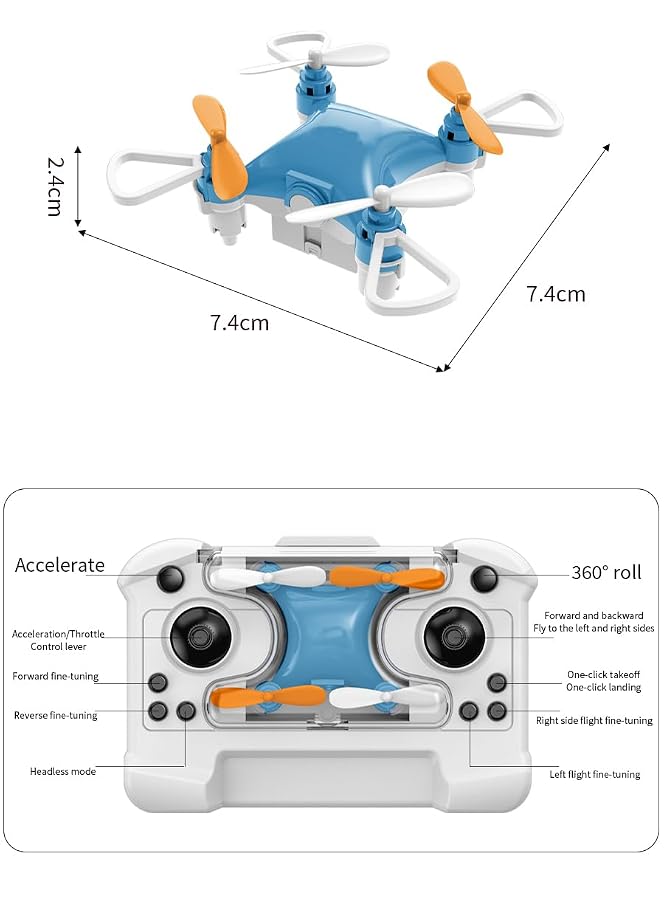
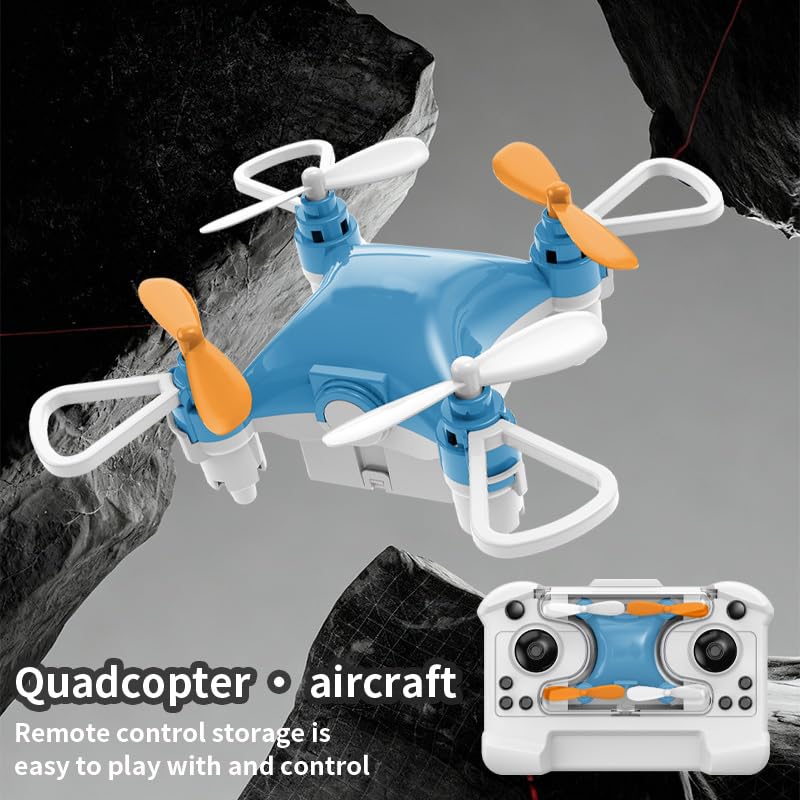
The Mini Drone with Easy Stunt Flights is an agile micro-airframe engineered for controlled indoor and outdoor operation. Measuring 8 inches long, 2 inches wide, and 6 inches tall with an airframe clearance height of roughly 2.4 inches (6 cm), this drone houses a miniaturized flight controller capable of executing complex 360-degree flips and multi-directional rolls. Its primary airframe is cast from impact-absorbing ABS plastic, designed to dissipate kinetic energy across the motor arms during sudden wall impacts or turf collisions. The airframe includes four detachable anti-slip landing stands and protective wing guards, shielding the spinning rotor assemblies from lateral friction during low-altitude indoor maneuvers.
From an electronic hardware perspective, this propel altitude hold drone integrates both Radio Frequency and Bluetooth transmission protocols. The flight computer processes sensor feedback through integrated optical hardware, featuring both CMOS and CCD sensor architectures, while encoding flight video captures into the standard MP4 file format. In flight, automated routines including headless mode, one-key takeoff, precise hovering, and one-key landing alleviate pilot workload by decoupling directional orientation from the physical heading of the fuselage. Unlike larger commercial platforms explored in our dji tiny drone technical analysis, this micro quad relies on onboard solid-state gyroscopes that must be calibrated on a flat, level surface prior to motor arming to prevent rotational drift.
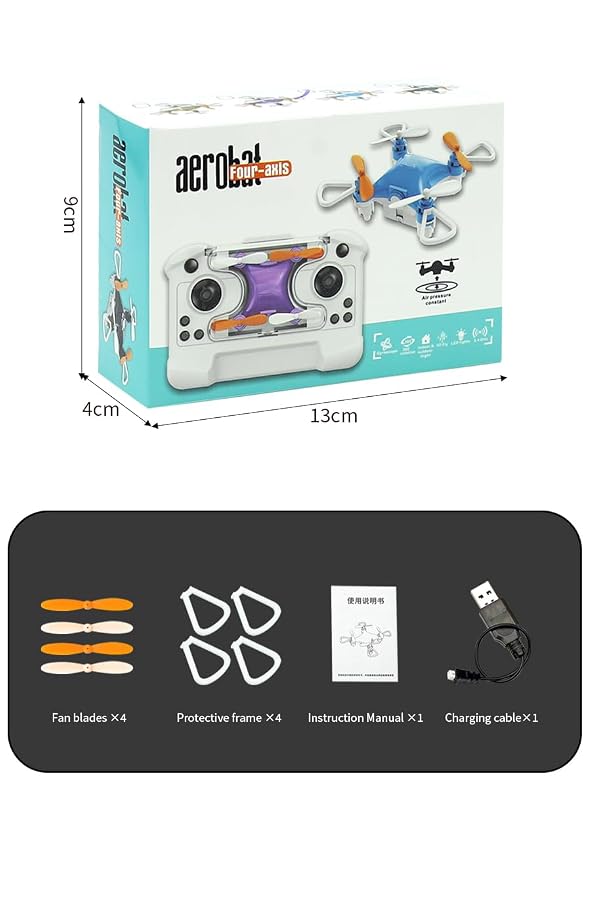
This model is tailored specifically for beginner operators and younger pilots who require forgiving collision tolerance alongside automated stunt flight functions. The package includes a wireless remote controller that operates on AA batteries (which are not included in the primary kit), a USB battery charging cable for the internal drone cell, two spare propellers, four landing legs, and an operation manual. The hardware setup requires users to align the numbered labels on the motor mounts with the matching propeller blades to ensure positive downward thrust before launching.
skrnrhrery Propeller Blades,1.8(in) Positive and Negative for Coreless Motor Maintenance


skrnrhrery Propeller Blades,1.8(in) Positive and Negative 4 photos from the Amazon listing
Best for: Pilots rebuilding 720 and 8520 coreless motors
Pros
- Balanced 20-piece nylon rotor kit
- Precision 1.0mm motor shaft fit
- Lightweight low-inertia profile
Cons
- Strict directional blade matching needed
- Not compatible with larger shafts
The skrnrhrery Propeller Blades,1.8(in) Positive and Negative package represents a foundational mechanical component set for maintaining micro-quadcopter propulsion systems. Each rotor blade measures exactly 46mm (1.8 inches) in total tip-to-tip length, manufactured with an ultra-precise 1.0mm (0.04-inch) center hub bore hole. These dimensions make the blades direct mechanical matches for high-speed micro brushed motors, specifically 720 (7mm diameter by 20mm length) and 8520 (8.5mm diameter by 20mm length) coreless hollow cup motors found throughout micro quadcopter hardware platforms.
Molded from lightweight, semi-flexible nylon plastic, these propel drone replacement blades balance aerodynamic rigidity against rotational mass. The entire 20-piece kit weighs only 0.493 ounces, minimizing rotational inertia and motor stator amp draw during rapid throttle escalations. Aerodynamically, the package provides a balanced inventory of 10 positive-pitch “A” blades and 10 negative-pitch “B” blades. In multirotor flight dynamics, counter-rotating propeller pairs are necessary to neutralize the yaw-inducing angular momentum generated by high-RPM brushed motors. Reversing an A blade onto a B motor spindle prevents lift generation entirely, creating negative pressure and pinning the frame to the ground.
This replacement pack suits hobbyists, quadcopter builders, and fleet technicians servicing micro-airframes after severe rotor strikes. Because nylon plastic resists shearing when encountering obstacles, these blades maintain their balanced airfoil profile through normal flight stress. When evaluating commercial hardware options across the broader dji drones for sale catalog, modular component repairs often involve proprietary assemblies, whereas these standardized 1.0mm press-fit hubs allow rapid physical bench servicing without complex fasteners or specialty tools.
Altitude Propel 2.4GHZ High Performance Drone for High-Frequency Flight Control

Altitude Propel 2.4GHZ High Performance Drone 1 photo from the Amazon listing
Best for: Pilots prioritizing dedicated 2.4GHz radio frequency control
Pros
- 4GHz low-latency signal link
- Lithium-ion power source
- Streamlined high-performance flight
Cons
- Listing omits dimensional measurements
- Minimal onboard accessory documentation
The Altitude Propel 2.4GHZ High Performance Drone focuses on responsive radio-controlled flight dynamics across open airspace. The core architecture centers on a 2.4GHz radio frequency link, an operating band engineered to provide rapid command latency, broad operational bandwidth, and strong rejection of ambient electromagnetic interference. By utilizing 2.4GHz transmission rather than lower-frequency infrared or congested short-range signals, the receiver on this platform maintains sustained bi-directional packet stability throughout rapid ascents, aggressive banks, and high-speed translation runs.
Power management on this propel 2.4ghz high performance drone is governed by an integrated Lithium-Ion battery cell chemistry. Lithium-Ion power packs provide the high energy density necessary to maintain steady voltage discharge curves under heavy throttle loads. This continuous current delivery prevents sudden motor desynchronization or erratic altitude drops when running all four drive channels simultaneously. The mechanical assembly prioritizes dynamic weight distribution, ensuring that motor output translates directly into linear acceleration rather than fighting excess chassis ballast.
This airframe is designed for pilots prioritizing basic aerodynamic flight mechanics and radio frequency stability over software-assisted camera feeds or autonomous return protocols. While the listing does not specify secondary camera payloads, optical flow sensors, or overall airframe dimensions, the reliance on high-frequency RF transmission and a lithium-ion power reserve provides the mechanical foundation needed for agile maneuvering in backyards or wide indoor facilities.
How to Choose the Right Propel Mini Drone Hardware
Selecting the correct model during a propel mini drone comparison requires evaluating mechanical drivetrain components, radio control architecture, and flight assistance features. When deciding which propel mini drone to buy, pilots must align their operational goals with the underlying hardware capabilities of each unit.
- Radio Frequency vs. Hybrid Connectivity: Control transmission directly dictates operating distance and responsiveness. The Altitude 2.4GHz flyer utilizes high-frequency radio waves to maintain uninterrupted control input over distance. In contrast, the stunt-oriented mini flyer provides hybrid Radio Frequency and Bluetooth connectivity, letting users pair the craft with physical handheld controllers or local mobile interfaces for short-range indoor maneuvers.
- Motor Specifications and Rotor Parity: Quadcopters rely on symmetrical thrust generation. When replacing hardware using the 46mm nylon propeller blade kit, verify that your micro-motors utilize standard 1.0mm drive shafts on 720 or 8520 coreless motor cans. Always check the embossed letters on the blade hubs; installing an “A” propeller on a counter-clockwise motor prevents flight and strains the motor coils.
- Sensor Payloads and Optical Architecture: If your flight profile requires aerial recording or optical positioning, review the onboard digital sensors. The stunt quadcopter houses CMOS and CCD sensor packages alongside MP4 capture formats. Pilots seeking advanced visual mapping or thermal imaging hardware should reference our dji drone with thermal camera review, as mini quadcopters in this weight class are built strictly for recreational line-of-sight flying.
- Airframe Resilience and Structural Safety: Flying indoors introduces immediate collision hazards with walls and furniture. Airframes constructed from molded ABS plastics, supported by clip-on rotor guards and anti-slip stands, absorb impact shocks that would otherwise crack brittle carbon-composite frames or bend motor drive pins.
FAQ
Why does my mini drone spin out of control immediately upon throttle application?
Spinning out of control without achieving lift is almost always caused by an incorrect propeller installation pattern. Quadcopters require two clockwise (A) and two counter-clockwise (B) propellers mounted in diagonal pairs to cancel out motor rotational torque. If an A blade is mounted on a B motor spindle, the airfoil drives air upward instead of downward, destabilizing the gyro and causing rapid spinning on the ground.
What does headless mode accomplish on a mini stunt drone?
Headless mode is an internal flight controller algorithm that overrides the physical orientation of the aircraft relative to the pilot. Normally, pushing forward on the pitch stick commands the drone to move in the direction its nose is pointing. In headless mode, the flight controller tracks the aircraft’s position relative to its takeoff orientation, meaning pushing forward moves the craft away from the pilot regardless of which way the fuselage is rotated.
Are 46mm propeller blades universally compatible with all mini quadcopters?
No, propeller compatibility depends strictly on motor can diameter, motor shaft thickness, and blade clearance. The 46mm replacement blades feature a 1.0mm center bore engineered specifically for standard 720 and 8520 coreless micro-motors. Attempting to press these blades onto a motor with a 0.8mm or 1.5mm shaft will either cause the hub to slip loose under load or crack the nylon plastic hub housing entirely.
Why must a mini drone be calibrated on a flat surface before flight?
Micro-drones use solid-state micro-electromechanical gyroscopes and accelerometers to determine level flight. During the initial power-on sequence, the flight computer reads sensor data to establish its neutral horizontal baseline. If the drone is calibrated while sitting on an inclined surface, held in a hand, or resting on soft carpet, the flight controller will interpret that angle as horizontal level, leading to severe lateral drifting as soon as the drone lifts off.
What are the primary performance advantages of a 2.4GHz control frequency?
A 2.4GHz radio frequency link provides superior operational range and lower latency compared to legacy infrared transmitters or standard short-range Bluetooth links. The 2.4GHz band uses frequency-hopping spread spectrum technology, allowing multiple controllers and drones to operate in the same vicinity without cross-channel signal interference or uncommanded control lockups.


