As Amazon Associates, we earn from qualifying purchases. This means we may receive a small commission at no extra cost to you if you click through and make a purchase.
DJI has established industry benchmarks in miniaturized aerial engineering, concentrating flight stability, intelligent tracking, and high-definition optical sensors into ultra-compact frames. In the micro-drone sector, the manufacturer prioritizes lightweight airframes that minimize regulatory friction while maximizing flight duration and automated recording. Prospective pilots analyzing dji drones for sale frequently focus on this lightweight category, where portable form factors serve both recreational hobbyists and mobile digital content creators.
Across the current compact lineup, these six models bifurcate between enclosed propeller-guard airframes designed for autonomous palm takeoff and traditional folding quadcopters engineered with motorized mechanical gimbals for long-range aerial videography.
DJI Tiny Drones Compared
Conducting a thorough dji tiny drone comparison requires evaluating hardware trade-offs between physical gimbal stabilization and ducted propeller safety cages. While folding frames prioritize aerodynamics across open landscapes, enclosed chassis models maximize close-quarters maneuverability and hands-free interaction. The comparative matrix below outlines key dji compact drone specs across takeoff mass, optical stabilization, power architecture, and remote communication protocols.
| Model | Takeoff Weight | Camera & Stabilization | Flight Time / Batteries | Control & Transmission |
|---|---|---|---|---|
| DJI Neo | 135g | 4K UHD, 12 MP, Electronic Stabilization | 1x Li-ion Battery (1435 mAh) | Wi-Fi, Bluetooth, Mobile App, Voice, 10km Range |
| DJI Mini 4K | Under 249g | 4K UHD, 12 MP, 3-Axis Mechanical Gimbal | 1x Li-ion Battery, 31-Min Flight Time | DJI O2, RC-N1C Remote, 10km Transmission |
| DJI Neo Fly More Combo | 135g | 4K UHD, 12 MP, Electronic Stabilization | 3x Li-ion Batteries, Two-Way Charging Hub | RC-N3 Remote, Radio Frequency, 10km Range |
| DJI Neo 2 Fly More Combo | 151g | 4K UHD, 12 MP, CMOS Sensor | 3x LiPo Batteries, Charging Hub | Gesture Control, Wi-Fi, Bluetooth, Apple Watch |
| DJI Mini 4K Camera Drone Combo | Under 249g | 4K UHD, 12 MP, 3-Axis Mechanical Gimbal | 2x Li-ion Batteries, 62-Min Total Flight Time | DJI O2, Remote Control, 10km Transmission |
| DJI Neo 2 Motion Fly More | 151g | 4K UHD, 12 MP, CMOS Sensor, FPV | 3x LiPo Batteries (1606 mAh), Charging Hub | DJI RC Motion 3, Goggles N3, Digital Transceiver |
Table from this guide — scroll sideways for the remaining columns.
DJI Neo for Autonomous Palm Launching


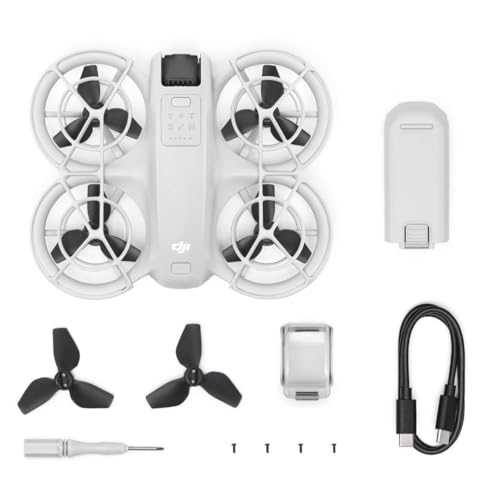
DJI Neo 4 photos from the Amazon listing
Best for: Solo vloggers wanting quick palm launches
Pros
- 135g ultra-lightweight frame
- Palm takeoff and subject tracking
- Full-coverage propeller guards
Cons
- Relies on electronic stabilization
- Single battery in base package
The DJI Neo represents an ultra-lightweight 135g aerial platform engineered specifically for rapid deployment without complex setup routines. Featuring full-coverage propeller guards integrated directly into its structure, this drone operates comfortably in confined indoor spaces or around outdoor gatherings. Its imaging hardware combines a 12 MP effective still resolution with 4K ultra-stabilized video recording in MP4 format. Because its takeoff weight registers well below statutory thresholds, it does not require FAA registration or Remote ID for recreational flights. Note that initial activation requires the DJI Fly app, which Android users must download directly from the official DJI website due to platform compatibility factors.
Operating flexibility is a defining engineering highlight of this model. Pilots can launch and land the aircraft directly from their palm with a single button press, completely bypassing traditional flight sticks. The drone supports multi-modal command inputs, including English and Chinese voice control, direct Wi-Fi and Bluetooth smartphone pairing, or pairing with separate remote controllers. When linked via wireless communication, the system lists a theoretical maximum range up to 10 km. Stability in open air is maintained through level-4 wind resistance backed by internal electronic stabilization algorithms, powered by a 1435 milliamp-hour lithium-ion cell.
This base configuration is tailored specifically for solo vloggers and family documentarians seeking automated tracking shots without carrying bulky gear. For creators accustomed to mounting smartphones on a dji tripod for iphone, this autonomous aircraft serves as an airborne alternative that follows movement automatically via eight preprogrammed QuickShots modes. However, users planning extended cinematic flights across windy landscapes will find that the single battery and lack of a mechanical gimbal yield to the dedicated flight controls of the Mini series.
DJI Mini 4K for Cinematic Mechanical Stabilization

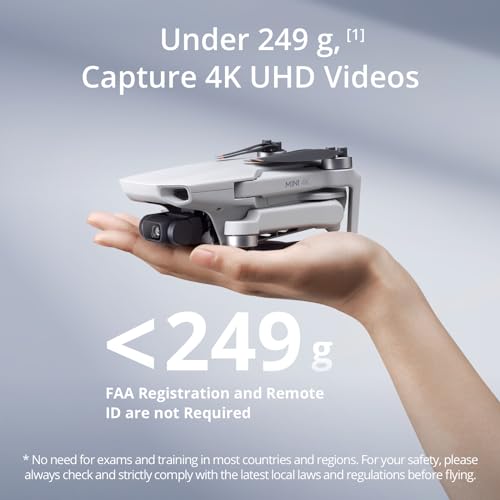


DJI Mini 4K 4 photos from the Amazon listing
Best for: Longer landscape flights without registration
Pros
- Two batteries for 62 minutes total
- 3-axis gimbal 4K camera
- 38kph Level 5 wind resistance
Cons
- No full propeller guards
- No omnidirectional obstacle sensors
Best for: Aerial photographers needing mechanical gimbal stabilization
Pros
- 3-axis mechanical gimbal
- Level 5 wind resistance
- 10km DJI O2 video transmission
Cons
- Single battery in base package
- Lacks propeller guards
Designed as a classic folding quadcopter, the DJI Mini 4K targets aerial creators who demand authentic cinematic image stabilization. Weighing under 249 g, this sub 249g dji drone meets recreational regulatory exemptions while carrying a motorized 3-axis mechanical gimbal. The camera houses a 12 MP sensor capable of capturing 4K Ultra HD video footage in MP4 format across diverse lighting conditions. Like other contemporary models from the manufacturer, setup involves downloading the DJI Fly app from the official DJI website to bypass app store availability constraints.
Flight performance is driven by robust brushless motors delivering Level 5 wind resistance up to 38 kph and the capability to execute takeoffs at altitudes reaching 4,000 meters. Long-distance control relies on the proprietary DJI O2 transmission protocol paired with the included RC-N1C remote controller, providing up to 10 km of clean HD video feedback. The single intelligent flight battery included in this package provides up to 31 minutes of uninterrupted operation, supported by safety mechanisms such as GPS Return to Home and stable satellite hovering.
This model is ideal for aspiring aerial cinematographers and landscape photographers who prioritize smooth panning, tilt control, and wind resistance over autonomous palm launches. It delivers dedicated stick-controlled precision and cinematic gimbal panning that electronic stabilization cannot replicate. Nevertheless, beginner pilots seeking hands-free tracking during personal vlogging may prefer the enclosed safety cages found on the Neo lineup.
DJI Neo Fly More Combo for Multi-Battery Workflow


DJI Neo Fly More Combo 4 photos from the Amazon listing
Best for: Content creators needing extended flight sessions
Pros
- Includes RC-N3 remote controller
- Three flight batteries and charging hub
- Full propeller protection
Cons
- Level 4 wind resistance ceiling
- Electronic stabilization instead of gimbal
Expanding upon the base lightweight platform, the DJI Neo Fly More Combo equips the 135g ducted drone with comprehensive accessories designed for extended flight sessions. The aircraft retains its regulation-friendly 135g footprint, integrated full-coverage propeller guards, and 4K ultra-stabilized optical sensor generating 12 MP stills. It incorporates palm takeoff and landing routines alongside eight creative QuickShots presets and AI-driven subject tracking.
The critical upgrade in this bundle lies in its hardware packaging. DJI includes the RC-N3 physical remote controller, shifting transmission from standard mobile Wi-Fi to a dedicated radio frequency link capable of managing flights up to 10 km. Furthermore, the combo supplies three lithium-ion flight batteries paired with a two-way charging hub, allowing pilots to cycle through cells sequentially without waiting for internal aircraft charging. The airframe operates in temperatures down to 32 degrees Fahrenheit and withstands Level 4 wind conditions.
This multi-battery bundle serves active content creators and travelers who require prolonged shooting capabilities in the field. Having three batteries eliminates downtime, while the tactile sticks of the RC-N3 controller provide refined manual framing during complex flight paths. Shoppers who need higher wind tolerance and a motorized physical gimbal should instead evaluate the Mini 4K bundles.
DJI Neo 2 Fly More Combo for Gesture and Sensor Navigation
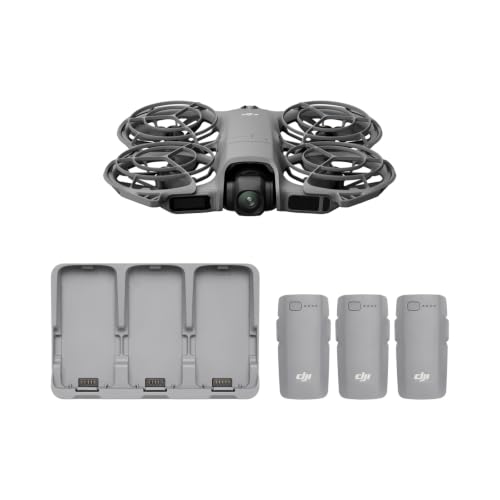


DJI Neo 2 Fly More Combo 4 photos from the Amazon listing
Best for: Immersive first-person view flight enthusiasts
Pros
- Includes Goggles N3 and RC Motion 3
- Omnidirectional obstacle sensing
- Three batteries with charging hub
Cons
- Requires learning motion controller navigation
- 151g takeoff mass
Best for: Hands-free flyers wanting advanced obstacle sensing
Pros
- Omnidirectional obstacle sensing
- Gesture and Apple Watch control
- Three batteries and charging hub
Cons
- Physical controller not included in bundle
- Slightly heavier at 151g
The DJI Neo 2 Fly More Combo presents an evolved iteration in the micro-drone category, weighing 151g and carrying an official C0 certification label. Maintaining an enclosed chassis with full-coverage propeller guards, the aircraft measures 6.74 inches long, 5.8 inches wide, and 1.59 inches high. Imaging duties are handled by a 4K CMOS sensor capturing crisp 12 MP still photographs and ultra-high-definition video files.
Navigation and safety represent substantial technical steps forward on this model. The airframe incorporates omnidirectional obstacle sensing, mitigating collision risks across omnidirectional flight paths. Pilot interaction is expanded through intuitive gesture control, palm takeoff and landing routines, and SelfieShot functionality. Moreover, the platform integrates with Apple Watch, allowing operators to monitor live video feeds, review flight telemetry, and issue voice commands to fine-tune ActiveTrack algorithms. The package supplies three lithium-polymer batteries alongside a multi-battery charging hub.
This system is built for solo adventure athletes and vloggers who prioritize automated obstacle avoidance and seamless wearable control. By removing reliance on traditional handheld controllers, it enables spontaneous recording. However, pilots who prioritize traditional dual-stick long-range exploratory flights will find the folding design and mechanical gimbal of the Mini 4K better suited to horizon-level scouting.
DJI Mini 4K Camera Drone Combo for Extended Range Exploration
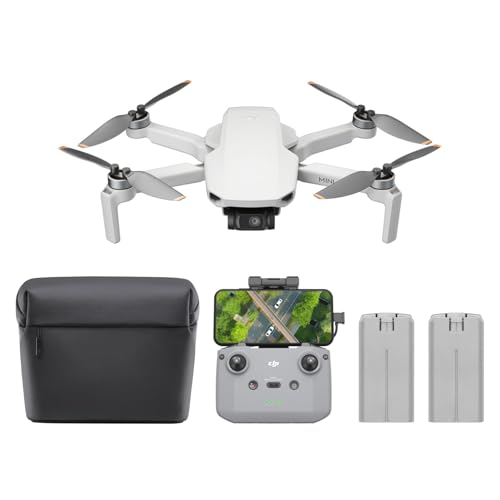


DJI Mini 4K Camera Drone Combo, Drone with 4K 4 photos from the Amazon listing
The DJI Mini 4K Camera Drone Combo builds upon the proven sub 249g dji drone architecture by providing an expanded flight kit tailored for outdoor exploration. Weighing under 249 g, the folding quadcopter evades recreational FAA registration requirements while housing a CMOS sensor on a 3-axis mechanical gimbal. It records 4K Ultra HD video at clean bitrates and outputs 12 MP still images in MP4 formats.
Power management and operational endurance receive a substantial boost with the inclusion of two flight batteries, delivering up to 62 minutes of combined operating time at 31 minutes per battery. The airframe utilizes brushless motors capable of overcoming Level 5 winds up to 38 kph. Navigation is anchored by reliable GPS Return to Home functionality, complemented by automated QuickShots modes including Helix, Dronie, Rocket, Circle, and Boomerang. The 10 km HD video transmission pipeline provides resilient anti-interference reception during distant excursions.
This package is specifically designed for hikers and landscape videographers who need sustained flight time in unpredictable outdoor environments. The twin-battery configuration ensures sufficient power reserves to scout locations and capture steady architectural or scenic perspectives. Conversely, those seeking palm launches and full propeller enclosures for indoor photography should consider the Neo platform.
DJI Neo 2 Motion Fly More for Immersive First-Person Piloting


DJI Neo 2 Motion Fly More Combo With RC 4 photos from the Amazon listing
Packaging first-person view technology into an ultra-compact airframe, the DJI Neo 2 Motion Fly More delivers an immersive flight configuration. The aircraft weighs 151g, holds C0 compliance, and incorporates full-coverage propeller guards to protect both the blades and surroundings during low-altitude indoor and outdoor maneuvers. Its 4K CMOS camera captures 12 MP imagery backed by omnidirectional obstacle sensing for all-around flight safety.
What sets this package apart is its specialized peripheral ecosystem. The bundle includes the DJI RC Motion 3 single-handed motion controller, the DJI Goggles N3 headset, and a dedicated DJI Neo 2 Digital Transceiver, alongside three 1606 milliamp-hour lithium-polymer batteries and a charging hub. Pilots comparing dji fpv goggles will recognize the Goggles N3 as an accessible display interface that pairs seamlessly with intuitive wrist-tilt flight inputs. The system retains smart flight functions including ActiveTrack, SelfieShot, palm takeoff, and gesture control, backed by Bluetooth and Wi-Fi data links reaching up to 10 km.
This motion bundle is intended for hobbyists and creative filmmakers seeking the visceral sensation of cockpit-perspective flight without navigating the steep learning curves of traditional acrobatic quadcopters. The pairing of omnidirectional sensing with motion steering minimizes pilot error. However, users who require conventional photographic framing tools and mechanical horizon leveling should stick with the Mini 4K family.
How to Choose the Right DJI Tiny Drone
Deciding which dji tiny drone to buy hinges on establishing your primary flight environment and stabilization expectations. If your primary objective is personal vlogging, indoor filming, or spontaneous group captures, the enclosed propeller guards on the DJI Neo and Neo 2 provide an essential protective barrier. These ducted frames permit safe palm takeoffs, gesture-based interactions, and tight maneuvers near obstacles where open-propeller drones risk blade damage.
Conversely, when capturing open-air landscapes, coastal scenery, or mountain vistas, mechanical stabilization becomes the overriding technical priority. The DJI Mini 4K models feature a physical 3-axis motorized gimbal that counteracts wind buffeting and chassis tilt far more effectively than electronic cropping algorithms. Furthermore, the Mini 4K airframe boasts Level 5 wind resistance up to 38 kph, compared to the Level 4 resistance rating found on the base Neo platform, ensuring superior stability in breezy weather.
Controller protocols and bundle contents represent the next critical decision point. Flying strictly via smartphone Wi-Fi or palm gestures limits your operational envelope to immediate visual proximity. Investing in a Fly More bundle—such as the DJI Neo Fly More Combo with its RC-N3 controller or the Mini 4K Camera Drone Combo with its dedicated remote—restores tactile dual-stick handling and delivers multiple batteries to support extended aerial sessions.
Finally, consider whether specialized flight interfaces match your creative ambitions. The DJI Neo 2 Motion Fly More introduces first-person view immersion through the Goggles N3 and RC Motion 3, making dynamic flight accessible through natural hand movements. Evaluating whether you prioritize automated hands-free tracking, traditional cinematic stick flying, or immersive cockpit navigation will guide you to the precise model that fulfills your operational requirements.
FAQ
Do these DJI tiny drones require FAA registration or Remote ID?
All models reviewed weigh below the 250-gram regulatory threshold. The DJI Neo weighs 135g, the Neo 2 weighs 151g, and the Mini 4K models weigh under 249g. Under current FAA regulations in the United States, recreational pilots are not required to complete FAA registration or implement Remote ID broadcast modules for aircraft operated purely for recreation below 250 grams.
Why is the DJI Fly app not available on the Google Play store?
The product listings note that due to platform compatibility issues, the DJI Fly app has been removed from Google Play. Android users must visit the official DJI website to download and install the official installation file directly onto their mobile device before activating and flying their aircraft.
What is the main difference between electronic stabilization and a 3-axis gimbal?
Electronic image stabilization, used in the DJI Neo series, stabilizes video digitally by cropping the frame and compensating for movement using software algorithms. In contrast, the 3-axis mechanical gimbal on the DJI Mini 4K uses physical brushless motors to actively stabilize the camera sensor against pitch, roll, and yaw movements, preserving full optical resolution and producing smoother cinematic pans.
Can the DJI Neo and Neo 2 be operated without a physical remote controller?
Yes. Both the DJI Neo and DJI Neo 2 support controller-free flight modes. Operators can launch and land the aircraft directly from their palms. The DJI Neo supports voice control and smartphone app control over Wi-Fi, while the Neo 2 incorporates gesture control, SelfieShot, and Apple Watch tracking controls.
What flight duration can pilots expect from the DJI Mini 4K compared to the Neo?
The DJI Mini 4K listing specifies a maximum flight time of 31 minutes per battery, yielding up to 62 minutes of airtime with the two-battery combo. The DJI Neo listings focus on rapid capture sessions and feature a 1435 mAh battery in the base model, while the Neo Fly More bundles mitigate shorter individual runtimes by supplying three hot-swappable batteries and multi-slot charging hubs.