As Amazon Associates, we earn from qualifying purchases. This means we may receive a small commission at no extra cost to you if you click through and make a purchase.
Meta has firmly established itself as the leading hardware developer in the consumer and commercial spatial computing sectors, delivering fully standalone devices that eliminate the need for tethered base stations or external compute units. Through continuous architectural revisions spanning multiple generations, the brand has advanced inside-out tracking, spatial audio processing, integrated mobile silicon, and full-color optical passthrough pipelines running on its dedicated operating systems.
While sharing a common standalone heritage, the five models in this lineup differ substantially across their compute microarchitectures, display resolutions, system memory capacities, specialized eye and face-tracking sensor arrays, and total onboard solid-state storage.
Meta VR Headsets Compared
| Headset Model | Display Maximum Resolution | Processor Architecture | RAM and Storage | Battery Average Life |
|---|---|---|---|---|
| Meta Quest 3S 128GB | 1832 x 1920 per Eye | Snapdragon XR2 Gen 2 | 8GB RAM, 128 GB | 2.5 hours |
| Meta Quest 3 512GB (Gorilla Tag Bundle) | 4128×2208 pixels | Snapdragon XR2 Gen 2 | 8GB RAM, 512 GB | 2.2 hours |
| Meta Quest Pro Headset with Virtual | High (Pancake Optics) | Not listed | 12GB RAM, 256 GB | 8 hours |
| Meta Quest 2 | 1832 x 1920 | Fast processor | Not listed, 128 GB | Not listed |
| Meta Quest 3 512GB (Batman Bundle) | 2064 x 2208 | Snapdragon XR2 Gen 2 | 8GB RAM, 512 GB | 2.4 hours |
Table from this guide — scroll sideways for the remaining columns.
Meta Quest 3S 128GB for Mixed Reality Entry

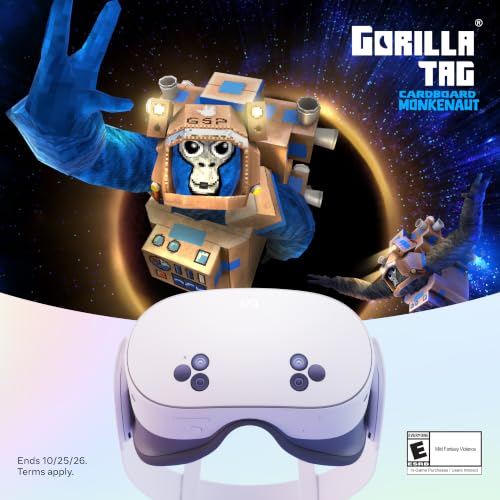


Meta Quest 3S 128GB 4 photos from the Amazon listing
Best for: Immersive gamers seeking high resolution and storage
Pros
- 2064 x 2208 per eye
- 512GB onboard storage
- Snapdragon XR2 Gen 2
Cons
- 4-hour runtime

Best for: Power users with large local gaming libraries
Pros
- 4128×2208 4K display
- 512GB onboard capacity
- Full-color mixed reality
Cons
- 2-hour average battery life
Best for: Value-oriented mixed reality gaming and workouts
Pros
- Snapdragon XR2 Gen 2
- 8GB system memory
- Dual RGB color cameras
Cons
- 128GB base storage
The Meta Quest 3S 128GB represents Meta’s modern entry point into mixed reality spatial computing, integrating the powerful Snapdragon XR2 Gen 2 platform to achieve twice the graphical processing performance of legacy hardware. This processor upgrade is backed by an expanded 8GB memory configuration, representing a 33% memory increase that accelerates asset caching, multitasking efficiency, and texture rendering. Visual output is driven by an optical pipeline rendering 1832 x 1920 per eye across a 110-degree field of view, maintaining reliable clarity for interactive software and media viewing.
Hardware inputs and environmental sensing on this unit center on dual RGB color cameras that power high-fidelity, full-color passthrough to blend digital elements seamlessly into physical spaces. The headset chassis includes an adjustable headband, physical 3.5mm auxiliary and USB Type C interface ports, Wi-Fi connectivity, and integrated motion tracking handled by onboard accelerometers and gyroscopes. Operating under the modern meta – quest platform running Meta Horizon OS, the headset provides access to a vast content catalog and includes a 3-month trial to over 100 games alongside the Cardboard Monkenaut Gorilla Tag bundle. Its internal power cell supports an average battery life of 2.5 hours of continuous runtime.
This model is built specifically for users seeking contemporary processing capability and full-color mixed reality features without needing expansive onboard storage. Its 128GB capacity accommodates core application suites, but users who intend to download extensive 4K video projects or massive game installations will find the physical storage ceiling restrictive compared to the larger 512GB tiers.
Meta Quest 3 512GB for High-Capacity Spatial Computing


Meta Quest 3 512GB | Virtual Reality — VR 4 photos from the Amazon listing
Engineered for enthusiasts who demand premium visual presentation, the Meta Quest 3 512GB delivers a visual upgrade anchored by its 4K+ Infinite Display. Producing a maximum display resolution of 4128×2208 pixels, this panel represents nearly a 30% leap in resolution over prior headset baselines, allowing fine text, complex game textures, and expansive environments to render with minimal screen-door effect. The listing specifies an expansive 360-degree field of view that maximizes environmental awareness across immersive simulations.
Internally, the headset relies on the flagship Snapdragon XR2 Gen 2 processor paired with 8GB of system RAM, enabling twice the graphical throughput of older generations alongside snappy operating system transitions. Dual RGB cameras deliver full-color passthrough for mixed reality workflows, while internal inertial measurement units (IMUs) handle precise spatial tracking without external beacons. Connectivity features include USB Type C and Bluetooth, allowing integration across gaming consoles, personal computers, smartphones, tablets, and televisions. Average battery life is rated at 2.2 hours, and the bundle features the Cardboard Monkenaut Gorilla Tag digital package.
With its massive 512GB storage capacity, this variation is suited for power users, simulation enthusiasts, and creators who maintain extensive game installations, heavy spatial productivity tools, and offline media libraries. Shoppers who prioritize enterprise facial telemetry or professional desktop multi-tasking, however, will look toward the specialized hardware features of the Meta Quest Pro.
Meta Quest Pro Headset with Virtual for Enterprise Collaboration


Meta Quest Pro Headset with Virtual 4 photos from the Amazon listing
Best for: Professional collaboration and facial expression tracking
Pros
- 12GB RAM allocation
- 10 advanced sensors
- 8-hour battery rating
Cons
- Processor model not listed
The Meta Quest Pro Headset with Virtual is an enterprise-oriented spatial computing system built from the ground up to redefine remote interaction and digital workflows. It incorporates compact pancake optics combined with local dimming and quantum dot technology to significantly enhance pixel density, contrast, and visual clarity across text-heavy productivity spaces. The headset includes 256GB of onboard storage and elevates multitasking performance with an extensive 12GB RAM allocation running on Meta Quest OS, though the specific core processor architecture is not listed in the product specifications.
Sensory input is a standout highlight of this system, which features 10 advanced VR and MR sensors encompassing accelerometers, gyroscopes, magnetometers, and proximity monitors. Inward-facing camera modules capture facial movements and eye directions in real time, projecting authentic facial expressions onto Meta Avatars during collaborative sessions. The included Meta Quest Touch Pro Controllers feature dedicated self-tracking cameras and multi-point advanced haptics, maintaining continuous tracking even when moved behind the user’s back. The hardware package provides spatial audio drivers, USB Type C connectivity, Wi-Fi support, an 8-hour average battery lifespan, and a 12-month access pass to Optima Academy Online virtual field trips.
This headset is the ultimate choice for professionals, educators, and enterprise operators who require continuous eye contact, authentic facial expressions, and sophisticated multi-screen virtual office setups. Conversely, standard gaming enthusiasts who want maximum standalone raw compute speed for modern game engines may prefer the consumer-tailored Snapdragon XR2 Gen 2 hardware.
Meta Quest 2 for Value-Focused Standalone VR


Meta Quest 2 4 photos from the Amazon listing
Best for: Entry-level standalone virtual reality without mixed reality
Pros
- 500+ title catalog
- 3D positional audio
- Integrated inside-out tracking
Cons
- System RAM not listed
As the hardware platform that defined standalone consumer virtual reality, the Meta Quest 2 remains a dependable standalone headset built around a unified, cable-free design. The device is powered by a fast internal processor (specific silicon variant not listed) paired with 128GB of internal storage, allowing users to install and run titles directly without tethering to a PC or console. The display pipeline renders 1832 x 1920 resolution per eye across a 360-degree field of view, maintaining clear visual performance across interactive games and spatial streaming applications.
Spatial tracking is handled by inside-out tracking sensors integrated with an internal accelerometer, gyroscope, and magnetometer, eliminating any requirement for external tracking towers. The system includes 3D positional audio drivers integrated directly into the headband struts, alongside responsive hand-tracking capabilities and wireless handheld controllers. Running the legacy Oculus operating system, the Quest 2 provides access to a mature ecosystem containing more than 500 active software titles spanning gaming, virtual fitness, and social multiplayer spaces. Device connectivity includes USB Type C and Wi-Fi, with support for real-time headset casting to compatible smartphones and connected displays.
The Quest 2 is an ideal option for newcomers seeking an entry-level entry into pure virtual reality gaming and workout routines without mixed reality expectations. However, it lacks the full-color RGB passthrough cameras, higher-tier RAM configurations, and advanced graphical processing found on the newer XR2 Gen 2 models.
Meta Quest 3 512GB with Action Gaming Bundle



Meta Quest 3 512GB | VR Headset — Get 3 photos from the Amazon listing
This specialized configuration of the Meta Quest 3 512GB targets immersive action gaming by packaging the flagship headset alongside Batman: Arkham Shadow. The hardware foundation features Meta’s 4K Infinite Display running a maximum resolution of 2064 x 2208 per eye across a 110-degree field of view, delivering nearly a 30% leap in resolution compared to earlier generations. Paired with integrated spatial audio drivers, the headset creates a deeply immersive audiovisual environment for complex, atmospheric game releases.
Computing tasks are driven by the Snapdragon XR2 Gen 2 processor, yielding twice the graphical performance of the Quest 2 architecture alongside a responsive 8GB system RAM configuration. The mixed reality system relies on dual RGB color cameras to stream full-color, high-fidelity passthrough video directly into the user’s visual field, allowing digital software interfaces to anchor to physical tabletops and walls. Sensor hardware uses inside-out tracking combined with upgraded Touch Plus Controllers for precision tracking. The unit features USB Type C charging, Wi-Fi networking, compatibility spanning PCs, mobile devices, and consoles, and an average battery operational life of 2.4 hours.
This package caters directly to dedicated gamers who require the vast 512GB storage capacity to accommodate modern high-definition titles with substantial installation footprints. For shoppers who want the same core computational performance and full-color mixed reality capabilities on a lighter budget, the 128GB Quest 3S remains the direct alternative.
How to Choose the Right Meta VR Headset
Choosing among Meta’s virtual reality and mixed reality headsets requires an analytical evaluation of computational architecture, display optics, physical storage, and sensory capabilities. Understanding how each specification impacts daily performance ensures you select the device best suited to your operational requirements.
- Processor Generation and Memory Architecture: Headsets incorporating the Qualcomm Snapdragon XR2 Gen 2 processor—such as the Quest 3S and Quest 3—deliver twice the raw graphical throughput compared to the Quest 2 baseline. This added computing power translates directly to richer environmental physics, complex lighting shaders, and faster loading speeds. Furthermore, the 8GB of system RAM on the newer consumer models and 12GB of RAM on the Quest Pro provide essential headroom for smooth multitasking, whereas older architectures can encounter performance limits with demanding applications.
- Display Resolution and Optical Assemblies: Visual acuity varies significantly across the product line. The Quest 2 and Quest 3S feature 1832 x 1920 per eye display panels, which provide reliable clarity for mainstream media and games. The Quest 3 raises this metric with its 4K Infinite Display delivering up to 2064 x 2208 per eye (or 4128×2208 aggregate resolution in specific listing configurations), offering superior text readability and rendering sharpness. The Quest Pro differentiates itself through pancake optical elements paired with local dimming and quantum dot technology to deliver professional visual depth.
- Passthrough Pipelines and Spatial Sensors: If your workflow involves mixed reality, full-color passthrough is non-negotiable. Both the Quest 3 and Quest 3S feature dual RGB cameras that render realistic representations of your physical environment in high fidelity. In contrast, the Quest 2 relies on basic tracking cameras primarily suited for boundary management. For specialized commercial environments, the Meta Quest Pro integrates 10 advanced sensors, including dedicated eye-tracking and facial expression monitors that translate natural emotions directly onto digital avatars.
- Local Storage Allocation: Storage capacity directly limits how many applications, recording captures, and media files you can maintain locally. The 128GB capacity found on the Quest 2 and Quest 3S is adequate for casual users who rotate through a curated selection of smaller titles. Heavy gamers and enterprise users who store expansive software installations, spatial video captures, or high-fidelity simulation environments should opt for the 256GB Quest Pro or the flagship 512GB Quest 3 variants.
- Battery Lifespan and Power Management: Standalone runtimes range from 2.2 to 2.5 hours on the consumer Quest 3, Quest 3S, and Quest 2 devices when running demanding gaming and mixed reality software. The Meta Quest Pro stands apart with an 8-hour average battery lifespan rating, making it the superior hardware platform for extended business meetings, training seminars, and uninterrupted productivity workflows. For related comparisons on wearable tech, explore our analysis of meta glasses 4k hardware.
FAQ
What makes the Snapdragon XR2 Gen 2 processor superior to older Quest hardware?
The Snapdragon XR2 Gen 2 platform delivers double the graphical processing power compared to the previous-generation chipset found in the Quest 2. This expanded compute pipeline allows modern headsets like the Quest 3 and Quest 3S to process higher polygon counts, render sharper textures, execute advanced dynamic lighting, and drive full-color RGB passthrough cameras without sacrificing frame rate stability.
How do display resolutions compare between the Quest 3S and the Quest 3?
The Quest 3S utilizes a display panel outputting 1832 x 1920 resolution per eye, identical to the resolution profile of the Quest 2. In contrast, the Quest 3 features an upgraded 4K Infinite Display rendering 2064 x 2208 pixels per eye (or 4128×2208 total pixels), yielding nearly a 30% increase in optical sharpness and substantially finer image detail.
Can Meta virtual reality headsets connect to external gaming PCs?
Yes. The Quest 3, Quest 3S, Quest 2, and Quest Pro feature high-speed USB Type C connectors and Wi-Fi capabilities, allowing them to interface with personal computers to stream complex desktop VR simulations, games, and spatial computing applications alongside their standalone functionality.
What unique capabilities do the Meta Quest Touch Pro Controllers provide?
Unlike standard controllers that rely entirely on the headset’s external cameras for tracking, the Meta Quest Touch Pro Controllers include built-in self-tracking cameras. This allows the controllers to maintain continuous 360-degree positional accuracy even when moved behind the player’s back or outside the headset’s direct field of view, complemented by multi-point advanced haptics for realistic tactical feedback.
Which Meta operating system runs on these headsets?
The Meta Quest 3, Quest 3S, and newer hardware run on Meta Horizon OS, which is engineered specifically for spatial multitasking, mixed reality boundary anchoring, and connected social avatars. Legacy headsets like the Quest 2 operate on the foundational Oculus operating platform, while the Quest Pro runs the productivity-focused Meta Quest OS.
Is 128GB of internal storage sufficient for modern VR gaming?
A 128GB capacity is sufficient for users who maintain a small, active library of casual games, social applications, and fitness software. However, users who play massive open-world titles, store high-resolution spatial videos, or prefer keeping dozen of apps installed simultaneously will quickly exhaust 128GB and should choose 256GB or 512GB hardware configurations instead. You can also review our guide covering new meta glasses to compare spatial ecosystem hardware.


