As Amazon Associates, we earn from qualifying purchases. This means we may receive a small commission at no extra cost to you if you click through and make a purchase.
Hisense has established a solid reputation in the display market by integrating quantum dot color enhancement, proprietary artificial intelligence processing, and diverse backlighting architectures across multiple panel sizes. Rather than reserving advanced picture technologies exclusively for flagship screens, the manufacturer offers wide color gamuts and high dynamic range decoding across budget and mid-tier models alike. Evaluating a hi sense tv involves analyzing panel backlighting structures, native refresh capabilities, and integrated smart platforms to find the configuration that matches your space and viewing habits.
Across this lineup, hardware ranges from compact 720p and 1080p quantum dot displays running Roku OS and Fire TV to midrange 4K Direct LED sets, culminating in a flagship Mini-LED powerhouse featuring thousands of local dimming zones and a 165Hz native panel for high-frame-rate gaming.
Hisense TVs Compared
| Model | Resolution | Refresh Rate | Backlight Configuration | Smart Platform |
|---|---|---|---|---|
| Hisense 43″ E6 Cinema Series Hi-QLED | 4K | 60Hz | Direct LED | Fire TV |
| Hisense 55″ E6 Cinema Series Hi-QLED | 4K | 60Hz | Direct LED | Fire TV |
| Hisense 50″ Class E6SR Series Hi-QLED | 4K | 60Hz | Not listed | Roku OS |
| Hisense 65″ U7 Mini-LED ULED 4K | 4K | 165Hz | Mini LED | Google TV |
| Hisense 40-Inch Class QD4 Series Hi-QLED | 1080p | 60Hz | Direct LED | Fire TV |
| Hisense 32-Inch Class QD4SR Series Hi-QLED | 720p | 60Hz | Direct LED | Roku OS |
Table from this guide — scroll sideways for the remaining columns.
Hisense 43″ E6 Cinema Series Hi-QLED for Compact Home Theaters


Hisense 43" E6 Cinema Series Hi-QLED 4 photos from the Amazon listing
Best for: Compact living rooms needing comprehensive HDR support
Pros
- Total HDR Solution with Dolby Vision
- AI Light Sensor auto brightness
- Integrated Fire TV platform
Cons
- Standard 60Hz native refresh ceiling
The Hisense 43″ E6 Cinema Series Hi-QLED brings 4K ultra-high-definition resolution to compact spaces like bedrooms and offices. Built with a Direct LED backlight and Hi-QLED quantum dot film, it achieves vibrant color saturation under the Wide Color Gamut specification. Motion handling is supported by AI Smooth Motion with MEMC and Motion Rate 120 processing across its 60Hz panel.
The Total HDR Solution package decodes Dolby Vision, HDR10, HDR10+, HDR10+ Adaptive, and HLG formats. An onboard AI Light Sensor automatically adjusts brightness based on ambient light to conserve power, while Filmmaker Mode and Dolby Atmos audio processing replicate director-intended visuals and cinematic acoustics.
Smart functionality is powered by Fire TV with an Alexa voice remote, alongside Game Mode Plus with Variable Refresh Rate (VRR) and an AI 4K Upscaler. While ideal for smaller media areas, users wanting higher contrast or larger screens will step up to the 55-inch model, while competitive gamers will prefer the 165Hz U7 series.
Hisense 55″ E6 Cinema Series Hi-QLED for Mainstream Media Rooms


Hisense 55" E6 Cinema Series Hi-QLED 4 photos from the Amazon listing
Best for: Mid-sized home theaters wanting cinema HDR formats
Pros
- 1,000,000:1 high contrast ratio
- Dolby Vision and Dolby Atmos
- Voice remote with Alexa
Cons
- Limited to 60Hz refresh rate
The Hisense 55″ E6 Cinema Series Hi-QLED delivers a balanced 55-inch living room display with a 1,000,000:1 contrast ratio and 4K resolution. Direct LED backlighting combines with Hi-QLED quantum dot color to produce rich hues, while an AI 4K Upscaler uses machine learning to enhance lower-resolution broadcasts and streaming feeds to near-4K clarity.
Dynamic range handling uses the Total HDR Solution suite, supporting Dolby Vision, HDR10+ Adaptive, HDR10, and HLG. The AI Light Sensor adapts screen luminance to ambient room lighting, and Dolby Atmos audio provides immersive sound decoding for movies and sports.
In this hisense e6 series review context, evaluating hisense 55e6qf vs 50e6sr highlights the 55E6QF’s Fire TV system, hands-free Alexa voice remote, and HDR10+ Adaptive support. When connecting external drives or peripherals, routing devices through a ugreen usb c hub keeps cable management clean. This set yields to the U7 series when high-speed refresh rates or Mini-LED dimming are required.
Hisense 50″ Class E6SR Series Hi-QLED for Roku Streaming Ecosystems


Hisense 50" Class E6SR Series Hi-QLED 4 photos from the Amazon listing
Best for: Streamers preferring Roku OS and AirPlay
Pros
- Intuitive Roku OS streaming
- Apple AirPlay compatibility
- DTS Virtual:X audio processing
Cons
- Backlight type not specified
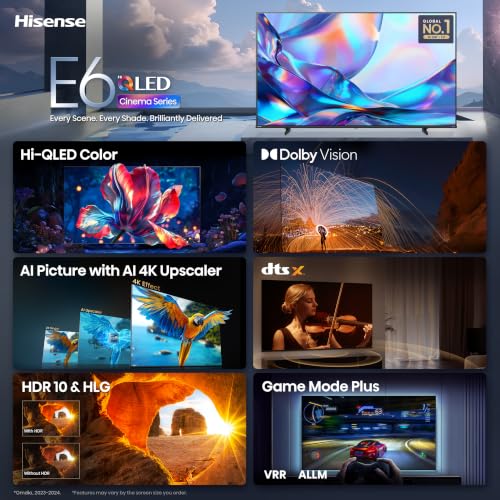
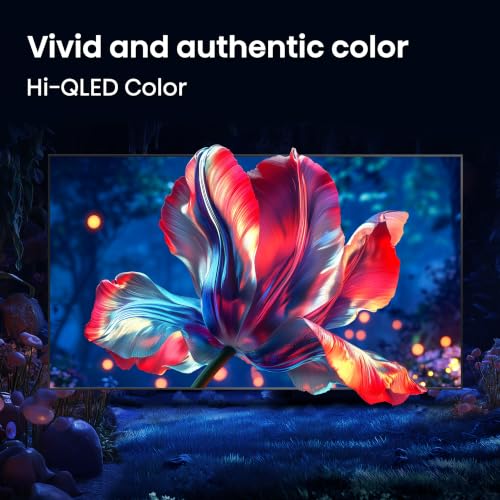
The Hisense 50″ Class E6SR Series Hi-QLED occupies a versatile 50-inch footprint measuring 3.1″D x 44″W x 25.6″H. It delivers 4K resolution backed by Hi-QLED color technology for natural tones. While the listing does not specify the backlight configuration, the display features a 60Hz refresh rate and includes a power cable, remote control with batteries, and user manual.
Picture processing is guided by AI Picture with an AI 4K Upscaler to sharpen standard definition and HD content. The panel decodes Dolby Vision, HDR10, and HLG formats to retain detail across high-contrast scenes, complemented by DTS Virtual:X audio processing for clearer dialogue and expanded virtual surround sound.
Running on Roku OS, this display offers intuitive grid navigation, Apple AirPlay integration, and compatibility with Alexa and Google Assistant. Gamers benefit from Game Mode Plus with VRR and Auto Low Latency Mode (ALLM). It suits viewers who favor the Roku interface over Fire TV, though users wanting Dolby Atmos or HDR10+ Adaptive will look to the E6 Cinema Series.
Hisense 65″ U7 Mini-LED ULED 4K for Enthusiast Gaming and High Brightness


Hisense 65" U7 Mini-LED ULED 4K 4 photos from the Amazon listing
Best for: Competitive console gamers and bright living rooms
Pros
- Native 165Hz refresh rate
- Up to 3000 nits brightness
- 3000 local dimming zones
Cons
- Large 65-inch footprint
The Hisense 65″ U7 Mini-LED ULED 4K is the flagship display of this roundup. Examining the hisense u7 miniled specs and hisense 65u7sg specs reveals a MiniLED Pro backlight array featuring thousands of Mini LEDs with up to 3,000 local dimming zones and up to 3,000 nits peak brightness. A dual-layer anti-reflection, glare-free screen keeps picture detail crisp against bright ambient light, complemented by Pantone Validated Hi-QLED color reproduction.
The display is engineered around a native 165Hz refresh rate with VRR 330, Motion Rate 480, MEMC, and Black Frame Insertion for blur-free high-speed motion. Driven by the Hi-View AI Engine Pro, it dynamically optimizes contrast and detail, supporting Dolby Vision, Dolby Vision IQ, HDR10+, HDR10+ Adaptive, IMAX Enhanced decoding, and a 2.1.2 multi-channel speaker configuration.
Powered by Google TV, this model caters to demanding PC and console gamers. Users organizing multi-device gaming stations can switch peripherals via a ugreen hdmi kvm switch before outputting high-framerate video to the screen. Its expansive 65-inch size gives way to the smaller E6 or QD4 lines in modest rooms.
Hisense 40-Inch Class QD4 Series Hi-QLED for Compact Secondary Displays


Hisense 40-Inch Class QD4 Series Hi-QLED FHD Smart Fire 4 photos from the Amazon listing
Best for: Bedrooms seeking low-latency 1080p gaming
Pros
- Quantum Dot Hi-QLED color
- Fast 16ms Game Mode latency
- DTS Virtual:X surround sound
Cons
- Restricted to 1080p resolution
- Basic HDR10 support only
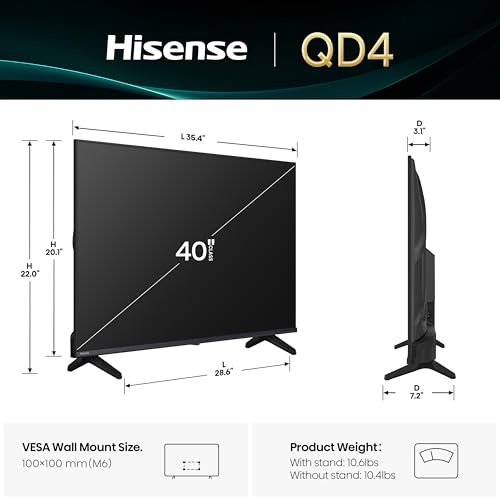
The Hisense 40-Inch Class QD4 Series Hi-QLED brings quantum dot color to secondary spaces like kitchens, bedrooms, and dorms. As part of the hisense qd4 series, it combines a 1080p Full HD resolution with Direct LED / Full Array backlighting and a 6000:1 contrast ratio, encased in a sleek slim bezel design.
Acoustic and visual performance includes HDR10 support and DTS Virtual:X sound for enhanced vocal clarity. Integrated Fire TV provides seamless app streaming, live television channel browsing, and voice navigation via the included Alexa Voice Remote.
For gaming, dedicated Game Mode minimizes input lag down to 16ms for prompt control responsiveness. This model fits buyers seeking rich color saturation in a compact format without paying for 4K. Viewers requiring full 4K resolution and Dolby Vision should consider the 43″ E6 Cinema Series instead.
Hisense 32-Inch Class QD4SR Series Hi-QLED for Tight Spaces and Kitchens


Hisense 32-Inch Class QD4SR Series Hi-QLED HD Smart Roku 4 photos from the Amazon listing
Best for: Kitchens or dorms wanting basic streaming
Pros
- Roku OS interface simplicity
- Hi-QLED quantum dot color
- Active noise reduction filtering
Cons
- 720p HD resolution limit
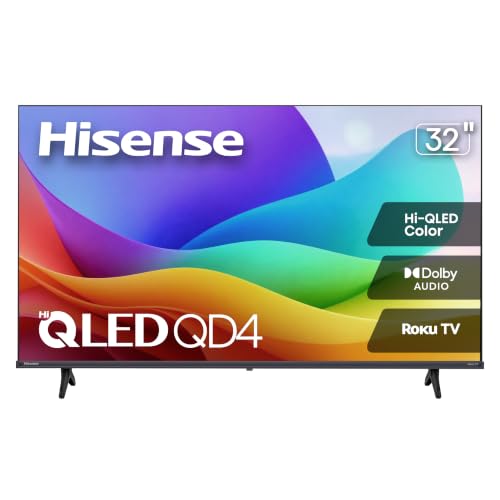
The Hisense 32-Inch Class QD4SR Series Hi-QLED is a compact display tailored for spaces where footprint is restricted. Featuring a 720p HD resolution and a 60Hz refresh rate, it pairs a Direct LED backlight with Hi-QLED quantum dot color to prevent the washed-out visuals common to budget small screens, framed by a slim bezel chassis.
The platform runs on Roku OS, giving users access to thousands of free and paid streaming channels. Roku Smart Picture optimizes visual parameters automatically, Roku Backdrops enables digital art display, and active frame-by-frame Noise Reduction cleans up compressed feeds, accompanied by Dolby Audio sound output.
Compatible with Alexa voice devices, the TV prioritizes straightforward usability. It represents an ideal choice for utility areas or guest bedrooms. When Full HD or 4K resolution, advanced HDR formats, or lower gaming latency are needed, buyers should step up to the 40-inch QD4 or 43-inch E6.
How to Choose the Right Hisense TV
When conducting a hisense tv comparison, selecting which hisense tv to buy depends on matching screen resolution, panel backlighting, motion capabilities, and smart platforms to your viewing environment. Resolution should align with display size and viewing distance. For compact screens at 32 or 40 inches, 720p and 1080p resolutions on the QD4 series provide clear visuals for casual watching. For 43 inches and larger, 4K resolution on the E6 and U7 series provides the pixel density needed for sharp text and detailed 4K streaming.
Backlight technology determines contrast and dynamic range. Direct LED configurations on the QD4 and E6 lines supply even illumination across the screen surface. In contrast, the MiniLED Pro configuration on the 65-inch U7 utilizes thousands of diodes with up to 3,000 local dimming zones and 3,000 nits peak brightness, delivering deep black levels and intense highlights that resist ambient sunlight.
Considering the hisense 4k tv refresh rate is vital for gaming and fast-moving content. Standard models across the E6, E6SR, and QD4 series feature 60Hz panels with MEMC motion processing for smooth daily viewing. The 65U7SG elevates motion performance with a native 165Hz refresh rate and VRR up to 330Hz for competitive gaming. Pairing this high-refresh display with ergonomic support like secret lab chairs ensures prolonged comfort during extended play sessions.
Operating systems define the user interface in the hisense roku tv vs fire tv choice. Roku OS on the 50E6SR and 32QD4SR offers a straightforward tile interface, Apple AirPlay, and extensive free channels. Fire TV on the 43E6QF, 55E6QF, and 40QD4QF emphasizes Amazon Alexa voice control and integrated live television guides. Google TV on the 65U7SG aggregates recommendations across streaming services into a single tailored hub.
Finally, HDR format compatibility should match your content sources. High-tier models supporting Dolby Vision, Dolby Vision IQ, and HDR10+ Adaptive dynamically adjust image settings scene by scene. Basic HDR10 on entry models enhances overall contrast, but lacks the dynamic metadata adaptation provided by Total HDR Solution and MiniLED Pro sets.
FAQ
What is the difference between Hi-QLED and standard LED on a Hisense TV?
Hi-QLED integrates a quantum dot color enhancement layer over the LED backlight. Standard LED panels rely on traditional color filters, which can limit color saturation. The microscopic nanocrystals in Hi-QLED emit precise primary red and green light when stimulated by the backlight, expanding the color gamut for more vivid scenes and authentic skin tones.
Which platform is better: Hisense Roku TV vs Fire TV?
The choice between Roku TV and Fire TV depends on your streaming preferences. Roku TV features an intuitive, grid-based menu with minimal clutter and native Apple AirPlay support. Fire TV integrates deeply with Amazon Alexa, offering advanced voice control and integrated live TV guides. Both provide access to major streaming services, but Roku emphasizes interface simplicity while Fire TV emphasizes voice features.
Does the Hisense E6 series support a native 120Hz refresh rate?
No, Hisense E6 series panels feature a native 60Hz refresh rate. The Motion Rate 120 specification indicates software motion enhancement using AI Smooth Motion with MEMC rather than a physical 120Hz panel. For native high-refresh-rate gaming beyond 60Hz, the Hisense U7 series includes a native 165Hz panel.
What makes the Hisense 55E6QF different from the 50E6SR?
The 55E6QF features a 55-inch panel with Fire TV, Total HDR Solution supporting Dolby Vision and HDR10+ Adaptive, and Dolby Atmos audio. The 50E6SR features a 50-inch panel running Roku OS with Apple AirPlay, DTS Virtual:X sound, and Dolby Vision, but lacks HDR10+ Adaptive. The choice depends on room dimensions, preferred smart interface, and HDR requirements.
What gaming features are offered across Hisense televisions?
Gaming support varies by tier. The QD4 series includes Game Mode with input lag reduced to 16ms. The E6 and E6SR series offer Game Mode Plus with Variable Refresh Rate (VRR) and Auto Low Latency Mode (ALLM) at 60Hz. The U7 series provides elite gaming performance with a native 165Hz refresh rate, VRR up to 330Hz, and low input latency.