As Amazon Associates, we earn from qualifying purchases. This means we may receive a small commission at no extra cost to you if you click through and make a purchase.
Samsung maintains an extensive footprint in the compact display segment, offering a diverse array of 43-inch panels engineered for bedrooms, home offices, commercial retail spaces, and mixed-use desktop workstations. In this form factor, the brand leverages several distinct panel architectures, ranging from baseline Crystal UHD LED backlighting and edge-lit Quantum Dot arrays to sophisticated Mini-LED matrices and dedicated smart hybrid monitors. While screen dimensions remain consistent diagonally across the category, the underlying hardware implementations diverge sharply in peak luminescence, dimming precision, optical anti-glare treatments, and integrated software platforms, giving spec-focused buyers a clear set of performance metrics to evaluate.
Across the current lineup, these six displays separate into entry-level edge lighting, high-contrast Mini-LED local dimming, matte-finished Neo QLED engineering, dedicated commercial signage firmware, and productivity-oriented USB-C smart monitor architecture. Exploring a broader 43 samsung smart tv evaluation reveals how panel configurations directly dictate dynamic range and contrast rendering. Whether evaluating the entry-level Crystal UHD platform, stepping up to high-output quantum filtration, or configuring a commercial display, analyzing the underlying hardware specifications provides clarity on which panel suits specific ambient lighting and source hardware requirements.
Samsung 43-Inch 4K Displays Compared
| Model | Backlight Technology | Brightness & Contrast | HDR Processing | Key Connectivity & Software |
|---|---|---|---|---|
| Samsung 43-Inch Class Crystal UHD U8000H | Direct LED | 250 nit, 4000:1 Contrast | HDR10+ | Tizen OS, Samsung TV Plus, Gaming Hub |
| Samsung 43-Inch Class M70H Series | Mini-LED | Not listed brightness, High Contrast | HDR10+, Mini LED HDR | Supreme Mini LED Dimming, DLG 120Hz |
| Samsung 43-Inch Class QN70H Series | Quantum Mini LED | Not listed brightness, High Contrast | Neo QLED Processing | NQ4 AI Processor, Matte Finish, Knox |
| Samsung 43-Inch Class QLED Q7F Series | Edge LED | 1000 nit, High Contrast | HDR10+, Quantum HDR | Supreme UHD Dimming, Q4 AI Gen1 |
| Samsung 43-Inch BE43T-H Pro TV | LED | 250 nit, Not listed contrast | High Dynamic Range | Samsung Pro TV App, 16/7 Commercial |
| Samsung 43” M7 | LED | 300 cd, 5000:1 Contrast | HDR10 | USB-C Data & Power, SmartThings, Knox |
Table from this guide — scroll sideways for the remaining columns.
Samsung 43-Inch Class Crystal UHD U8000H for General Home Streaming
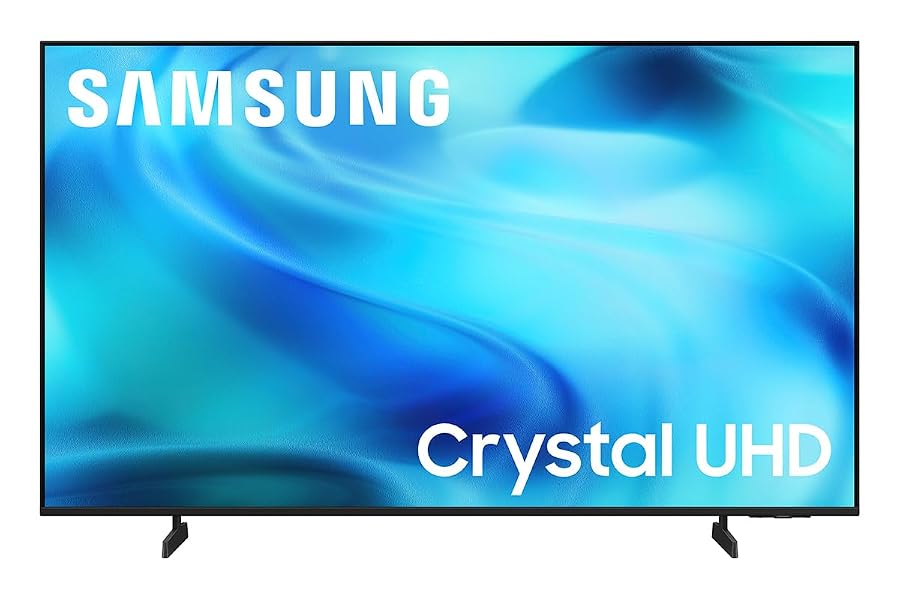


Samsung 43-Inch Class Crystal UHD U8000H 4 photos from the Amazon listing

Best for: High-peak-brightness HDR viewing
Pros
- 1000 nit maximum display brightness
- Pantone-certified color accuracy
- Supreme UHD Dimming control
Cons
- Edge LED backlight configuration
- Native 60Hz panel limit
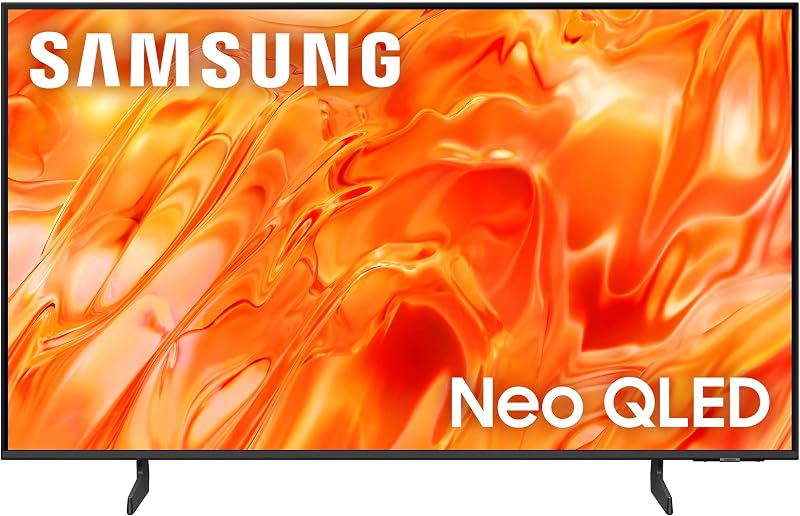
Best for: Bright rooms requiring anti-glare performance
Pros
- Quantum Mini LED with Quantum Dots
- Glare-dispersing matte screen finish
- NQ4 AI Processor optimization
Cons
- Standard 60Hz refresh rate
- Substantial 18.5 pound chassis weight

Best for: High-contrast movies and live sports
Pros
- Mini-LED backlight precision
- Pure Color Spectrum billion colors
- Dedicated Soccer Mode motion processing
Cons
- Glossy screen finish reflects glare
- Native 60Hz panel limitation
Best for: Budget-focused everyday home streaming
Pros
- Crystal Processor 4K upscaling
- 4000:1 static contrast ratio
- Over 2,700 free streaming channels
Cons
- Modest 250 nit peak brightness
- Standard 60Hz refresh rate
The Samsung 43-Inch Class Crystal UHD U8000H serves as the foundational 4K offering in Samsung’s compact television catalog. Built around a standard LED backlight arrangement, this display utilizes Samsung’s Crystal Processor 4K to manage color mapping, frame transitions, and 4K upscaling from legacy video formats. For color enhancement, the panel integrates proprietary Color Booster technology, which amplifies saturation levels across standard dynamic range streams without blowing out midtones. It is managed by Samsung’s smart environment, granting native access to Samsung TV Plus with over 2,700 free streaming options and 750 subscription-free channels, alongside the Samsung Gaming Hub for cloud gaming without requiring a physical console.
From an analytical hardware standpoint, the U8000H delivers an exact static contrast ratio of 4000:1, which enables solid black level depth in darkened viewing environments. However, its maximum display brightness is rated at 250 nits, which means it will struggle to overcome severe glare in rooms with direct, unfiltered sunlight. The panel operates at a native 60Hz refresh rate and incorporates Motion Xcelerator technology to interpolate intermediate frames during fast-moving sports and gaming sequences. High dynamic range handling is governed via HDR10+ decoding, ensuring dynamic metadata is interpreted accurately frame-by-frame, though overall highlight impact remains bounded by the 250-nit luminescent ceiling.
This television suits buyers seeking a dependable secondary screen for a bedroom, guest room, or casual home den where controlled ambient lighting prevails. The 4000:1 native contrast ratio ensures standard evening viewing is well-balanced, and the inclusion of Alexa voice navigation streamlines device operation. However, when compared to quantum dot or Mini-LED alternatives in the lineup, the U8000H lacks advanced local dimming hardware and wide color volume architectures, making it less ideal for critical home theater cinephiles who demand searing specular highlights or deep local contrast zone isolation.
Samsung 43-Inch Class M70H Series for High-Contrast Sports and Media


Samsung 43-Inch Class M70H Series, Mini LED, 4K, Smart 4 photos from the Amazon listing
Representing a major evolutionary step in compact backlighting, the Samsung 43-Inch Class M70H Series introduces Mini-LED backlighting into the 43-inch television category. By replacing standard LED clusters with thousands of miniaturized light-emitting diodes, the display achieves superior control over light dispersion and backlight bleed. Backed by the Mini LED Processor 4K and Pure Color Spectrum technology, this model outputs more than one billion distinct color gradations. The chassis is paired with a glossy screen finish that enhances perceived optical depth, allowing colors and shadow gradients to appear noticeably punchy under moderate room illumination.
The technical core of the M70H lies in its Supreme Mini LED Dimming system, which actively drives distinct lighting zones to prevent blooming around bright text and sharp objects. While the panel runs natively at 60Hz, it incorporates Motion Xcelerator paired with DLG 120Hz processing, a driver-level configuration designed to sample and display fast movement with enhanced frame pacing for sports and console titles. Samsung includes a specialized Soccer Mode, engineered to deliver 40 percent clearer motion tracking on rapid ball movement and a 30 percent boost in turf green vibrancy. HDR support includes HDR10+ via dedicated Mini LED HDR tone processing, while Samsung Knox Security safeguards passwords, PIN entries, and SmartThings IoT device data.
The M70H is designed specifically for sports enthusiasts, gamers, and viewers who consume varied multimedia in spaces where strong contrast is mandatory. The Mini-LED array delivers deeper black levels and reduced haloing compared to traditional edge-lit or direct-lit LED screens. While its glossy finish optimizes color saturation and black depth, it does reflect pinpoint overhead light sources more visibly than matte treatments. Viewers requiring strict daytime glare suppression may find that anti-reflective alternatives like the QN70H better serve sunlit spaces, but for evening viewing and sports motion, the M70H is an exceptionally capable performer.
Samsung 43-Inch Class QN70H Series for Glare-Heavy Bright Rooms


Samsung 43-Inch Class QN70H Series, Neo QLED Mini LED, 4 photos from the Amazon listing
The Samsung 43-Inch Class QN70H Series stands at the top of Samsung’s compact engineering tier, carrying the Neo QLED designation. This architecture marries a Quantum Mini LED backlight array with a microscopic Quantum Dot optical layer, eliminating color filtration losses and maximizing color purity. Internally, the television is driven by the NQ4 AI Processor, an advanced neural-network silicon block that analyzes incoming source frames in real time to optimize upscaling, audio tracking, and dynamic range delivery. Encased in a slim chassis measuring 38 inches wide by 24.2 inches high and weighing 18.5 pounds, the QN70H integrates sophisticated hardware into a compact footprint.
A defining technical feature of the QN70H is its specialized matte screen finish, engineered to diffuse incoming directional light across the panel surface and virtually eliminate specular reflections from windows or lamps. In terms of color fidelity, the Quantum Dot layer achieves 100 percent Color Volume measured in Movie Mode within the DCI-P3 color space, as certified by the German testing institute VDE. The panel’s native 3840 x 2160 resolution operates at 60Hz, supported by Color Booster Pro, which leverages AI-driven algorithms to dynamically manage color saturation according to ambient room characteristics and content genre. The listing notes that contrast is high, driven by the fine-grained Mini-LED matrix.
This model is the ideal choice for brightly lit offices, sunrooms, and living spaces with expansive windows where typical glossy screens act like mirrors. The combination of VDE-certified 100 percent DCI-P3 color volume and glare-dispersing matte surface coating ensures that bright daylight will not wash out on-screen detail. While desktop workstation users requiring dedicated DisplayPort or USB-C hub connectivity might still lean toward the M7 smart monitor, the QN70H remains Samsung’s most capable 43-inch television for high-ambient-light video entertainment and broadcast viewing.
Samsung 43-Inch Class QLED Q7F Series for Vibrant Everyday Streaming


Samsung 43-Inch Class QLED Q7F Series Samsung Vision AI 4 photos from the Amazon listing
Bridging traditional LED designs and dense Mini-LED arrays, the Samsung 43-Inch Class QLED Q7F Series focuses on high luminance and broad color volume within an ultra-thin physical profile. Instead of a full-array grid, this model utilizes an Edge LED backlight configuration modulated by Supreme UHD Dimming. The panel incorporates Quantum Dots capable of rendering over one billion individual shades, backed by Pantone certification for precise hue accuracy. Processing tasks are delegated to the Q4 AI Gen1 Processor, which automates 4K upscaling and real-time audio tuning via Object Tracking Sound Lite to position audio effects in sync with on-screen movement.
Where the Q7F distinguishes itself in hard technical specifications is its maximum display brightness, which reaches an impressive 1000 nits. This luminance ceiling significantly outpaces conventional 250-nit entry models, granting the panel the headroom necessary to produce radiant specular highlights in HDR10+ master tracks via Quantum HDR processing. The screen has a native 60Hz refresh rate augmented by Motion Xcelerator, and features high contrast capabilities despite its edge-lit backlight framework. Integrated Samsung Knox Security deploys triple-layer protection for digital assets, and Samsung Vision AI adjusts image parameters based on the specific media type playing.
Shoppers who want a vibrant, exceptionally bright screen for daytime streaming without the chassis depth of full-array backlighting will find the Q7F well aligned with their criteria. Similar to the design philosophy seen in specialized lifestyle products like samsung picture frame tv alternatives, the edge-lit assembly keeps the cabinet sleek and modern. However, because it relies on edge-mounted LEDs rather than a multi-zone Mini-LED array like the M70H, the Q7F can exhibit subtle horizontal or vertical light bleed when displaying high-contrast white text against pitch-black backgrounds in fully darkened rooms.
Samsung 43-Inch BE43T-H Pro TV for Commercial Signage and Small Business


Samsung 43-Inch BE43T-H Pro TV | Commercial | Easy 4 photos from the Amazon listing
Best for: Small business digital signage setups
Pros
- 16/7 commercial duty cycle rating
- Samsung Pro TV app management
- Dual HDMI and RF tuner inputs
Cons
- Lacks native consumer streaming apps
- 250 nit display brightness
The Samsung 43-Inch BE43T-H Pro TV is engineered specifically for commercial enterprise, hospitality, and small-business environments rather than standard consumer living rooms. Unlike consumer TVs that are intended for standard residential usage patterns, the BE43T-H is rated for continuous 16/7 operational duty cycles, allowing retail shops, medical offices, and restaurants to run digital messaging for 16 hours a day, 7 days a week without invalidating warranty parameters. Physical dimensions are 37.94 inches wide by 7.89 inches deep and 24.75 inches tall with the included stand, shrinking to a 2.34-inch depth when wall-mounted via standard hardware.
The commercial architecture of the BE43T-H manifests prominently in its interface and software ecosystem. The unit is managed remotely via the Samsung Pro TV app on mobile devices, which provides pre-built business templates for menus, promotions, and announcements. It is crucial to note that the internal smart system natively supports only YouTube; it does not feature native consumer streaming applications such as Netflix or Prime Video, requiring an external media streaming player connected via HDMI for consumer video subscription playback. Physical connectivity includes two HDMI inputs, two USB ports, Wi-Fi 5, Bluetooth, and dedicated RF inputs for terrestrial and cable broadcast tuners. Display brightness is rated at 250 nits with high dynamic range decoding support on an LED-backlit 60Hz 4K panel.
This display is suited strictly for business owners, corporate conference rooms, and commercial settings that require scheduled digital signage, automated power cycles, and reliable continuous operation. Its physical tuner also makes it practical for waiting rooms showing basic cable or antenna broadcasts. Conversely, home entertainment shoppers should bypass the BE43T-H entirely in favor of consumer models like the U8000H or Q7F, as the absence of native residential streaming software creates unnecessary friction for standard movie and television watching.
Samsung 43” M7 for Hybrid Workstation and Streaming Integration

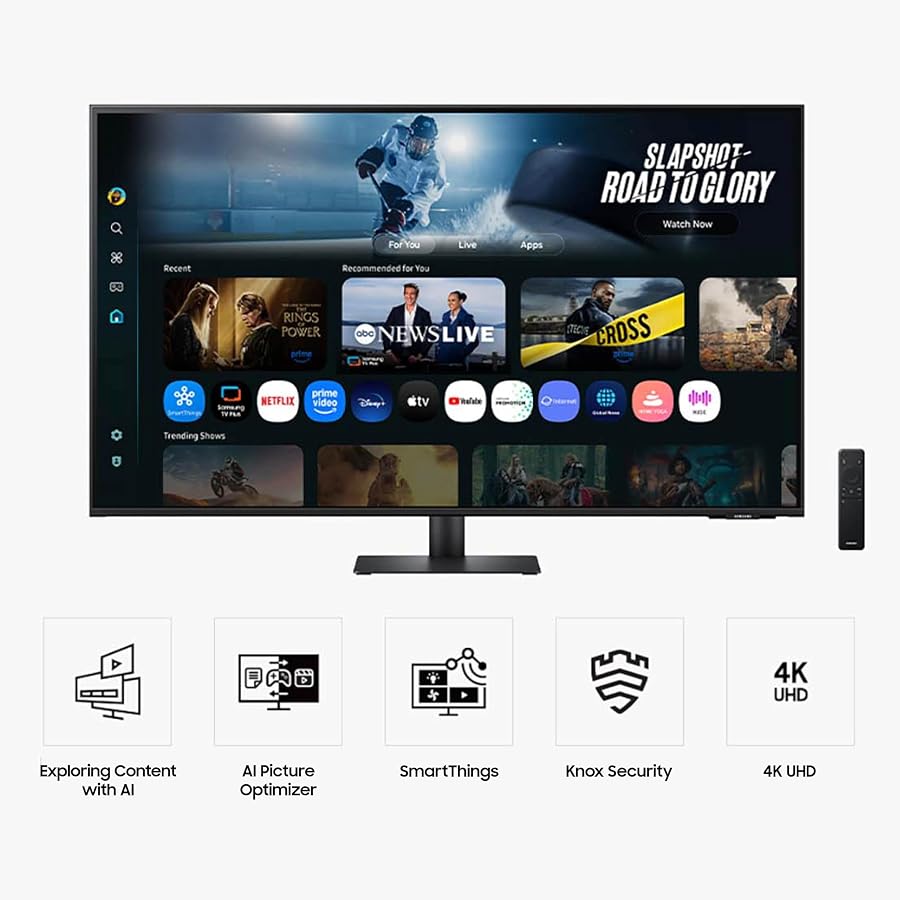


Samsung 43” M7 (M70F) Series 4K UHD Smart Monitor 4 photos from the Amazon listing
Best for: Hybrid desktop productivity and streaming
Pros
- USB-C power delivery and video
- 5000:1 high static contrast ratio
- Standalone smart streaming platform
Cons
- Lacks physical RF broadcast tuner
- Native 60Hz refresh rate
The Samsung 43” M7 redefines the compact 4K category by operating as a fully integrated hybrid smart monitor rather than a traditional broadcast television. Engineered to serve as a primary computer display that functions as an independent entertainment hub when the host PC is powered down, the M7 embeds the full Tizen smart platform directly into monitor hardware. It features built-in speakers, an AI Picture Optimizer that adjusts contrast for desktop document editing or cinema viewing, Active Voice Amplifier for dialogue clarity in noisy offices, and Samsung TV Plus for live channels without requiring an external receiver.
The physical and optical specifications of the M7 cater directly to desktop ergonomics. The 43-inch panel features a 3840 x 2160 resolution with a fine 0.23 mm pixel pitch, a glossy screen finish, 178-degree horizontal and vertical viewing angles, and 99 percent color gamut coverage. The panel achieves an exceptional 5000:1 static contrast ratio paired with a maximum brightness of 300 cd/m² (candela per square meter, equivalent to 300 nits) and HDR10 support. For connectivity, the M7 provides standard HDMI inputs, a USB-A hub, and a high-bandwidth USB-C port that carries 4K video signals, transfers data, and supplies power to connected laptops via a single cable. It also includes SmartThings 3D Map View and Samsung Knox encryption for connected IoT devices.
For home office workers, coders, and productivity power users who require massive screen real estate for multi-window workflows, the M7 is an outstanding centerpiece. It eliminates desktop cable clutter through its USB-C connection while serving double duty as a 4K streaming monitor after work hours. Buyers should note that it lacks an integrated RF coaxial tuner for over-the-air antenna signals. Users who require terrestrial broadcast television or maximum peak brightness for daytime sports should consider conventional televisions instead, such as the Q7F or larger formats like a tv samsung 85 setup in primary entertainment rooms.
How to Choose the Right Samsung 43-Inch 4K TV
Selecting the ideal 43-inch Samsung display requires matching your physical room environment, expected daily duty cycles, and input hardware to the correct panel architecture. While all models share 3840 x 2160 resolution, the way that resolution is illuminated determines performance in varied ambient conditions. Buyers looking for an everyday screen with reliable contrast for dark-room viewing can rely on the 4000:1 static contrast ratio of the baseline Crystal UHD U8000H. However, if your viewing space features ambient glare or multiple light sources, evaluating panel backlighting is the critical first step before finalizing a purchase decision.
The divide between standard LED, Edge-lit QLED, and Mini-LED architectures forms the most significant performance benchmark across this lineup. Standard LED arrays like those in the U8000H and commercial BE43T-H max out at 250 nits of brightness. Stepping up to the edge-lit QLED Q7F increases brightness dramatically to 1000 nits, making HDR10+ highlights pop with substantial intensity. Meanwhile, models like the M70H and QN70H transition to Mini-LED backlights, replacing broad lighting blocks with thousands of tiny diodes managed by precision local dimming algorithms. This Mini-LED structure minimizes haloing around subtitles and renders significantly deeper black levels than traditional edge lighting can muster.
Screen coating and optical finishes also play a massive role in viewer satisfaction. The glossy screen finishes found on the M70H Series and the M7 smart monitor enhance perceived contrast, color vibrancy, and deep shadow detail, but they are vulnerable to direct reflections from opposite windows. In contrast, the QN70H Neo QLED features a specialized matte screen finish that diffuses harsh light across the panel, making it uniquely suited for sunlit rooms or desktop positions beneath bright fluorescent bulbs. For productivity-focused setups, the M7 stands alone with its USB-C single-cable docking and 5000:1 contrast, whereas retail businesses require the dedicated 16/7 runtime engineering of the BE43T-H.
Processing silicon rounds out the selection criteria. Standard content upscaling is capably handled by the Crystal Processor 4K in entry tiers, but higher tiers benefit from artificial intelligence acceleration. The Q4 AI Gen1 processor in the Q7F and the NQ4 AI processor in the QN70H dynamically optimize both color grading and sound tracking in real time, catering to mixed media consumption. For sports fans, the M70H offers specialized DLG 120Hz processing and Soccer Mode software to keep high-velocity objects sharp. Carefully mapping your room lighting, primary content sources, and cable connectivity requirements against these technical specifications ensures you invest in the exact panel suited to your lifestyle.
FAQ
What is the primary difference between Samsung Crystal UHD and QLED in 43-inch models?
The primary difference lies in the color filtration and backlighting hardware. Crystal UHD models like the U8000H utilize traditional LED backlights paired with standard phosphor color filters, reaching a brightness level of 250 nits. In contrast, QLED models like the Q7F introduce a layer of nano-sized Quantum Dots that emit precise wavelengths when illuminated, achieving 1000 nits of peak brightness and reproducing over one billion Pantone-certified colors with higher dynamic range impact.
Can the Samsung BE43T-H Pro TV be used as a standard home living room TV?
While the BE43T-H can physically display HDMI video sources and cable television via its RF tuner, its internal smart interface is engineered strictly for commercial digital signage. The only native streaming application installed on the unit is YouTube; it lacks native access to consumer streaming platforms like Netflix, Hulu, or Prime Video. Home viewers can still use it by attaching an external streaming stick or set-top box to one of its two HDMI ports, but consumer models like the U8000H offer a far more convenient residential software experience out of the box.
Does the Samsung 43” M7 smart monitor require a connected PC to stream content?
No, the Samsung 43” M7 operates as an independent smart entertainment hub without requiring an active PC connection. It features Samsung’s built-in Tizen operating system, Wi-Fi connectivity, integrated stereo speakers, and native streaming apps alongside Samsung TV Plus. While it provides a USB-C port and HDMI inputs for computer docking, it functions completely standalone as a streaming display when the connected computer is turned off or disconnected.
How does Mini-LED backlighting improve picture quality on 43-inch displays?
Mini-LED backlighting, utilized in the M70H and QN70H series, replaces large standard LED diodes with thousands of significantly smaller light emitters grouped into dense local dimming zones. This dense grid allows the display processor to illuminate bright on-screen elements while completely darkening adjacent zones, resulting in deeper black levels, minimized light bleed, and dramatically reduced blooming around bright subtitles or small highlights compared to conventional edge-lit or direct-lit LED displays.
Do these Samsung 43-inch 4K TVs support native 120Hz console gaming?
All six 43-inch displays covered in this lineup feature native 60Hz display refresh rates. The Samsung M70H includes driver-level DLG 120Hz (Dual Line Gate) technology paired with Motion Xcelerator Turbo+ to optimize frame pacing and motion clarity for gaming sources, but the physical panel refresh rate remains rated at 60 hertz across the board. Gamers seeking uncompromised native 120Hz or 144Hz panel refresh rates must look toward larger flagship screen sizes or specialized dedicated gaming monitors.


