As Amazon Associates, we earn from qualifying purchases. This means we may receive a small commission at no extra cost to you if you click through and make a purchase.
Polaroid established the analog instant photography category by integrating self-developing chemical pods directly into film sheets, pairing light-sensitive emulsion with dedicated optical chambers. Modern iterations retain this chemical development process while overhauling the underlying electrical systems, swapping legacy disposable cartridge batteries for internal USB-C rechargeable lithium cells. When evaluating a modern polaroid camera, technical buyers need to examine optical configurations, distance-ranging mechanisms, shutter ranges, and chemical media dimensions rather than digital sensor resolution. Current designs incorporate upgraded ambient light sensors, multi-element focal switching arrays, and precision flash controllers into chassis manufactured from recycled and future-friendly plastics.
A detailed polaroid instant camera comparison reveals distinct hardware architectures across the lineup: the Polaroid Now 3rd Generation I-Type Instant pairs full-sized square chemistry with a dual-lens autofocusing system, the compact Polaroid Go Generation 2 miniaturizes the optical stack and film format for pocket transport, and the advanced Polaroid Flip Instant Camera introduces an acoustic sonar autofocus system alongside a four-lens hyperfocal array and wireless mobile connectivity.
Polaroid Instant Cameras Compared
| Model | Lens Configuration | Film Compatibility | Maximum Shutter Speed | Autofocus Mechanism |
|---|---|---|---|---|
| Polaroid Now 3rd Generation I-Type Instant | Twin-lens switching system | Polaroid i-Type and 600 | 1/60 seconds | Ranging sensor twin-zone |
| Polaroid Go Generation 2 | Aperture-optimized fixed optical stack | Polaroid Go | 1/300 – 1 seconds | Not listed |
| Polaroid Flip Instant Camera | Hyperfocal 4-lens system | Polaroid i-Type and 600 | 1/100s | Sonar acoustic rangefinder |
Table from this guide — scroll sideways for the remaining columns.
Polaroid Now 3rd Generation I-Type Instant for Studio and Everyday Portfolios




Polaroid Now 3rd Generation I-Type Instant 4 photos from the Amazon listing
Best for: Everyday shooters wanting iconic square prints
Pros
- Twin-lens autofocus system
- USB-C rechargeable battery
- Built-in tripod mount socket
Cons
- Fixed 1/60s maximum shutter speed
- Lacks acoustic distance sonar
The Polaroid Now 3rd Generation I-Type Instant serves as the standard full-format analog body in the lineup. Powered by an internal lithium-ion battery rechargeable via USB-C, the hardware provides operating capacity for more than 15 film packs per charge cycle. This modern electrical architecture eliminates the need for battery-powered cartridges, making it one of the most practical polaroid i-type film cameras for regular shooting. The camera produces authentic full-sized square instant prints framed by classic white borders from an enclosure made with future-friendly materials across six color finishes.
Optically, the third-generation revision refines exposure calculations by adjusting the position of the light meter and integrating a dedicated optical ranging sensor. Its twin-lens autofocusing system automatically alternates between close-up and standard focal zones depending on subject distance, eliminating manual macro adjustments. An automated electronic shutter caps at a maximum shutter speed of 1/60 seconds, functioning alongside automatic exposure controls to balance ambient light. Photographers can also access double-exposure mode directly on the body or set up hands-free framing with the built-in self-timer through the optical viewfinder.
For studio environments and tabletop projects, this camera incorporates a built-in tripod mount directly into its baseplate. The front lens barrel also maintains photo filter compatibility, allowing users to mount creative tint or prism filters over the optical path. Photographers purchasing a bundled polaroid camera with film configuration gain immediate full-format capability. While its 1/60-second shutter ceiling requires a stable shooting hand in dimmer ambient lighting, the camera remains the benchmark tool for authentic square-format analog prints.
Polaroid Go Generation 2 for Pocket Portability
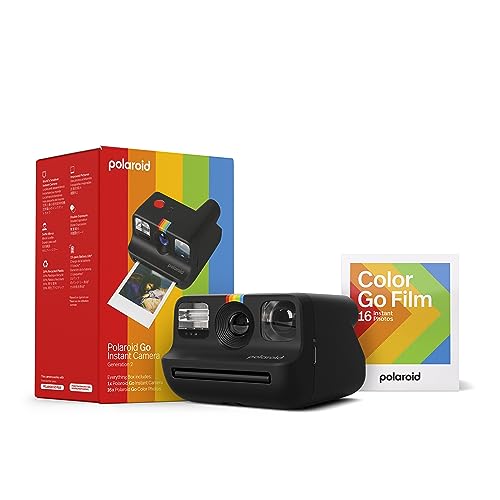


Polaroid Go Generation 2 4 photos from the Amazon listing
Best for: Travelers prioritizing ultra-compact pocket portability
Pros
- Pocketable lightweight form factor
- Dynamic 1/300 to 1s shutter range
- Integrated viewfinder selfie mirror
Cons
- Requires smaller Go film format
- No companion app integration
The Polaroid Go Generation 2 represents the brand’s smallest instant camera, engineered specifically for field mobility and everyday carry. Built using 30% recycled materials, the camera features an internal USB-C rechargeable battery capable of shooting through 15 film packs on a single charge. Unlike full-sized analog cameras that require dedicated gear bags, this pocketable chassis functions as an ultra-compact tool that slips into jackets, small bags, or packs. Optical updates on the Generation 2 model include an expanded aperture range, a precise light sensor, and adjusted exposure calibration.
Despite its miniature construction, the camera features an agile shutter mechanism operating across a dynamic range from 1/300 of a second down to a full 1 second. This wide shutter window provides greater latitude across changing ambient lighting than typical entry-level analog cameras. A built-in automatic flash provides supplemental illumination, while a reflective selfie mirror integrated over the viewfinder window simplifies solo portrait composition. Hardware buttons provide direct control over double-exposure and self-timer shooting modes, and the optical housing accepts custom miniature color filters. The listing specifications also list a 5.27-inch screen size metric and an effective still resolution value of 20.
The core trade-off of this miniaturized design centers on its proprietary film media: the unit shoots exclusively on miniature Polaroid Go film. While these physical prints deliver authentic chemical emulsion aesthetics, the overall image area is smaller than standard square i-Type prints. Readers reviewing this model within a simple polaroid camera framework will find it suited for street documentation and casual travel. Photographers who demand large-format prints and deeper focal separation will prefer the full-sized Now or Flip models.
Polaroid Flip Instant Camera for Advanced Optical Range


Polaroid Flip Instant Camera 4 photos from the Amazon listing
Best for: Technical photographers wanting advanced optical control
Pros
- Hyperfocal 4-lens system
- All-weather sonar acoustic autofocus
- Adaptive 4.5-meter lid flash
Cons
- Bulkier articulating lid chassis
- More complex multi-mode operation
The Polaroid Flip Instant Camera stands as the brand’s most advanced optical system, developed for photographers who require precise subject zoning, robust flash output, and mobile device integration. Built around a hyperfocal 4-lens system housed within an articulating lid chassis, the Flip moves beyond dual-lens switching by offering four distinct optical sweet spots optimized across varied distances. Built-in Bluetooth allows pairing with a companion app for smartphones and tablets, unlocking extended control parameters. The camera exposes full-sized square i-Type and vintage 600 film packs, and it includes a built-in tripod mount socket on the base.
Subject distance evaluation is handled by an active polaroid sonar autofocus system that emits ultrasonic sound waves to calculate focal distance. Because acoustic ranging operates independently of ambient lighting, sonar focusing functions consistently in deep shadows, high-contrast backlighting, and direct midday sun. Once distance is calculated, the internal mechanism switches to the appropriate lens in the 4-lens array. An integrated scene analysis engine continuously monitors exposure values and distance, illuminating warning LEDs inside the optical viewfinder to alert the photographer if the scene is underexposed, overexposed, or framed closer than the minimum focal distance.
Flash integration is a major mechanical strength on the Flip, utilizing an adaptive strobe mounted inside the lid that automatically modulates output power based on subject distance up to 4.5 meters. The exposure architecture supports an extensive ISO sensitivity range from 100 to 6400, paired with an electronic shutter reaching a maximum speed of 1/100s. For technical photographers seeking a dedicated polaroid with flash setup, the Flip provides superior exposure consistency and flash falloff control compared to basic fixed-output cameras.
How to Choose the Right Polaroid Instant Camera
Deciding which polaroid instant camera to buy starts with analyzing film dimensions and media economics. In the polaroid go vs itype comparison, physical print area is the defining distinction: i-Type film delivers standard 3.1 x 3.1-inch square images with traditional borders, while Polaroid Go film outputs pocket-sized prints. Full-sized i-Type emulsion provides greater surface area for rendering subtle optical gradients, chemical tones, and fine portrait textures, making it the preferred choice for physical framing and portfolios. Conversely, Go film cartridges are lightweight and compact, reducing kit bulk for mobile shooters who prioritize spontaneous pocket capture.
Focusing mechanics represent the second major hardware consideration across these models. The Go Generation 2 relies on an aperture-optimized fixed optical stack, whereas the Now 3rd Generation utilizes an optical ranging sensor to toggle between two preset focal lenses. The most versatile focusing setup belongs to the Flip, which uses acoustic sonar distance calculations to engage one of four hyperfocal lens elements. Photographers who shoot frequently in low-light environments, dark venues, or backlit conditions will find sonar autofocus advantageous, as sound waves calculate distance accurately where optical contrast sensors can struggle.
Shutter agility, exposure versatility, and flash management further separate these cameras. The Now 3rd Generation relies on an automatic 1/60s shutter ceiling, making it reliable for daylight portraits but vulnerable to motion blur in low ambient light without flash. The Go Generation 2 provides a broad 1/300 to 1-second shutter range, offering better exposure flexibility across varying outdoor light levels. The Flip pairs a 1/100s top shutter speed with an ISO 100 to 6400 sensitivity range and an adaptive 4.5-meter strobe. For photographers selecting a capable polaroid camera for adults, this adaptive strobe prevents washed-out highlights on close subjects while lighting background areas evenly.
Form factor, ergonomics, and workflow requirements will determine your best fit. The Polaroid Now 3rd Generation offers a balanced platform with tripod mounting, filter compatibility, and straightforward analog operation. The Polaroid Go Generation 2 provides a wearable design with an integrated selfie mirror for portable daily use. For technical photographers seeking the best modern polaroid camera with mobile app connectivity, comprehensive scene analysis, and multi-lens optical sharpness, the Polaroid Flip Instant Camera represents the highest performing option in the catalog.
FAQ
What is the difference between Polaroid i-Type and vintage 600 film?
Polaroid i-Type and vintage 600 film share the same square image dimensions, development chemistry, and frame border options. The technical difference is the internal power source: vintage 600 cartridges contain a built-in 6-volt battery to operate vintage cameras that lack internal power. Modern i-Type cameras, including the Polaroid Now 3rd Generation and Polaroid Flip, feature internal USB-C rechargeable lithium batteries and do not require battery power from the cartridge. Consequently, i-Type film packs do not include an integrated battery. Modern i-Type cameras can expose both i-Type and 600 film packs, but vintage cameras cannot expose i-Type film.
How does polaroid sonar autofocus operate in low-light environments?
Sonar autofocus uses active acoustic rangefinding rather than optical contrast evaluation. The camera emits an ultrasonic sound wave that bounces off the subject and returns to an onboard transducer. By measuring the time between pulse emission and return, the camera calculates subject distance with high precision. Because sound waves travel independently of visible light, sonar autofocus functions identically in total darkness, direct sunlight, or shadowed environments, avoiding the focus hunting typical of passive optical rangefinders.
Can the Polaroid Go Generation 2 accept full-sized square film?
No, the Polaroid Go Generation 2 cannot accept full-sized Polaroid i-Type or 600 film. To achieve its compact, pocket-friendly dimensions, the internal film chamber, drive gears, and chemical development rollers were designed specifically for miniature Polaroid Go film packs. Go film prints measure approximately 2.6 x 2.1 inches with an image square of 1.8 x 1.8 inches. Attempting to insert a full-sized square film cartridge into the Go chassis will cause mechanical jams and can damage the internal motor mechanism.
How do the shutter speeds compare across modern Polaroid cameras?
Each camera uses a shutter configuration tailored to its physical design and intended shooting scenario. The Polaroid Now 3rd Generation I-Type Instant features an automatic shutter with a maximum speed of 1/60 seconds, suited for daylight exposures and flash-assisted indoor work. The Polaroid Flip Instant Camera increases maximum shutter speed to 1/100s, operating alongside an expanded ISO 100-6400 sensitivity range to help freeze motion. The Polaroid Go Generation 2 features a broad dynamic shutter span from 1/300 of a second down to 1 second, handling bright outdoor scenes as well as long low-light exposures.
Why is USB-C charging beneficial compared to traditional Polaroid battery packs?
Vintage instant cameras relied on disposable zinc-carbon batteries built into every single film cartridge, resulting in battery waste with every pack used. Modern Polaroid cameras feature internal rechargeable lithium-ion cells powered via standard USB-C cables. A single complete charge powers the camera through 15 or more film packs, eliminating single-use battery waste while ensuring consistent motor ejection speed and reliable flash recycle times throughout each shoot.