As Amazon Associates, we earn from qualifying purchases. This means we may receive a small commission at no extra cost to you if you click through and make a purchase.
Canon has established itself as an optical powerhouse in the mirrorless realm through its RF mount architecture, engineered with a wide 54mm internal diameter, a short 20mm flange focal distance, and a high-speed 12-pin communication interface. This optical design allows engineers to position large rear elements closer to the camera sensor, unlocking unprecedented sharpness, minimized chromatic aberrations, and rapid bidirectional communication between glass and body. Whether designing ultra-compact primes for casual carry or rugged L-series zooms for demanding assignments, the manufacturer optimizes each optic around the precise imaging parameters of the modern full-frame and APS-C mirrorless sensor.
Across this lineup, these six models span ultra-compact prime optics with stepping motors, versatile constant-aperture L-series professional standard zooms featuring Nano USM drives, and accessible long-range telephoto zooms with varied stabilization implementations.
Canon Camera Lenses Compared
| Lens Model | Focal Length | Maximum Aperture | Image Stabilization | Autofocus Drive Motor |
|---|---|---|---|---|
| Canon RF50mm F1.8 STM Lens | 50mm | f/1.8 | Digital | Gear-Type STM |
| Canon RF100-400mm F5.6-8 is USM Telephoto | 100-400mm | f/5.6-8 | Optical (Up to 5.5 Stops) | Nano USM |
| Canon RF24-70mm F2.8 L is USM | 24-70mm | f/2.8 | Optical (Up to 5 Stops) | Nano USM |
| Canon RF75-300mm F4-5.6 | 75-300mm | f/4-5.6 | No image stabilization | Servo AF / Not listed |
| Canon RF 24-105mm f 4L is | 24-105mm | f/4 | Optical (Up to 5 Stops) | Nano USM |
| Canon RF35mm F1.8 is Macro STM | 35mm | f/1.8 | Optical (Up to 5 Stops) | STM |
Table from this guide — scroll sideways for the remaining columns.
Canon RF50mm F1.8 STM Lens for Compact Low-Light Shooting


Canon RF50mm F1.8 STM Lens 4 photos from the Amazon listing
Best for: Compact everyday carry and low-light portraiture
Pros
- Bright f/1.8 aperture
- Extremely lightweight and compact
- Customizable control ring
Cons
- Lacks optical image stabilization
- Gear-type STM slower than USM
The Canon RF50mm F1.8 STM Lens delivers the classic standard prime perspective in an ultra-portable housing tailored for mirrorless mobility. Weighing mere ounces, this prime optic incorporates a fixed 50mm focal length that closely matches human visual perspective, offering a natural 46-degree real angle of view. Its large f/1.8 aperture excels in dim ambient light, facilitating rapid shutter speeds while producing pronounced background separation and smooth bokeh. The optical formula utilizes Super Spectra coating and optimized lens placement to reduce internal reflections, flare, and ghosting, maintaining contrast when shooting into strong light sources.
Autofocus is driven by a gear-type stepping motor (STM) that provides quiet, smooth continuous tracking suitable for both still photography and video capture. The barrel features Canon’s tactile control ring, which allows photographers to adjust exposure compensation, shutter speed, aperture, or ISO directly from the lens barrel without looking away from the viewfinder. The technical specifications identify this optic as having a macro classification and digital image stabilization integration across compatible EOS R system bodies, including full-frame entries like the EOS R5, R6, and RP, as well as APS-C cameras like the EOS R7 and R10.
This optic is ideal for street photographers, portrait enthusiasts, and everyday content creators who prioritize extreme compactness and low-light capability over zoom flexibility. However, users requiring built-in optical shake correction for handheld video or optical telephoto reach will find it gives way to stabilized zooms like the RF 24-105mm f 4L or the dedicated macro mechanics found on wider primes.
Canon RF100-400mm F5.6-8 is USM Telephoto for Wildlife and Sports


Canon RF100-400mm F5.6-8 is USM Telephoto 4 photos from the Amazon listing
Best for: Handheld wildlife and outdoor sports photography
Pros
- Up to 5.5 stops optical IS
- Rapid Nano USM autofocus
- Impressive 0.41x telephoto magnification
Cons
- Narrow f/8 aperture at 400mm
The Canon RF100-400mm F5.6-8 is USM Telephoto brings extended reach to mirrorless shooters without the substantial bulk typically associated with long telephoto zooms. Covering a 4x zoom ratio across 100mm to 400mm, this telephoto tool delivers a tight 61-degree field of view at the wide end that narrows significantly at maximum extension. The variable f/5.6 to f/8 aperture design enables a lightweight chassis that remains comfortable during handheld field operations. An advanced optical image stabilizer provides up to 5.5 stops of shake correction on its own, expanding up to 6 stops of coordinated stabilization when mounted to camera bodies equipped with In-Body Image Stabilizer (IBIS) systems.
Autofocus operations are managed by Canon’s high-speed Nano USM drive, which unites the swift burst-capture responsiveness of an ultrasonic motor with the quiet, continuous tracking smoothness of an STM unit. The lens boasts close-focusing capabilities, maintaining a minimum focusing distance of 2.89 feet at 200mm and reaching a 0.41x maximum magnification ratio at the 400mm mark. Incorporating an Ultra Low Dispersion element, the optical structure actively controls chromatic fringing across the zoom throw. Action photographers comparing options in our canon sports lens guide will appreciate how quickly the Nano USM locks onto moving subjects.
This telephoto lens is engineered specifically for outdoor sports shooters, birders, and travel photographers who need extensive reach without carrying heavy professional super-telephotos. When working in low-light indoor stadiums or heavily shaded forests, however, the f/8 aperture at 400mm gives way to wider-aperture standard zooms like the RF 24-70mm f/2.8 L.
Canon RF24-70mm F2.8 L is USM for Professional Standard Zoom Work


Canon RF24-70mm F2.8 L is USM 4 photos from the Amazon listing
Best for: Professional event, commercial, and wedding photographers
Pros
- Constant bright f/2.8 aperture
- 5-stop optical image stabilizer
- Air Sphere and Fluorine coatings
Cons
- Substantial physical barrel weight
The Canon RF24-70mm F2.8 L is USM serves as the professional workhorse of the RF system, combining high optical resolution with a bright, constant f/2.8 aperture throughout its 24-70mm zoom range. Spanning an 84-degree maximum angle of view down to standard telephoto framing, this lens handles diverse assignments ranging from environmental landscapes to intimate portraits. As an elite L-series optic, it incorporates advanced Air Sphere and Fluorine coatings to suppress optical aberrations, repel moisture, and resist smudges. The lens features an integrated control ring for direct tactile adjustment of critical exposure settings on the fly.
For hand-held reliability, the lens incorporates an optical image stabilization system rated for up to 5 stops of shake correction, an essential feature for maintaining sharpness at slower shutter speeds. Focus drive duties are executed by a Nano USM mechanism that delivers instantaneous, whisper-quiet autofocus tracking, making it exceptionally reliable for fast-paced commercial stills and cinematic video tracking. Its close-up performance is equally robust, offering a minimum focusing distance of just 0.69 feet (0.21 meters) at the 24mm wide angle and 1.25 feet (0.38 meters) at the 70mm telephoto position. For shooters analyzing zoom ranges, our canon rf zoom lens analysis details how this constant-aperture zoom handles varied production environments.
This optic is tailored for wedding professionals, photojournalists, and commercial creators demanding uncompromising sharpness, weather-resistant construction, and consistent light gathering. Where extreme focal range or minimal weight is the primary priority, it gives way to lighter alternatives like the RF 24-105mm f/4L or compact prime lenses.
Canon RF75-300mm F4-5.6 for Telephoto Reach
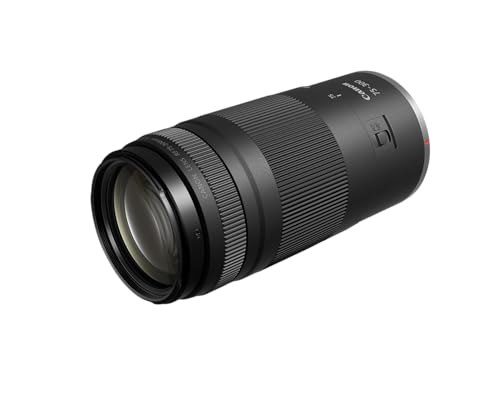


Canon RF75-300mm F4-5.6 4 photos from the Amazon listing
Best for: Beginner telephoto reach on a budget
Pros
- Extensive 75-300mm zoom reach
- Supports Servo AF pupil tracking
- Compact telephoto form factor
Cons
- No internal image stabilization
- Variable f/4-5.6 maximum aperture
The Canon RF75-300mm F4-5.6 provides an approachable telephoto zoom solution for photographers looking to compress distant backgrounds and bring far-off subjects into view. Covering a 75mm to 300mm focal range, this optic yields a 32-degree angle of view, translating to an effective 35mm-equivalent reach of approximately 120mm to 480mm when attached to APS-C sensor mirrorless bodies. The variable f/4-5.6 aperture keeps the physical barrel compact and portable, ensuring it remains easy to transport for field outings, zoo visits, and casual sporting events.
Despite its accessible design, the optic retains advanced autofocus features, supporting Servo AF and pupil detection tracking to ensure that human and animal subjects remain sharp even when operating at the maximum 300mm telephoto boundary. The long focal length naturally creates attractive optical compression and background blur, isolating subjects cleanly from distracting backgrounds. Unlike many other telephoto options in the lineup, the listing specifies that this model has no optical image stabilization mechanism, meaning shake control relies on camera technique, fast shutter speeds, or in-body stabilization systems on equipped camera bodies.
This model suits amateur photographers, hobbyists, and daytime outdoor enthusiasts who want substantial telephoto reach without a heavy footprint. However, for wildlife photographers working under dense canopy or in dim dawn and dusk conditions, the lack of optical stabilization and narrower variable aperture gives way to the stabilized RF 100-400mm IS USM.
Canon RF 24-105mm f 4L is for All-in-One Professional Versatility


Canon RF 24-105mm f/4L is USM Zoom Lens, Black, 4 photos from the Amazon listing
Best for: All-in-one travel and documentary photography
Pros
- Versatile 4.4x zoom range
- Constant f/4 maximum aperture
- Smooth, silent Nano USM drive
Cons
- F/4 aperture limits low-light bokeh
The Canon RF 24-105mm f 4L is stands as one of the most versatile standard zooms in the RF lineup, merging broad focal coverage with rugged L-series craftsmanship. Spanning from an expansive 24mm wide-angle perspective to a compressed 105mm portrait length, it offers a 4.4x zoom ratio with a consistent f/4 maximum aperture across the entire range. The constant aperture ensures that exposure values remain locked during zoom pulls, a crucial feature for documentary video shooters and studio photographers alike. The front and internal elements benefit from Nano AR Coating to eliminate flare and internal reflections under direct sunlight.
Historically notable as the first L-series lens to incorporate a Nano USM drive, it delivers near-instantaneous autofocus for stills alongside smooth, silent tracking during video recording. Handheld performance is reinforced by an optical image stabilizer providing up to 5 stops of shake correction, ensuring tack-sharp exposures in low light without requiring a tripod. A dedicated barrel-mounted control ring allows immediate access to exposure parameters. Photographers exploring package setups in our cannon camerashot bundle overview will recognize this lens as a premier general-purpose foundation for EOS R mirrorless bodies.
This lens is the definitive choice for event documentarians, travel photographers, and landscape shooters who need one reliable optic that covers wide-angle vistas through medium-telephoto portraits. For situations demanding maximum background separation or indoor sports action, it yields to the brighter f/2.8 maximum aperture of the RF 24-70mm L.
Canon RF35mm F1.8 is Macro STM for Wide-Angle Close-Up Photography


Canon RF35mm F1.8 is Macro STM Lens 2 photos from the Amazon listing
Best for: Close-up detail, vlogging, and street scenes
Pros
- 5x half-life-size macro magnification
- 5-stop optical image stabilization
- Bright f/1.8 maximum aperture
Cons
- STM focus slower than Nano USM
The Canon RF35mm F1.8 is Macro STM provides an agile wide-angle focal length combined with half-life-size close-up imaging capabilities. With a wide 63.43-degree real angle of view, this 35mm prime excels at street photography, environmental portraits, and interior scenes. Its bright f/1.8 maximum aperture permits shooting in dimly lit venues while creating shallow depth of field when framing subjects near the minimum focusing distance of 0.56 feet (0.17 meters). Specialized optical elements are treated with Super Spectra coating to maintain rich color fidelity and prevent ghosting in high-contrast lighting.
Setting this prime apart is its 0.5x (1:2) magnification ratio, allowing creators to capture intricate textures, product details, and flora. Unlike many wide prime lenses, it integrates built-in optical image stabilization rated at up to 5 stops of shake correction, greatly enhancing handheld stability for low-light stills and mobile video capture. The lens features an STM autofocus motor for quiet, smooth focus transitions, a customizable control ring, and a rapid 12-pin communication interface that interfaces seamlessly with EOS R bodies. Detailed close-up comparisons in our canon macro lens technical review highlight how this wide perspective contrasts with traditional telephoto macro glass.
This optic is ideally suited for food photographers, vloggers, and detail-oriented travel shooters who require an intimate minimum focus distance alongside wide-angle field coverage. Those seeking long telephoto compression or zoom flexibility will find their needs better served by the RF 100-400mm or the RF 24-105mm f/4L.
How to Choose the Right Canon Camera Lenses
Selecting the ideal optic from Canon’s native mirrorless ecosystem requires a methodical evaluation of motor technology, image stabilization, and optical aperture constraints. A comprehensive canon r lens comparison starts with understanding the distinction between stepping motors and ultrasonic drives. The Canon RF 50mm f1.8 STM and Canon RF 35mm f1.8 Macro STM utilize stepping motors (STM), which are optimized for smooth, quiet video transitions and compact barrel designs. Conversely, the Canon RF 24-70mm f2.8 L IS USM, Canon RF 24-105mm f4 L IS USM, and Canon RF 100-400mm f5.6-8 IS USM incorporate Nano USM drives, which deliver instantaneous burst-rate autofocus tracking essential for fast-moving subjects and professional event work.
Image stabilization is another critical performance metric when deciding which canon r lens to buy. Native canon rf mount lenses like the RF 100-400mm offer up to 5.5 stops of standalone optical shake correction, expanding to 6 stops when paired with camera bodies featuring in-body image stabilization (IBIS). The RF 24-70mm, RF 24-105mm, and RF 35mm all provide 5 stops of optical stabilization, making them formidable handheld tools. In contrast, the Canon RF 75-300mm features no internal optical stabilization, requiring higher shutter speeds or IBIS-equipped bodies like the EOS R5 or R6 to prevent motion blur at 300mm.
Focal coverage and maximum aperture establish the creative limits of each lens across canon eos r lenses. Prime lenses like the 50mm and 35mm provide wide f/1.8 apertures for low-light gathering and shallow depth of field, making them indispensable for portraiture and night street photography. However, zoom optics like the constant-aperture f/2.8 and f/4 L-series models trade maximum light intake for framing flexibility, covering wide-to-telephoto perspectives without requiring lens swaps in dusty environments.
Finally, physical construction and operational controls differentiate enthusiast glass from professional tools. L-series selections feature weather-resistant gaskets, fluorine coatings, and sophisticated optical configurations such as Air Sphere coatings. Every native RF optic reviewed here, from the budget-friendly primes to the premier zooms, incorporates the electronic control ring, granting immediate manual tactile authority over camera settings directly at your fingertips.
FAQ
What is the difference between STM and Nano USM autofocus motors in Canon RF lenses?
STM (stepping motor) lenses utilize a mechanical gear-type or lead-screw mechanism that moves optical elements smoothly and quietly, making them well-suited for video recording and compact prime lenses like the RF 50mm f/1.8 and RF 35mm f/1.8 Macro. Nano USM combines the quiet fluidity of an STM motor with the rapid start-and-stop responsiveness of an ultrasonic drive, delivering the near-instantaneous autofocus speeds required for tracking sports, wildlife, and fast action in lenses like the RF 24-70mm f/2.8 L and RF 100-400mm IS USM.
Can full-frame Canon RF lenses be used on APS-C EOS R cameras?
Yes, all native Canon RF mount lenses are fully compatible with APS-C sensor cameras in the EOS R system, such as the EOS R7, R10, R50, and R100. When mounting a full-frame RF lens on an APS-C body, the smaller sensor applies a 1.6x crop factor to the field of view. For instance, the Canon RF 75-300mm yields an effective focal length of approximately 120mm to 480mm, providing extended telephoto reach for wildlife and sports photography without requiring an adapter.
How does optical image stabilization interact with Canon In-Body Image Stabilization?
When an optically stabilized RF lens is mounted to an EOS R series body featuring an In-Body Image Stabilizer (IBIS), such as the EOS R5 or EOS R6, the lens and camera communicate through the 12-pin RF mount to coordinate shake correction. The lens handles pitch and yaw corrections, while the in-body sensor handles roll and translational movements. In lenses like the RF 100-400mm IS USM, this coordinated system increases total stabilization performance from 5.5 stops up to 6 stops of shake correction.
What functionality does the Canon RF lens control ring provide?
The control ring is an assignable physical ring integrated into the barrel of Canon RF mount lenses. Photographers can customize its function through the camera menu to adjust key exposure settings directly, including aperture, shutter speed, ISO sensitivity, or exposure compensation. This tactile interface allows direct manual parameter adjustments without entering digital camera menus or removing your eye from the electronic viewfinder.
What are the macro capabilities of the Canon RF 35mm f1.8 IS Macro STM?
The Canon RF 35mm f/1.8 IS Macro STM offers a maximum magnification ratio of 0.5x (1:2 half-life-size reproduction) with a minimum focusing distance of 0.56 feet (0.17 meters). While not a 1:1 true macro optic, its close-focusing capabilities allow photographers to capture detailed close-ups of small objects, food, and textures while retaining the wide-angle context of a 35mm field of view.