As Amazon Associates, we earn from qualifying purchases. This means we may receive a small commission at no extra cost to you if you click through and make a purchase.
ASUS Republic of Gamers has engineered some of the most thermally ambitious mobile platforms in personal computing, establishing a reputation for pushing silicon wattage to its absolute thermal threshold. For hardware analysts and performance enthusiasts comparing top-tier hardware, the manufacturer is recognized for integrating dense vapor chamber heat spreaders, tri-fan exhaust layouts, and factory-applied liquid metal compounds that allow graphics processors and host processors to operate at sustained clocks without immediate thermal down-throttling. Evaluating modern high-wattage systems against established graphical benchmarks like the mobile RTX 4080 requires a granular look at power delivery, dynamic boost limits, and thermal saturation behavior. Whether managing complex shader compilation workloads or rendering high-framerate 1440p and 4K gaming titles, an asus rog laptop configuration relies on coordinated thermal and electrical balancing to deliver desktop-grade compute within transportable enclosures.
Across this lineup, these four portable gaming stations diverge significantly in physical form factor, display resolution, and silicon integration, spanning agile 16-inch chassis driven by Core Ultra 9 or Ryzen 9 processors paired with RTX 5070 Ti graphics up to massive 18-inch desktop-replacement enclosures housing RTX 5080 and 175-watt RTX 5090 silicon with advanced Mini LED panels.
ASUS Gaming Laptops Compared
| Model | Processor | Graphics & TGP | Display | Memory & Storage |
|---|---|---|---|---|
| ASUS ROG Strix G16 | Intel Core Ultra 9 275HX | NVIDIA GeForce RTX 5070 Ti (TGP Not listed) | 16-inch 2.5K (2560×1600), 240Hz, 3ms, ROG Nebula, ACR film | 32GB DDR5-5600MHz, 1TB PCIe Gen 4 SSD |
| ASUS ROG Strix SCAR 18 | Intel Core Ultra 9 275HX | NVIDIA GeForce RTX 5090, 175W TGP | 18-inch 2.5K, 240Hz, 3ms, ROG Nebula HDR Mini LED, 2,000+ zones | 32GB DDR5-5600MHz, 2TB PCIe Gen 4 SSD (up to 7,000MB/s) |
| ASUS 2025 ROG Strix G16 Gaming | AMD Ryzen 9 8940HX (16 Cores, 32 Threads, up to 5.3GHz) | NVIDIA GeForce RTX 5070 Ti, 140W TGP, 12GB GDDR7 | 16-inch WUXGA (1920×1200), 165Hz, 3ms, 100% sRGB, G-SYNC | 32GB DDR5-5600 RAM, 1TB PCIe 4.0 SSD (Gen 5 slot available) |
| ASUS ROG Strix Scar 18 | Intel Core Ultra 9 290HX Plus | NVIDIA GeForce RTX 5080, 16GB VRAM (TGP Not listed) | 18-inch 4K, 240Hz, 3ms, ROG Nebula HDR Mini LED, ELMB | 32GB DDR5-6400MHz, 1TB PCIe Gen 4 SSD |
Table from this guide — scroll sideways for the remaining columns.
ASUS ROG Strix G16 for High-Refresh Esports Mobility


ASUS ROG Strix G16 4 photos from the Amazon listing

Best for: Creators demanding 4K 240Hz visual precision
Pros
- World-first 4K 240Hz Mini LED panel
- Dual high-speed Thunderbolt 5 connectivity ports
- Fast 6400MHz DDR5 memory configuration
- Upgraded thermal assembly with 91 percent more airflow
Cons
- Substantial desktop replacement footprint and mass
Best for: Enthusiasts seeking uncompromised 175W desktop replacement graphics
Pros
- Flagship 175W RTX 5090 graphics silicon
- Mini LED display with 2000 plus dimming zones
- Tool-free chassis access for quick hardware upgrades
- Fast 2TB SSD with 7000MBps throughput
Cons
- Heavy 6.3-pound chassis limits frequent mobility
Best for: Competitive esports players needing 240Hz portability
Pros
- Fast 240Hz ROG Nebula display with ACR film
- Next-gen Blackwell RTX 5070 Ti graphics
- End-to-end vapor chamber cooling with liquid metal
Cons
- Limited to 1TB internal storage from factory
The ASUS ROG Strix G16 (model G615LR-AS96) is configured as a balanced, high-velocity machine tailored for competitive esports players and power users who require high pixel density without committing to an oversized footprint. Encased in a black chassis weighing 5.8 pounds, this ultra-portable clamshell integrates an Intel Core Ultra 9 Processor 275HX working alongside the NVIDIA GeForce RTX 5070 Ti Laptop GPU. Built upon NVIDIA Blackwell architecture, the dedicated graphics solution leverages DLSS 4 frame generation and Max-Q efficiency technologies to drive sustained frame rates in high-demand titles. The platform includes 32GB of DDR5-5600MHz system memory and a 1TB PCIe Gen 4 solid-state drive, establishing a robust computational pipeline for simultaneous game streaming, multitasking, and background shader compilation.
Visual fidelity is anchored by an ROG Nebula 16:10 aspect ratio 2.5K WQXGA panel operating at a 240Hz refresh rate and a rapid 3ms gray-to-gray response time. A newly implemented Anti-Corona Reflection (ACR) film coats the screen, directly mitigating ambient light glare while enhancing color contrast during intense visual scenes. Managing the thermal load generated by the high-frequency processor and dedicated graphics package is an ROG Intelligent Cooling assembly incorporating an end-to-end vapor chamber, tri-fan technology, and Conductonaut Extreme liquid metal interface material applied directly to the chipset. For personalized aesthetics and workspace adaptability, the chassis features a customizable full-surround RGB lightbar that synchronizes with peripheral devices, complemented by a dedicated Stealth Mode that disables all lighting accents for discreet use in professional environments.
For gamers and technical analysts seeking an agile configuration, this machine serves as a direct evolution beyond older asus rog strix laptop baselines, delivering modern Blackwell architectural efficiency in a sub-six-pound package. While it excels in esports titles where 240Hz refresh rates at 2.5K resolution offer a distinct competitive edge, users demanding expansive screen real estate, multi-terabyte factory solid-state storage, or the absolute graphical ceilings provided by 175W flagship silicon will find greater headroom in the brand’s larger 18-inch desktop-replacement tiers.
ASUS ROG Strix SCAR 18 for Maximum 175W Flagship Throughput


ASUS ROG Strix SCAR 18 (2025) Gaming Laptop, 18” 4 photos from the Amazon listing
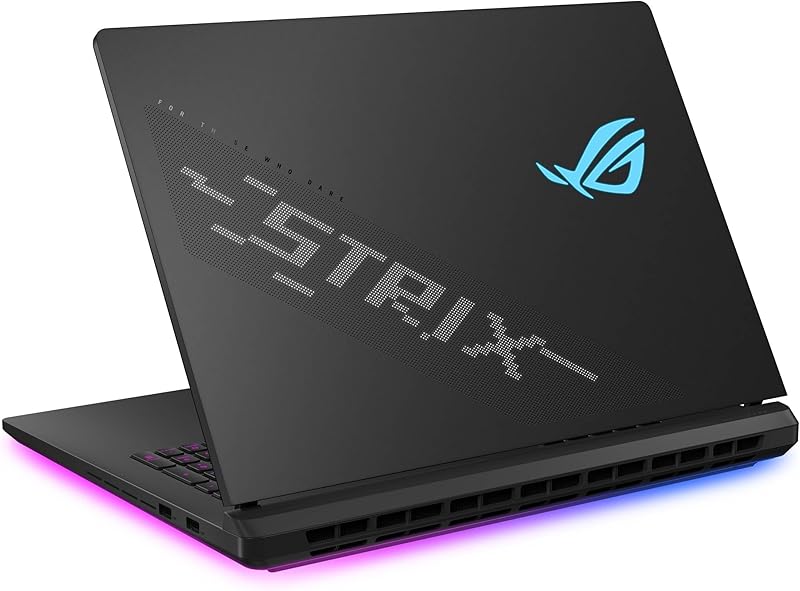
Engineered for uncompromised desktop-grade graphical throughput, the ASUS ROG Strix SCAR 18 (model G835LX-XS97) represents an apex configuration centered on maximum power delivery and display luminance. At the heart of this 6.3-pound clamshell system sits the Intel Core Ultra 9 275HX processor linked to a flagship NVIDIA GeForce RTX 5090 Laptop GPU configured to a maximum Total Graphics Power (TGP) of 175 watts. System responsiveness is supported by 32GB of DDR5-5600MHz RAM and a 2TB PCIe Gen 4 NVMe solid-state drive offering sequential read throughput up to 7,000MB/s. Graphics pipeline routing is managed by an integrated hardware MUX Switch coupled with Advanced Optimus technology, boosting gaming performance by 5 to 10 percent through direct discrete GPU routing while preserving battery runtimes during non-gaming tasks by automatically toggling the integrated graphics processor without requiring a system restart.
The centerpiece of this model is its 18-inch ROG Nebula HDR 16:10 2.5K display, engineered with Mini LED backlighting across more than 2,000 discrete local dimming zones. Capable of achieving a 240Hz refresh rate and 3ms response time, the panel delivers 100% DCI-P3 color space coverage and features dual ACR anti-reflective layers to ensure vibrant, accurate color rendition in heavily lit environments. Underpinning this hardware is an advanced iteration of ROG Intelligent Cooling, which pairs an end-to-end vapor chamber and sandwiched heatsink structure with a tri-fan design and Conductonaut Extreme liquid metal. Chassis customization is elevated via the AniMe Vision display on the lid, allowing users to project custom text and animations, alongside a 360-degree full-surround RGB lightbar with a togglable Stealth Mode.
This powerhouse is designed specifically for computational specialists, professional streamers, and enthusiasts looking to maximize frame rates at extreme quality presets. Hardware maintenance is simplified via tool-free access, featuring a slide latch on the bottom half of the chassis that exposes the RAM slots, SSD bays, and cooling fans without requiring a screwdriver, protected by an internal removable sub-frame. Shoppers evaluating an asus 5090 laptop deployment will appreciate the inclusion of Windows 11 Pro and a 3-month PC Game Pass subscription, though users prioritizing compact mobility will find its 18-inch profile and 6.3-pound chassis tailored primarily for stationary desk operation rather than daily transit.
ASUS 2025 ROG Strix G16 Gaming for Dual-Interface AMD Workloads


ASUS 2025 ROG Strix G16 Gaming 4 photos from the Amazon listing
Best for: Developers requiring 32 AMD execution threads
Pros
- 16-core AMD Ryzen 9 8940HX processor
- Dedicated PCIe Gen 5 SSD expansion slot
- Dual 40Gbps USB4 ports with PCIe tunneling
- 140W RTX 5070 Ti matches 4080 baselines
Cons
- Lower 1200p resolution compared to 2.5K panels
Providing a distinct silicon architecture within the lineup, the ASUS 2025 ROG Strix G16 Gaming integrates an AMD-driven computational foundation housed in an Eclipse Grey enclosure measuring 13.94 inches long, 10.39 inches wide, and 0.89 inches thick. Processing workloads are handled by the 16-core, 32-thread AMD Ryzen 9 8940HX processor, capable of boosting up to 5.3GHz from a 2.4GHz base frequency. Dedicated graphics processing is executed by the NVIDIA GeForce RTX 5070 Ti Laptop GPU equipped with 12GB of high-speed GDDR7 video memory and tuned to a maximum TGP of 140 watts with Dynamic Boost. In graphical capability, this 140W GPU configuration performs roughly on par with or slightly higher than previous-generation mobile RTX 4080 baselines, giving computational power users substantial headroom for rendering and gaming.
Storage and interface expansion represent standout strengths for this build. The laptop arrives populated with 32GB of DDR5-5600 memory and a 1TB PCIe 4.0 NVMe SSD, while notably providing an additional expansion slot that supports cutting-edge PCIe Gen 5 solid-state drives for next-generation storage upgrades. Connectivity is equally robust, featuring dual USB4 ports operating at 40Gbps that support DisplayPort output, G-SYNC synchronization, and PCIe tunneling for external graphics docking stations, rounded out by a dedicated HDMI 2.1 port. Visual output is channeled through a 16-inch WUXGA (1920×1200) IPS-level display operating at a 165Hz refresh rate with a 3ms response time, 100% sRGB color gamut coverage, G-SYNC variable refresh rate support, and an anti-glare finish.
This edition is particularly suited for software developers, content creators, and multi-platform power users who require the parallel processing strength of 32 AMD execution threads alongside versatile high-bandwidth peripheral expansion. The physical bundle includes an auxiliary mouse pad alongside Windows 11 Home. While the 1920×1200 resolution display delivers high frame rates in fast-twitch esports, enthusiasts who demand higher pixel density like 2.5K WQXGA or 4K Mini LED backlighting will find the alternate G16 or SCAR tiers better aligned with ultra-high-definition visual demands.
ASUS ROG Strix Scar 18 for 4K Mini LED Desktop Replacement


ASUS ROG Strix Scar 18 (2026) Gaming Laptop, 18” 4 photos from the Amazon listing
Representing the cutting edge of visual resolution and computational throughput, the 2026 edition of the ASUS ROG Strix Scar 18 (model G835LWG-DB96) introduces an unprecedented 4K 240Hz display engine into an 18-inch desktop replacement form factor. Finished in an Off Black tone, the notebook integrates the flagship Intel Core Ultra 9 Processor 290HX Plus alongside an NVIDIA GeForce RTX 5080 Laptop GPU equipped with 16GB of dedicated video memory. The internal processing pipeline is reinforced by 32GB of ultra-fast DDR5-6400MHz memory and a 1TB PCIe Gen 4 solid-state drive, ensuring zero memory bottlenecks when managing expansive virtual machines, ultra-high-resolution asset rendering, or modern ray-traced gaming workloads.
The hallmark achievement of this model is its 18-inch ROG Nebula HDR display, recognized as a 4K 240Hz Mini LED panel with a 3ms response time. Motion clarity is amplified sixteen-fold during high-speed action through Extreme Low Motion Blur (ELMB) integration, while visual depth is reinforced by more than 2,000 local dimming zones, 100% DCI-P3 cinematic color coverage, and dual ACR anti-reflective coatings that preserve color saturation even under harsh ambient lighting. To stabilize the heightened thermal output of the 290HX Plus CPU and RTX 5080 GPU, the ROG Intelligent Cooling architecture incorporates a 20 percent larger end-to-end vapor chamber, a Tri-Fan array generating 91 percent more airflow than previous generations, and Conductonaut Extreme liquid metal thermal compound applied to both the CPU and GPU dies.
External interfacing reaches enterprise levels with dual Thunderbolt 5 ports offering three times the theoretical bandwidth of Thunderbolt 4, enabling seamless connectivity to high-speed external storage arrays, dual external high-resolution displays, and modular workstations. Audio reproduction is managed by a studio-quality quad-speaker array driven by Dolby Atmos and Smart Amp technology, supplemented by Two-Way AI Noise Cancelation for crystal-clear team communication. Completed with an AniMe Vision lid display, 360-degree light bar, front-facing webcam, Wi-Fi 7, and tool-free latch access for rapid RAM and fan servicing, this system is the definitive choice for users who demand uncompromised 4K fidelity and cutting-edge Thunderbolt 5 throughput in a complete all-in-one workstation.
How to Choose the Right ASUS Gaming Laptops
Selecting an ideal high-performance laptop requires balancing raw processor specifications, graphical wattage, thermal dissipation capacity, and display parameters. When determining which asus gaming laptop to buy, shoppers must look beyond headline marketing numbers to evaluate how chassis engineering dictates sustained performance during prolonged execution cycles.
- Chassis Thermal Ceiling and Total Graphics Power: The total graphics power assigned to a laptop GPU directly controls its sustained core frequencies under full load. While compact models like the ASUS ROG Strix G16 balance portability with high-efficiency graphics silicon, high-tier chassis such as the ASUS ROG Strix SCAR 18 allocate a massive 175W TGP to their graphics hardware. Evaluating the cooling infrastructure—such as tri-fan layouts, end-to-end vapor chambers, and factory-applied Conductonaut Extreme liquid metal—ensures that the system maintains its performance baseline without thermal throttling during demanding rendering tasks.
- Display Technology and Resolution Targets: Visual requirements vary significantly between esports competitors and fidelity-driven creators. Esports enthusiasts benefit from the 16-inch 240Hz 2.5K Nebula panel or the 165Hz WUXGA display on the AMD-based Strix G16, where rapid pixel response and high refresh rates take precedence. Conversely, creative professionals and immersion gamers should focus on the ROG Nebula HDR panels found on the SCAR 18 models, which feature Mini LED technology with over 2,000 local dimming zones, 100% DCI-P3 color gamut, and resolutions scaling from 2.5K up to a world-first 4K 240Hz panel with ELMB technology.
- Processor Architecture and Memory Bandwidth: System workloads dictate whether an Intel or AMD platform represents the superior match. The 16-core, 32-thread AMD Ryzen 9 8940HX in the G16 Gaming variant provides massive multi-threaded parallel throughput for compiling and compute tasks, coupled with an available PCIe Gen 5 SSD expansion slot. On the other hand, the Intel Core Ultra 9 275HX and 290HX Plus configurations deliver blistering single-core performance, integrated NPU acceleration, and system memory speeds reaching up to 6400MHz DDR5 in the SCAR 18 (2026), optimizing frame delivery in CPU-bound game engines.
- External Connectivity and Interface Bandwidth: Peripheral bandwidth requirements should guide port selection. The AMD-powered Strix G16 provides dual 40Gbps USB4 ports supporting PCIe tunneling for external docks, while the Intel-based SCAR 18 (2026) incorporates dual Thunderbolt 5 ports capable of delivering up to three times the throughput of Thunderbolt 4. Furthermore, users who plan to expand memory or clean cooling fans over time should prioritize models offering tool-free chassis access, which eliminates the need for screwdrivers during routine hardware maintenance.
FAQ
How does an RTX 5070 Ti laptop compare to an RTX 4080 gaming laptop?
In high-end mobile gaming benchmarks, an NVIDIA GeForce RTX 5070 Ti laptop GPU operating at 140W TGP performs roughly on par with or slightly higher than previous-generation mobile RTX 4080 hardware. Utilizing 12GB of GDDR7 memory alongside the updated Blackwell architecture, the RTX 5070 Ti offers architectural advantages such as DLSS 4 support and updated Max-Q power balancing, allowing it to sustain competitive frame rates with optimized power consumption.
What makes the ROG Nebula HDR 240Hz display distinct from standard IPS laptop screens?
The ROG Nebula HDR display upgrades traditional IPS panels by incorporating Mini LED backlighting controlled across more than 2,000 individual dimming zones. This dense backlighting matrix delivers deep black levels, high contrast ratios, and 100% DCI-P3 cinematic color coverage, while maintaining an esports-ready 240Hz refresh rate and a 3ms response time. Additionally, dual Anti-Corona Reflection (ACR) layers dramatically reduce surface glare in bright environments.
What is the importance of ASUS gaming laptop TGP in daily performance?
Total Graphics Power, or TGP, defines the maximum electrical wattage that the laptop’s thermal cooling solution can supply to the dedicated GPU, including Dynamic Boost allocations. A higher TGP ceiling, such as the 175W rating featured on the ROG Strix SCAR 18, allows the GPU to sustain higher boost clock frequencies during sustained gaming and 3D rendering workloads without dropping performance due to electrical power limits.
How does ROG Intelligent Cooling manage extreme hardware thermals?
ROG Intelligent Cooling combines several proprietary thermal components to handle high-wattage components. These systems utilize an end-to-end vapor chamber covering critical components, an additional third auxiliary fan to direct air across the chassis, sandwiched heatsink fins, and Conductonaut Extreme liquid metal thermal compound applied to processor dies, which transfers heat far more efficiently than standard silicone-based thermal pastes.
Can storage and memory be upgraded without tools on ASUS ROG laptops?
Yes, select flagship models such as the ASUS ROG Strix SCAR 18 feature tool-free chassis access. By sliding an integrated release latch on the underside of the device, users can remove the bottom maintenance panel without using a screwdriver. This provides direct access to the dual DDR5 SO-DIMM slots, M.2 PCIe SSD bays, and cooling fan modules for straightforward cleaning and component upgrades.


