As Amazon Associates, we earn from qualifying purchases. This means we may receive a small commission at no extra cost to you if you click through and make a purchase.
AmScope has long served as a primary hardware provider for benchtop optical microscopy, offering imaging accessories that bridge analog optical paths to digital workstations. Within digital microscopy, an amscope usb digital camera serves as an optoelectronic replacement for standard oculars or mounts directly to dedicated trinocular photo ports. These camera units integrate CMOS sensors, onboard processing firmware, and standardized communication protocols to feed live feeds and still frames directly to host computing platforms running specialized measurement and capture software.
Across this lineup, units diverge significantly by sensor pixel count, maximum streaming frame rates enabled by USB 2.0 versus USB 3.0 bus interfaces, optical mounting configurations between direct ocular drop-in sleeves and threaded C-mounts, and developer-level API driver support. Choosing the correct module requires balancing the demands of high-magnification pixel density against the data throughput needed for fluid, real-time specimen manipulation.
AmScope Microscope Cameras Compared
| Model | Sensor Resolution | Interface Bus | Mount Compatibility | Supported Operating Systems |
|---|---|---|---|---|
| AmScope MD500-CK | 5.0 MP | USB (single-cable) | 23mm, 30mm, 30.5mm | Not listed |
| AmScope MD500 | 5.0 MP | USB | 23mm, 30mm, 30.5mm | Not listed |
| AmScope MU503B | 5.0 MP (5.7×4.28mm CMOS) | USB 3.0 | 23mm, 30mm, 30.5mm, C-mount | Not listed |
| AmScope MU1003 | 10.0 MP (3584×2748) | USB 3.0 | 23mm photo port, C-mount | Not listed |
| AmScope MD1200A | 12.0 MP Color CMOS | USB 2.0 (UVC) | 23mm, 30mm, 30.5mm | Windows, Mac OS, Linux |
| AmScope MD300A | 3.0 MP / 3.1 MP Color CMOS | USB 2.0 (UVC) | 23mm, 30mm, 30.5mm | Not listed |
Table from this guide — scroll sideways for the remaining columns.
AmScope MD500-CK USB Digital Microscope Camera for Calibrated Eyepiece Imaging



AmScope MD500-CK USB Digital Microscope Camera 4 photos from the Amazon listing
Best for: Calibrated laboratory measurements
Pros
- Calibration kit included
- EDF and stitching software
- Fits 23mm, 30mm, 30.5mm ports
Cons
- Narrow 40-degree field of view
- USB 2.0 bandwidth limit
The AmScope MD500-CK USB Digital Microscope Camera is an ultra-compact 5-megapixel imaging device designed to seat directly into microscope ocular tubes. The camera natively fits 23mm ocular or photo ports and includes two adapter sleeves to expand its mechanical compatibility to 30mm and 30.5mm barrels, making it suitable for compound biological microscopes as well as stereo inspection systems. Operating over a single USB cable for both data transfer and power delivery, the camera eliminates the need for supplemental power supplies on the lab bench.
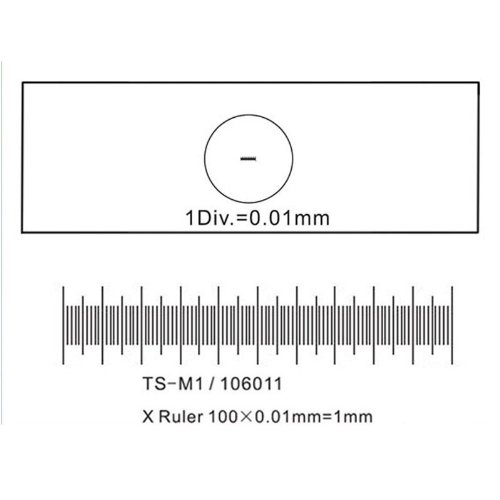
A central technical advantage of the AmScope MD500-CK USB Digital Microscope Camera is the inclusion of a dedicated calibration kit, which allows technicians to calibrate the on-screen measurement tools within the software suite. The Windows-compatible software bundle supports advanced image compositing, including Extended Depth of Focus (EDF) focus stacking, multi-frame image stitching, and dimensional measurement. For programmatic environments, the hardware interfaces via Native C/C++, DirectShow, and TWAIN drivers, while the physical optical system produces a 40-degree real angle of view rated up to 1600x magnification.
This model is built specifically for laboratory analysts and educators who require repeatable, metric-accurate measurements across captured frames. When compared to the non-calibrated MD500, the MD500-CK is the superior choice for documentation requiring spatial validation. However, users running automated vision pipelines or high-framerate video feeds will find the higher-bandwidth MU series more appropriate.
AmScope MD500 USB Digital Camera for General Eyepiece Digitization


AmScope MD500 USB Digital Camera 4 photos from the Amazon listing
Best for: Routine compound microscope digitization
Pros
- Wider 45-degree angle of view
- LabVIEW and TWAIN driver support
- Drop-in ocular sleeves included
Cons
- No physical calibration standard included
- Windows-centric advanced software
The AmScope MD500 USB Digital Camera shares the core imaging core of the MD series, housing a 5.0-megapixel imager inside a cylindrical eyepiece-style form factor. Designed to drop into standard 23mm ocular openings, the package includes two metal adapter sleeves accommodating 30mm and 30.5mm ocular tubes. Optical specifications for this model note a 45-degree real angle of view, delivering a broad field of capture for biological specimens under compound lenses or surface topographies under stereo optics.
Software support covers Windows XP through Windows 10, delivering integrated utilities for video recording, still photo acquisition, measurement, image stitching, and EDF algorithms. Developer compatibility is broad, featuring integration paths for Native C/C++, C#, DirectShow, TWAIN, and National Instruments LabVIEW environments. While modern consumer optics often mirror the evolution seen in consumer gear like a vintage y2k sony camera, industrial microscope imagers like the MD500 prioritize continuous streaming stability and API hooks over automated consumer features.
This camera fits routine clinical, veterinary, or instructional tasks where microscopic fields must be viewed on a monitor without requiring micrometer calibration slides in the box. Users who do not need calibration standards and plan to capture general histology or material samples will find this a direct, utilitarian solution. Those needing higher live refresh rates should look to AmScope USB 3.0 models instead.
AmScope MU503B 5MP High-Speed USB 3.0 for Fast Frame Rate Capture


AmScope MU503B 5MP High-Speed USB 3.0 3 photos from the Amazon listing
Best for: High-speed dynamic specimen recording
Pros
- Up to 101fps video capture
- High-bandwidth USB 3.0 interface
- Versatile C-mount and eyepiece fitting
Cons
- Lower resolution than MU1003
- Advanced software limited to Windows
The AmScope MU503B 5MP High-Speed USB 3.0 represents a departure from baseline ocular imagers by integrating a high-speed SuperSpeed USB 3.0 bus with a 5.0-megapixel CMOS sensor. Measuring 5.7×4.28mm with a native 1.33:1 aspect ratio, this sensor can capture full-resolution 5MP stills while delivering high-speed video up to 101 frames per second at lower binning resolutions. It features manual and automated exposure controls, program modes, aperture priority, and shutter priority, with exposure durations spanning from 1 second up to nearly 30 seconds.
Physical mounting flexibility is comprehensive: the MU503B features standard female C-mount threading directly on its front face and ships with optical reduction hardware and adapter sleeves to fit 23mm, 30mm, and 30.5mm ports. The Windows software package includes focus-stacking, measurement routines, and image stitching. In specialized laboratory setups where sensor dynamic range and data transfer speeds are analyzed side-by-side—analogous to technical distinctions explored in a digital camera sony cybershot architectural analysis—the MU503B distinguishes itself through raw transmission bandwidth.
This unit is specifically matched for researchers monitoring dynamic biological phenomena, motile organisms, or microfluidics where USB 2.0 models suffer from motion blur and frame drop. It gives way to the MU1003 when static spatial resolution is the primary requirement over capture speed.
AmScope MU1003 10MP USB3.0 Real-Time Live for High-Detail C-Mount Inspection


AmScope MU1003 10MP USB3.0 Real-Time Live 4 photos from the Amazon listing
Best for: High-detail industrial inspection
Pros
- High-resolution 3584×2748 output
- Fast USB 3.0 data transfer
- Wide 120-degree angle of view
Cons
- Larger file sizes
- Heavier than eyepiece-only models
The AmScope MU1003 10MP USB3.0 Real-Time Live utilizes a high-resolution 10-megapixel CMOS sensor outputting a native 3584×2748 pixel grid. Operating on a USB 3.0 bus, it delivers high-throughput real-time video streaming alongside large-format image capture. The optical front assembly incorporates built-in C-mount threading and includes a 23mm reduction lens adapter, allowing it to couple directly with dedicated trinocular microscope ports, inspection endoscopes, or standard ocular tubes.
The camera features a 120-degree real angle of view and operates across Windows XP, Vista, 7, 8, and 10, as well as Mac OS 10.6 and higher and Linux distributions. Development and third-party integration are supported via Native C/C++, C#, DirectShow, TWAIN, and LabVIEW drivers. Similar to how compact imaging sensors were refined across multi-generational hardware such as a cyber shot sony camera, the MU1003 incorporates updated onboard circuitry designed into a compact chassis with reduced physical weight, backed by a 1-year warranty.
This camera is optimal for industrial quality control, metallurgy, and pathology documentation where fine structural details require maximum pixel resolve. Users who prioritize extreme framerates over static resolution, however, will be better served by the lower pixel count and higher refresh rates of the MU503B.
AmScope MD1200A 12MP USB 2.0 Digital for Ultra-High Resolution Stills


AmScope MD1200A 12MP USB 2.0 Digital Eyepiece Microscope Camera 3 photos from the Amazon listing
Best for: Ultra-high resolution still documentation
Pros
- 12MP high-density CMOS sensor
- Driverless UVC webcam protocol
- Cross-platform Mac and Linux support
Cons
- Slow USB 2.0 live stream
- Lacks native C-mount threading
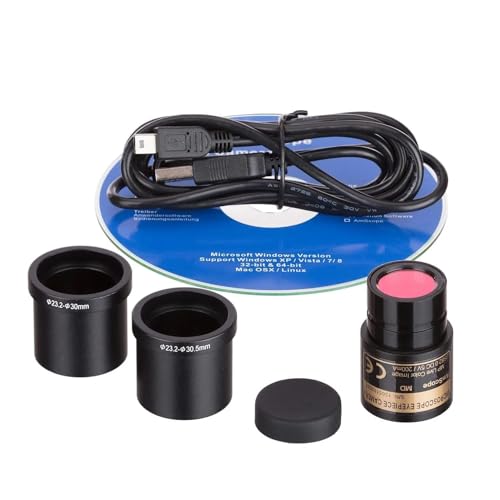
The AmScope MD1200A 12MP USB 2.0 Digital eyepiece camera houses a 12-megapixel color CMOS sensor, making it the highest-resolution sensor in the MD ocular lineup. Operating on the USB 2.0 standard, the MD1200A implements the Universal Video Class (UVC) protocol, allowing it to function as a driverless video source across Windows, Mac OS, and Linux platforms. This UVC architecture allows direct integration into standard video conferencing applications for remote instruction or quality control streaming.
The included Windows utility provides advanced measurement, video recording, image stitching, and Extended Depth of Focus (EDF), while the dedicated Linux and Mac software allows still and video capture alongside manual color and exposure adjustments. Developers can address the hardware through Native C/C++, C#, DirectShow, TWAIN, or LabVIEW. Mechanically, the chassis seats into 23mm tubes and includes two adapter sleeves for 30mm and 30.5mm ocular tubes, supported by a 1-year manufacturer warranty.
The MD1200A suits documentation specialists who need maximum resolving power for static specimen photography without needing a C-mount port. Because it streams 12 megapixels over the USB 2.0 bus, live preview framerates are inherently lower than on USB 3.0 models, making this model less suited for real-time dissection or live tracking.
AmScope MD300A Digital Eyepiece Microscope Camera for Routine Classroom Instruction


AmScope MD300A Digital Eyepiece Microscope Camera, 3MP USB 2.0 4 photos from the Amazon listing
Best for: Classroom instruction and beginner microscopy
Pros
- Kid-friendly software bundle
- Plug-and-play UVC protocol
- Broad cross-platform compatibility
Cons
- Low 3MP sensor resolution
- Basic optical housing
The AmScope MD300A Digital Eyepiece Microscope Camera is a lightweight ocular module equipped with a 3-megapixel (rated 3.1MP) color CMOS sensor. Designed as an entry-level digital eyepiece for general education and hobbyist microscopy, the camera utilizes a standard USB 2.0 interface and UVC protocol compliance for plug-and-play operation across Windows, Mac OS X, and Linux operating systems. The package includes AmScope’s exclusive Kid’s Friendly Software alongside standard capture packages.
Despite its lower price tier, the software suite provides advanced processing capabilities on Windows, including image stitching, EDF focus merging, live video capture, and measurement functions. Mac and Linux software variants provide controls for exposure, balance, and image capture. Developers also have access to Native C/C++, C#, DirectShow, TWAIN, and LabVIEW development libraries. Like the rest of the MD family, it fits 23mm oculars natively and includes adapter sleeves for 30mm and 30.5mm tubes, backed by a 1-year manufacturer warranty.
The MD300A is tailored specifically for primary and secondary education environments, students, and basic hobbyist inspection. Its 3MP resolution is well-matched to lower-magnification viewing, but professional laboratories and research facilities should step up to the MD500-CK or MU series for higher resolving power and quantitative measurement accuracy.
How to Choose the Right AmScope Microscope Camera
Selecting the optimal camera from AmScope requires evaluating sensor resolution, communication bus architecture, optical mounting format, and host software compatibility.
- Sensor Resolution vs. Frame Rate: Sensor requirements should mirror the optical limits of your microscope. High-resolution sensors like the 12MP MD1200A or 10MP MU1003 resolve ultra-fine specimen morphology for publication stills. However, higher pixel counts generate larger file payloads; pairing high resolutions with USB 2.0 reduces live viewing frame rates. If live sample manipulation, dissection, or fluid tracking is required, prioritize the high-speed USB 3.0 interface of the MU503B.
- Interface Bandwidth: USB 2.0 provides a functional, single-cable solution for standard still capture and UVC webcam streaming, as demonstrated on the MD300A and MD1200A. USB 3.0 models like the MU503B and MU1003 unlock the bus throughput necessary to stream uncompressed, high-framerate video without perceptible lag.
- Mounting Hardware: The MD series (MD300A, MD500, MD500-CK, MD1200A) is built around a 23mm cylindrical barrel designed to replace a standard ocular, with 30mm and 30.5mm adapter sleeves included for stereo scopes. If your microscope features a dedicated trinocular photo tube with 1x or 0.5x C-mount threading, the MU series (MU503B, MU1003) provides native threaded mounting alongside 23mm reduction lenses.
- Measurement and Software Protocol: If dimensional analysis is a legal or scientific requirement, choose a model that includes a dedicated physical calibration slide, such as the MD500-CK. Furthermore, verify whether your workflow relies on standard UVC plug-and-play webcam drivers or specialized development environments such as LabVIEW, DirectShow, or TWAIN.
FAQ
What is the primary difference between the AmScope MD series and the MU series?
The MD series uses an eyepiece-style cylindrical housing engineered to insert directly into 23mm, 30mm, or 30.5mm ocular tubes, primarily relying on USB 2.0 connections and UVC drivers. The MU series features industrial-style compact camera housings with native C-mount threading, high-speed USB 3.0 interfaces, and modular optical reduction lenses for both trinocular ports and ocular tubes.
Does a USB 3.0 microscope camera provide better image quality than a USB 2.0 camera?
USB 3.0 does not inherently alter sensor optical resolution or pixel sensitivity, but it dramatically increases data transmission bandwidth. This allows cameras like the MU503B and MU1003 to stream live feeds at significantly higher frame rates and lower compression levels compared to USB 2.0 models, eliminating screen lag during specimen repositioning and focusing.
Can AmScope eyepiece cameras fit stereo microscopes?
Yes. While standard biological compound microscope oculars measure 23mm in outer diameter, stereo inspection microscopes typically use 30mm or 30.5mm eyepiece tubes. AmScope MD series cameras (and MU models equipped with ocular adapters) include two adapter sleeves designed specifically to fit 30mm and 30.5mm ports.
Do AmScope microscope cameras work on Mac and Linux operating systems?
Several models support multi-platform operating systems, but software feature sets vary. The MD1200A, MD300A, and MU1003 provide native compatibility across Windows, Mac OS, and Linux platforms. While the Windows utility includes advanced compositing tools like EDF focus stacking and stitching, the Mac and Linux software variants generally focus on still capture, video recording, and direct parameter controls for exposure and color.
Is a calibration kit required for taking measurements with an AmScope camera?
While the AmScope Windows software provides measurement tools across all models, these tools require spatial calibration against a known physical scale to output real-world units such as micrometers or millimeters. The MD500-CK includes a dedicated calibration slide in the package; cameras lacking this kit require a separate calibration micrometer slide to convert pixel distances into certified metric measurements.


